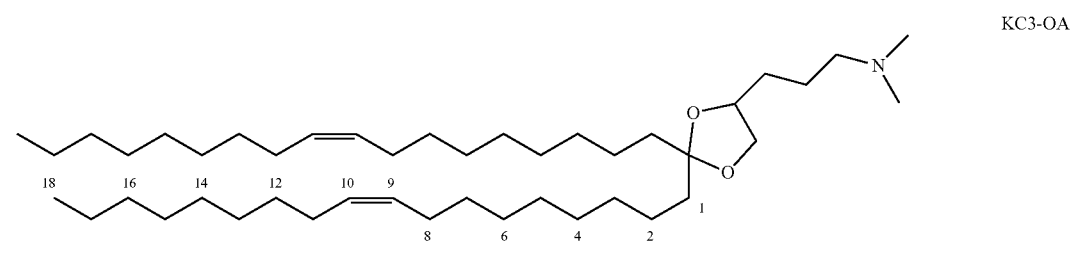
KC3-OA, chemically known as 3-((S)-2,2-di((Z)-octadec-9-en-1-yl)-1,3-dioxolan-4-yl)-N,N-dimethylpropan-1-amine, is an ionizable cationic lipid (ICL) optimized for lipid nanoparticle (LNP) formulations in nucleic acid delivery, particularly for mRNA vaccines. It features a unique structure with mono-unsaturated alkyl chains (C18:1), which enhances oxidative stability compared to polyunsaturated analogs like KC3, while maintaining efficient membrane fusion and endosomal escape capabilities. In LNP compositions, KC3-OA is typically incorporated at 46–54 mol% of total lipids, with an N/P ratio of 4–6 relative to mRNA, ensuring high encapsulation efficiency and transfection potency.
Experimental data demonstrate that KC3-OA-based LNPs achieve superior mRNA expression in human dendritic cells, outperforming alternatives like KC3-PA or KC3-01 in both in vitro and in vivo models. For instance, in FIG. 2, KC3-OA LNPs showed ~2-fold higher mCherry expression at low mRNA doses (0.1 μg/mL) due to improved cellular uptake and reduced degradation. Its synergy with anionic phospholipids like DPPS (5 mol%) further enhances dendritic cell targeting via receptor-mediated internalization, leading to robust CD4+ and CD8+ T-cell responses against Mycobacterium tuberculosis antigens. This balance of stability, efficiency, and immunogenicity makes KC3-OA a leading candidate for next-generation vaccines.