Alternate TextTo enhance service speed and avoid tariff delays, we've opened a US warehouse. All US orders ship directly from our US facility.
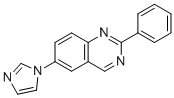

CR4056

  Cat. No.:  DC12396   Featured
Chemical Structure
1004997-71-0
For research use only. We do not sell to patients.
We match the best price and quality on market.
Email:order@dcchemicals.com  sales@dcchemicals.com
Tel:+86 21 58447131
We are official vendor of:
  • 20
  • 19
  • 18
  • 17
  • 16
  • 15
  • 14
  • 12
  • 11
  • 10
  • 9
  • 8
  • 13
  • 6
  • 5
  • 4
  • 3
  • 2
  • 1
More than 5000 active chemicals with high quality for research!
Field of application
CR4056 (CR 4056, CR-4056) is a novel, orally active imidazoline-2 receptor (I2R) ligand with binding IC50 of 596 nM, also selectively inhibits the enzymatic activity of MAO-A with IC50 of 202.7 nM; increases norepinephrine (NE) tissue levels both in the rat cerebral cortex and lumbar spinal cord, shows ED50 of 5.8 mg/kg in CFA rat model of inflammatory pain; shows high effectivity against bortezomib-induced painful neuropathy in rats.
Cas No.: 1004997-71-0
Chemical Name: 6-(1H-imidazol-1-yl)-2-phenylquinazoline
Synonyms: CR 4056;CR-4056
SMILES: N1=C2C(C=C(N3C=NC=C3)C=C2)=CN=C1C1=CC=CC=C1
Formula: C17H12N4
M.Wt: 272.311
Purity: >98%
Sotrage: 2 years -20°C Powder, 2 weeks 4°C in DMSO, 6 months -80°C in DMSO
Publication: 1. Ferrari F, et al. J Pain Res. 2011;4:111-25. 2. Thorn DA, et al. Br J Pharmacol. 2012 Jul;166(6):1936-45. 3. Meregalli C, et al. J Pain Res. 2012;5:151-67. 4. Lanza M, et al. Br J Pharmacol. 2014 Aug;171(15):3693-701.
Description: CR4056 is a selective inhibitor of human recombinant MAO-A with an IC50 of 202.7 nM. CR4056 is also a ligand of imidazoline-2 receptor (I2R) with an IC50 of 596 nM.
Target: IC50: 202.7 nM (MAO-A), 596 nM (I2R)[1]
In Vivo: Two hours after a single oral dose of 20 mg/kg CR4056, endogenous norepinephrine (NE) levels increase by 68.2%±14.1% (P<0.05 versus vehicle) in the parieto-occipital cortex. Sub-chronic (four days) oral treatment with 20 mg/kg CR4056 once daily, significantly increases NE levels both in the cerebral cortex (63.1%±4.2%; P<0.05 versus vehicle) and in the lumbar spinal cord (51.3%±6.7%; P<0.05 versus vehicle). CR4056 dose-dependently reduces mechanical hyperalgesia (effective dose [ED50]=5.8 mg/kg) (P<0.001). CR4056 (10 mg/kg) and piroxicam (10 mg/kg) significantly reverse the decrease in withdrawal threshold caused by capsaicin (P<0.001 versus vehicle). The highest tested dose of CR4056 (30 mg/kg) completely reverses the effect of capsaicin, increasing paw withdrawal threshold (PWT) to 239±12 g (P<0.001 versus vehicle) after 1 hour. CR4056 dose-dependently decreases streptozotocin (STZ)-induced diabetic pain in rats (F[4, 35]=31.27, P<0.001). CR4056 significantly increases the mechanical withdrawal thresholds of both ipsilateral (F[4, 30]=19.97, P<0.001) and contralateral (F[4, 30]=31.58, P<0.001) hind paws compare with vehicle control[1].
In Vitro: CR4056 is an imidazoline-2 receptor (I2R) ligand with an IC50 of 596±76 nM. CR4056 is also an inhibitor of both human recombinant MAO-A and MAO-B with IC50s of 202.7±10.3 and >10000, respectively[1]. The co-treatment of bortezomib (BTZ) with CR4056 at all the concentrations used (range 3 to 30 μM) does not induce any significant difference in cell survival compare with BTZ-treated cells, either in H929 or in RPMI 8226 myeloma cells[2].
Kinase Assay: Binding assays on monoamine oxidases in rat cerebral cortical membranes are conducted. In summary, for the MAO-A binding assay, tritiated N-(2-aminoethyl)-5-(m-fluorophenyl)-4-thiazole carboxamide HCl ([3H]Ro 41-1049, 10 nM) is incubated in the absence or presence of CR4056 for 60 minutes at 37°C and non specific binding is determined in the presence of 1 μM clorgyline. For the MAO-B binding assay, incubation of [3H]Ro 19-6327(tritiated lazabemide) (15 nM) is carried out for 90 minutes at 22°C and non specific binding is determined in the presence of 10 μM (R)-deprenyl [1].
Cell Assay: To rule out any interference of CR4056 with bortezomib (BTZ)-induced cytotoxicity, non-small cell lung cancer and MM cell lines are simultaneously treated for 72 hours with BTZ and CR4056. Cells are exposed to the IC50 of BTZ, estimated in the cytotoxicity study, with or without three concentrations of CR4056 (3, 10, and 30 μM). The incubations with CR4056 alone (3, 10, and 30 μM) and with the highest dose of vehicle (DMSO) are also performed. Growth inhibition is assessed by MTT assay. In these experiments, the CR4056 is tested in vitro in a range of concentrations spanning from pharmacological to toxicological levels[2].
Animal Administration: Rats: Rats are fasted overnight before drug administration. A first measurement of pain threshold is undertaken before capsaicin injection. Capsaicin is administered at time t=0 by the intraplantar route in the right hind paw (10 μL of a 1 mg/mL Tween 80/saline solution). Sixty minutes later, animals are dosed by the oral route with CR4056 (3 to 30 mg/kg) or its vehicle in a volume of 5 mL/kg. A sham control group is always present for comparison. In mechanistic studies, antagonists are administered 30 minutes after capsaicin and 15 minutes before CR4056 administration[1].
References: [1]. Ferrari F, et al. Analgesic efficacy of CR4056, a novel imidazoline-2 receptor ligand, in rat models of inflammatory and neuropathic pain. J Pain Res. 2011;4:111-25. [2]. Meregalli C, et al. CR4056, a new analgesic I2 ligand, is highly effective against bortezomib-induced painful neuropathy in rats. J Pain Res. 2012;5:151-67.
Cat. No. Product name Field of application
DC31079 Abarelix Abarelix is a synthetic decapeptide and antagonist of naturally occurring gonadotropin-releasing hormone (GnRH). Abarelix directly and competitively binds to and blocks the gonadotropin releasing hormone receptor in the anterior pituitary gland, thereby inhibiting the secretion and release of luteinizing hormone (LH) and follicle stimulating hormone (FSH). In males, the inhibition of LH secretion prevents the release of testosterone. As a result, this may relieve symptoms associated with prostate hypertrophy or prostate cancer, since testosterone is required to sustain prostate growth.
DC31074 Isopropyl myristate Isopropyl myristate is the ester of isopropyl alcohol and myristic acid.
DC79856 EVT0185 EVT0185 is an orally active ATP citrate lyase (ACLY) inhibitor. EVT0185 is converted to a CoA thioester in the liver by SLC27A2 and interacts with the CoA-binding site of ACLY. EVT0185-CoA inhibits ACLY activity with an IC50 of 2.5 μM. EVT0185 can phenocopy the immune and antitumour effects of genetic ACLY deletion. EVT0185 can increase tumour-infiltrating B cells and chemokine CXCL13 levels. EVT0185 can be used for the research of cancer, such as hepatocellular carcinoma (HCC).
DC79609 NCGC00685960 NCGC00685960 is a Nicotinamide N-methyltransferase (NNMT) inhibitor with an IC50 < 10  nM. NCGC00685960 has potent antitumor activity. NCGC00685960 increases H3K27 trimethylation levels in ovarian cancer cells and inhibits α-SMA expression in NNMT-expressing ovarian fibroblasts. NCGC00685960 reduces 1-MNA levels, reverses SAM and H3K27 hypomethylation and significantly impairs collagen contractility in cancer-associated fibroblasts (CAFs). NCGC00685960 can be used for cancers research.
DC79112 Simepdekinra Simepdekinra (Compound 221) is a IL-17A modulator with IC50s ≤10  nM and 10-100 nM for IL-17A/A HEK-Blue and IL-17A/F HEK-Blue cells. Simepdekinra can be used for inflammatory diseases such as psoriasis, ankylosing spondylitis and psoriatic arthritis research.
DC78751 RSL3-NH2 RSL3-NH2 is a GPX4 inhibitor and Ferroptosis inducer. RSL3-NH2 can be used as a cytotoxic payload for synthesis of antibody-drug conjugates (ADCs).
DC77831 Vicadrostat Vicadrostat (compound 29 A) is a potent and selective inhibitor of aldosterone synthase(CYP11B2) with an IC50 of 16 nM. It exhibits potential in renal disease, diabetic nephropathy, cardiovascular diseases and fibrotic disorder research.
DC77813 Zeltociclib Zeltociclib is a cyclin-dependent kinase inhibitor with antitumor effects.
DC77784 UNC10013 UNC10013 is a SETDB1 allosteric modulator that forms a covalent bond with Cys385 in the 3TD domain, exhibiting negative allosteric regulatory activity. It has a kinact/KI value of 1.0 × 10⁶ M-1*s-1. UNC10013 effectively disrupts SETDB1-mediated Akt methylation and holds potential value for research in cancer and neurodegenerative diseases.
DC77740 T0080 T0080 is a FPR-1 antagonist. T0080 reduces the cell apoptosis, inhibits ROS production and pro-inflammatory cytokines (TNF-α and IL-1β) from plaque macrophages, which attenuates atherosclerotic progression in ApoE−/− mice.
X
