 To enhance service speed and avoid tariff delays, we've opened a US warehouse. All US orders ship directly from our US facility.
| Cat. No. | Product Name | Field of Application | Chemical Structure |
|---|---|---|---|
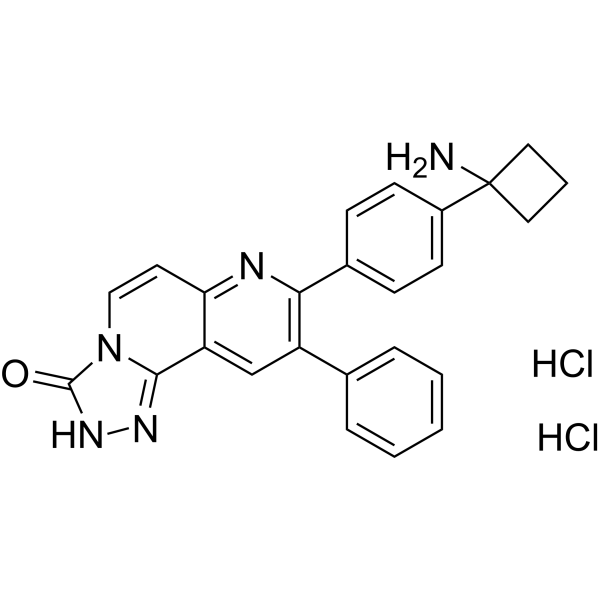
| DC7465 | MK-2206 2HCl Featured |
MK-2206 2HCl is a highly selective inhibitor of Akt1/2/3 with IC50 of 8 nM/12 nM/65 nM, respectively; no inhibitory activities against 250 other protein kinases observed. Phase 2.
More description
|
|
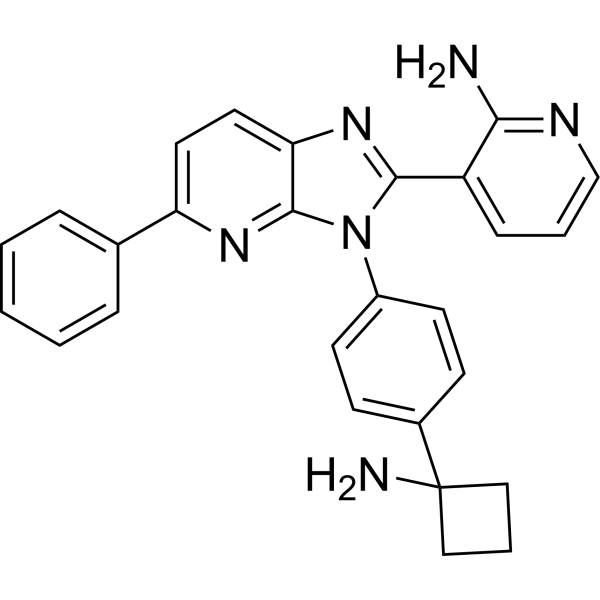
| DC9972 | ARQ-092(Miransertib) Featured |
ARQ 092 is an oral activie, potent and selective AKT inhibitor with IC50 values: 5.0 nM (AKT1); 4.5 nM (AKT2); 16 nM (AKT3).
More description
|
|
| DC81760 | Y207–5465 |
Y207–5465 is a potent and highly selective PLK2 inhibitor with an IC50 value of 584.3 nM. Y207–5465 shows only limited anti-cancer activity in HT-29 and HCT-116 cells. Y207–5465 can be used in cancer research.
More description
|

|
| DC81436 | RAI-20 |
RAI-20 (H018) is an orally active JAK1/JAK2 dual inhibitor (IC50=15.1 and 22.7 nM). RAI-20 exhibits excellent pharmacokinetic properties, including plasma stability, systemic exposure, and a long half-life. In a collagen-induced arthritis rat model, RAI-20 shows significant anti-inflammatory and anti-arthritic activities, effectively reducing paw swelling volume and arthritis index. RAI-20 can be used for research on the pathogenesis of rheumatoid arthritis.
More description
|
|
| DC81413 | p-Toluenesulfonamide-15N |
p-Toluenesulfonamide-15N is the 15N-labeled p-Toluenesulfonamide. p-Toluenesulfonamide is an intermediate and plasticizer. p-Toluenesulfonamide is also the main degradation product of the disinfectant Chloramine-T in water. p-Toluenesulfonamide facilitates the localization of fluorescent probes to the endoplasmic reticulum.
More description
|
|
| DC81388 | PROTAC MLLT1 Degrader-1 |
PROTAC MLLT1 Degrader-1 is a PROTAC degrader targeting MLLT1. PROTAC MLLT1 Degrader-1 inhibits AML cell proliferation and viability, suppresses tumor growth in human AML xenograft models, and can block the oncogene transcriptional program. PROTAC MLLT1 Degrader-1 can be used for the research of MLL-rearranged acute myeloid leukemia (AML).
More description
|
|
| DC81195 | OICR19451 |
OICR19451 is an orally active dual NUAK1/NUAK2 and MARK2/MARK3 kinase inhibitor, with IC50 values of 12 nM and 10 nM against NUAK1 and NUAK2, and 101 nM and 124 nM against MARK2 and MARK3, respectively. OICR19451 modulates the Hippo signaling pathway, increases the phosphorylation level of YAP, enhances the cytoplasmic localization of YAP/TAZ, and inhibits the expression of oncogenes. OICR19451 inhibits cancer cell growth, reduces metastasis, promotes tumor capsule formation, and improves mouse survival in an orthotopic breast cancer model. OICR19451 can be used for research related to triple-negative breast cancer.
More description
|
|
| DC80291 | BAA-065 |
BAA-065 is a selective and orally active PKMYT1 inhibitor with an IC50 of <50 nM. BAA-065 inhibits cancer cells proliferation, induces γH2AX expression and DNA damage. BAA-065 inhibits tumor growth in OVCAR3 xenograft mice. BAA-065 can be used for the research of cancer, such as ovarian cancer.
More description
|
|
| DC77859 | Archexin |
Archexin is an antisense oligonucleotide (ASO) against Akt1. It is used for the study of metastatic renal cancer.
More description
|
|
| DC77858 | Archexin sodium |
Archexin sodium is an antisense oligonucleotide (ASO) against Akt1. It is used for the study of metastatic renal cancer.
More description
|
|
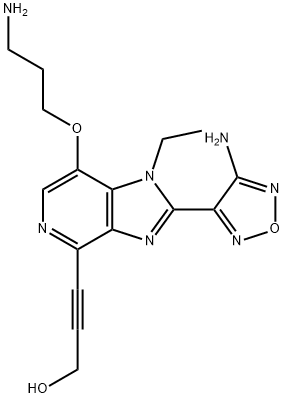
| DC74250 | TCMDC-136364 Featured |
TCMDC-136364 (AKT Kinase Inhibitor) is an Akt kinase inhibitor, selectively inhibits Akt in proliferating cells expressing Trop-2, also potently inhibits P. falciparum multidrug resistant strain Dd2.
More description
|
|
| DC79239 | AZD3409 |
AZD3409 is a prenyl inhibitor that exhibits inhibitory activity against both farnesyl transferase and geranylgeranyl transferase I. AZD3409 inhibits the growth of breast cancer cells, with IC50s of 220 nM (MDA-MB-468), 180 nM (MDA-MB-361), and 290 nM (SK-Br-3). AZD3409 significantly reduces the activation level of AKT in breast cancer cell lines. AZD3409 induces G0/G1 phase arrest in MDA-MB-468 cells, causes G2/M phase arrest in MDA-MB-361 cells. AZD3409 can be used for the study of breast cancer.
More description
|
|
| DC79150 | SM1-71-R |
SM1-71-R is a reversible analog o SM1-71). SM1-71-R lacks the acrylamide warhead and therefore cannot form a covalent bond with the kinase. SM1-71-R can be used as a control compound for SM1-71.
More description
|
|
| DC78865 | Ganglioside GT1b |
Ganglioside GT1b is a member of the ganglioside family. Ganglioside GT1b acts as a protective signal against nerve injury-induced spinal synapse elimination. Ganglioside GT1b induces HA synthesis and the phosphorylation of Akt/mTOR in orbital fibroblasts. Ganglioside GT1b enhances porcine oocyte maturation and induce activation of EGFR and ERK1/2 signaling. Ganglioside GT1b is a putative host cell receptor for the Merkel cell polyomavirus. Ganglioside GT1b can be used for the researches of cancer, infection, immunology, endocrinology and neurological disease, such as Thyroid eye disease.
More description
|
|
| DC78858 | D-myo-Inositol-1,3,4,5,6-pentaphosphate ammonium salt |
D-myo-Inositol-1,3,4,5,6-pentaphosphate (ammonium salt) (Ins(1,3,4,5,6)P5 (ammonium salt)) is an isomer of inositol phosphate that acts as a small and soluble second messenger in the transmission of cellular signals. D-myo-Inositol-1,3,4,5,6-pentaphosphate (ammonium salt) can bind to the PH domain of Grp1 with a Kd of 590 nM. D-myo-Inositol-1,3,4,5,6-pentaphosphate (ammonium salt) can inhibit the phosphorylation and kinase activity of Akt/PKB, inducing apoptosis in ovarian, lung, and breast cancer cells. D-myo-Inositol-1,3,4,5,6-pentaphosphate (ammonium salt) exhibits antiangiogenic activity in vitro and blocks capillary tube formation of HUVEC. D-myo-Inositol-1,3,4,5,6-pentaphosphate (ammonium salt) exerts antitumor effects against cancer xenografts in nude mice.
More description
|
|
| DC78720 | Tanerasertib |
Tanerasertib (Compound 456) is an AKT1 inhibitor with an IC50 of less than 15 nM against AKT1 E17K. Tanerasertib can be used in the study of cancer.
More description
|
|
| DC77097 | ML-B01 |
ML-B01 is the orally active inhibitor for Akt and PKA with the IC50 of 2 nM and 136 nM. ML-B01 exhibits good ability to penetrate the blood-brain barrier (BBB) in the mouse brain.
More description
|
|
| DC47763 | Vevorisertib trihydrochloride Featured |
Vevorisertib (ARQ 751) (trihydrochloride) is an orally active, potent and selective pan-AKT serine/threonine kinase inhibitor against AKT1 (IC50=0.55 nM), AKT2 (IC50=0.81 nM), and AKT3 (IC50=1.31 nM). Vevorisertib (trihydrochloride), as a single agent or in combination with other anti-cancer agents, can be used for the research of solid tumors with PIK3CA / AKT / PTEN mutations.
More description
|

|
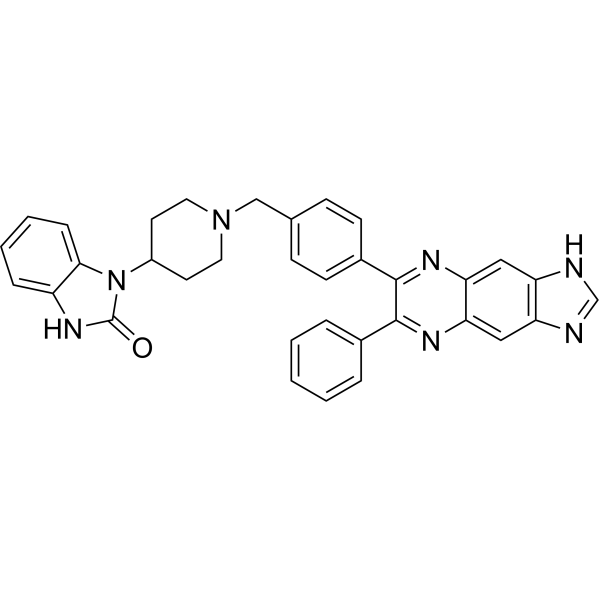
| DC8458 | Akt Inhibitor VIII Featured |
Akt Inhibitor VIII is a cell-permeable quinoxaline compound that has been shown to potently, selectively, allosterically, and reversibly inhibit Akt1, Akt2, and Akt3 activity (IC50 = 58 nM, 210 nM, and 2.12 μM; respectively).
More description
|
|
| DC74249 | TAS0612 |
TAS0612 (TAS-0612) is an orally bioavailable multikinase inhibitor of AKT, p70S6K, and p90RSK, inhibits Y-box-binding protein (YBX1) phosphorylation.
More description
|
|
| DC10055 | Akt-I-1,2 HCl Featured |
The compound (Akt-I-1,2) inhibited both Akt1 and Akt2 with IC50 values of 2.7 and 21 μM respectively.
More description
|

|
| DC8333 | SC-79 Featured |
SC-79 is an activator of Akt; binds to the pleckstrin homology domain of Akt.
More description
|

|
| DC9273 | SC-66 Featured |
SC-66 is an allosteric inhibitor of Akt; interferes with pleckstrin homology domain binding to PIP3 and facilitates Akt ubiquitination.
More description
|

|
| DC7481 | PHT427 Featured |
PHT-427 is a dual Akt and PDPK1 inhibitor (high affinity binding for the PH domains of Akt and PDPK1) with Ki of 2.7 μM and 5.2 μM, respectively.
More description
|

|
| DC2021 | Perifosine (KRX-0401) Featured |
Perifosine (KRX-0401) is a novel Akt inhibitor with IC50 of 4.7 μM.
More description
|

|
| DC2070 | GSK690693 Featured |
GSK690693 is a pan-Akt inhibitor targeting Akt1, Akt2 and Akt3 with IC50 of 2 nM, 13 nM, and 9 nM, respectively.
More description
|

|
| DC9335 | AT7867 Featured |
AT7867 is a potent ATP-competitive inhibitor of Akt1/2/3 and p70S6K/PKA with IC50 of 32 nM/17 nM/47 nM and 85 nM/20 nM, respectively; little activity outside the AGC kinase family.
More description
|

|
| DC7994 | Afuresertib HCl Featured |
Afuresertib (GSK2110183) is a potent pan-AKT inhibitor that demonstrated synergy with bortezomib in preclinical models of multiple myeloma (MM).
More description
|

|
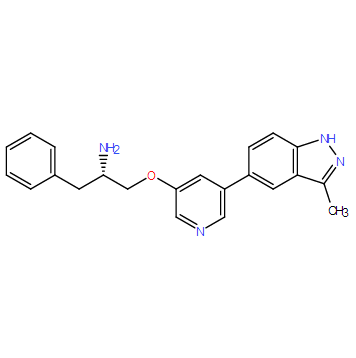
| DC5163 | A-674563 Featured |
A-674563 is a potent, orally available Akt1 inhibitor with an IC50 value of 11nM. Also displays activity against PKA and CDK2 with IC50 values of 16nM and 46nM respectively.
More description
|
|
| DC72234 | ALM301 |
ALM301 is an orally active highly specific AKT inhibitor with IC50 values of 0.13 µM, 0.09 µM and 2.75 µM for AKT1, AKT2 and AKT3, respectively. ALM301 inhibits AKT phosphorylation and modulates downstream signalling in vitro. ALM301 can inhibit cancer cell proliferation and tumor growth.
More description
|
|
