 To enhance service speed and avoid tariff delays, we've opened a US warehouse. All US orders ship directly from our US facility.
| Cat. No. | Product Name | Field of Application | Chemical Structure |
|---|---|---|---|
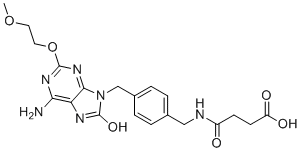
| DC73565 | SZU-101 Featured |
SZU101 is a small molecule TLR7 agonist that directly activates, induces reporter activity (23-fold) in a TLR7-NF-kB reporter system expressed in HEK-293 cells TLR7 signalling.
More description
|
|
| DC81478 | RSK4-IN-2 |
RSK4-IN-2 (compound 16o) is a potent, orally active RSK4 inhibitor with an IC50 of 17 nM. RSK4-IN-2 suppresses esophageal squamous cell carcinoma (ESCC) cell growth and invasion, by inhibiting phosphorylation of RSK4 downstream targets. RSK4-IN-2 inhibits tumor growth and metastasis in ESCC mouse models. RSK4-IN-2 can be used for ESCC research.
More description
|

|
| DC81449 | Retro-1 |
Retro-1 is a toxin inhibitor. Retro-1 blocks the retrograde transport of STxB to the trans-Golgi network/Golgi. Retro-1 inhibits the cytotoxic effects of Ricin, bacterial toxins Stx1 and Stx2. Retro-1 can also substantially enhance the effectiveness of antisense and splice switching oligonucleotides.
More description
|
|
| DC81411 | PTH1R agonist 1 |
PTH1R agonist 1 (Example 2) is a parathyroid hormone 1 receptor (PTH1R) agonist. PTH1R agonist 1 can be used for research of hypoparathyroidism and osteoporosis.
More description
|
|
| DC81259 | PDE4B/D-IN-5 |
PDE4B/D-IN-5 (Compound P32) is a peripherally restricted, oral active inhibitor of PDE4B and PDE4D with extremely low blood-brain barrier penetration, with IC50 values of 3.4 nM and 2.2 nM, respectively. PDE4B-IN-8 inhibits the production of TNF-α. PDE4B/D-IN-5 significantly reduces the Bax/Bcl2 ratio, and alleviates oxidative stress by decreasing MPO activity and NO levels. PDE4B/D-IN-5 exhibits anti-inflammatory, antioxidant, and anti-apoptotic activities. PDE4B/D-IN-5 can be used for the research of acute lung injury.
More description
|
|
| DC81164 | NN-01-195 |
NN-01-195 is a HSP90 inhibitor-drug conjugate. NN-01-195 binds tightly to and inhibits AURKA and HSP90, with an IC50 of 3.1 nM against AURKA and an IC50 of 8.7 nM against HSP90α. NN-01-195 induces mitotic arrest and spindle abnormality in tumor cells, and triggers cell apoptosis. NN-01-195 can be used in the research of solid tumors.
More description
|
|
| DC81078 | MrgprX2 antagonist-10 |
MrgprX2 antagonist-10 (Example 218) is a MrgprX2 antagonist with an IC50 of less than 100 nM. MrgprX2 antagonist-10 can be used for the study of various inflammatory diseases.
More description
|
|
| DC80996 | Mal-PEG2-Val-Arg-PABC-OMe-Eribulin |
Mal-PEG2-Val-Arg-PABC-OMe-Eribulin (Compound L-1) is a drug-linker conjugate composed of O-Me Eribulin and the linker Mal-PEG2-Val-Cit-PAB-OH. Mal-PEG2-Val-Arg-PABC-OMe-Eribulin can be used to synthesize anti-HER3/MET antibody-drug conjugates (ADCs).
More description
|
|
| DC80703 | GIPR antagonist 2 |
GIPR antagonist 2 (Example 14) is a GIPR antagonist that can be used for the study of diseases such as obesity and type 2 diabetes.
More description
|
|
| DC80574 | DX-8951 Hydroxy-acid |
DX-8951 Hydroxy-acid is a prodrug of phosphoramide. ProAX can effectively increase intracellular ATP levels. DX-8951 Hydroxy-acid activates the AMPK signaling pathway by increasing the AMP/ATP ratio. DX-8951 Hydroxy-acid can enhance mitochondrial function and antioxidant capacity while reducing reactive oxygen species (ROS) levels. DX-8951 Hydroxy-acid has shown significant anti-aging and longevity effects in both human fibroblast and nematode models.
More description
|
|
| DC80316 | BKT300 |
BKT300 is a potent and selective protein regulator of cytokinesis 1 (PRC1) inhibitor. BKT300 inhibits PRC1 dephosphorylation at T481, disrupts actin and microtubule formation, induces G2/M cell cycle arrest, triggers mitotic catastrophe, and promotes apoptosis, thereby inhibiting proliferation and migration of acute myeloid leukemia (AML) cells while sparing normal cells. BKT300 inhibits tumor growth in mouse xenograft AML models. BKT300 can be used for the research of AML[1].
More description
|
|
| DC80103 | 5-HT2A agonist 8 |
5-HT2A agonist 8 (Compound 67) is a 5-HT2A agonist, with an EC50 of 4 nM. 5-HT2A agonist 8 can be used in the research of neuropsychiatric and neurodegenerative diseases.
More description
|
|
| DC79933 | (S,R,S)-BBO-11818 |
(S,R,S)-BBO-11818 (compound 59) is an inhibitor of KRAS that can be used in the research of cancer.
More description
|
|
| DC77926 | Litenimod sodium |
Litenimod sodium is potent type B agonist of toll Like receptor 9 (TLR9), triggering both innate and adaptive immune response.
More description
|
|
| DC77905 | GNKG168 |
GNKG168 is a synthetic, 21-mer, unmethylated CpG oligodeoxynucleotide. It acts as a TLR9 agonist with immunostimulatory activity.
More description
|
|
| DC77904 | GNKG168 sodium |
GNKG168 sodium is a synthetic, 21-mer, unmethylated CpG oligodeoxynucleotide. It acts as a TLR9 agonist with immunostimulatory activity.
More description
|
|
| DC77880 | CpG-ODN c41 |
CpG-ODN c41, an oligonucleotide, is an antagonist of TLR9.
More description
|
|
| DC77879 | CpG-ODN c41 sodium |
CpG-ODN c41 sodium, an oligonucleotide, is an antagonist of TLR9.
More description
|
|
| DC77861 | Bazlitoran |
Bazlitoran, an oligonucleotide, is an antagonist of TLR7, TLR8, and TLR9.
More description
|
|
| DC77860 | Bazlitoran sodium |
Bazlitoran sodium, an oligonucleotide, is an antagonist of TLR7, TLR8, and TLR9.
More description
|
|
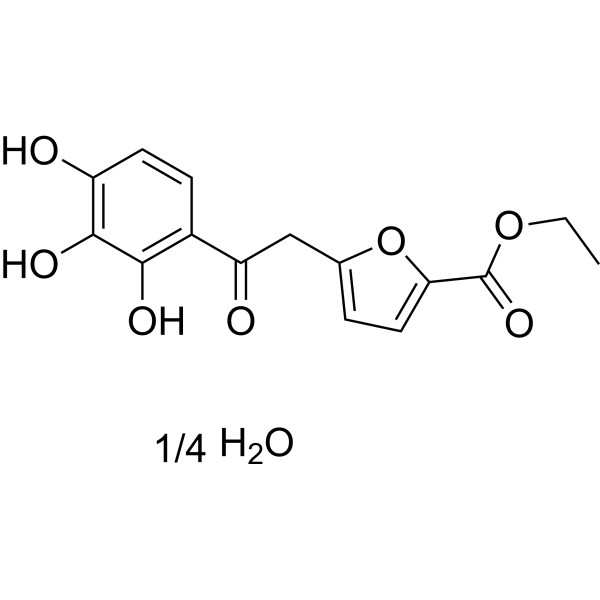
| DC40153 | MMG-11 quarterhydrate |
MMG-11 quarterhydrate is a potent and selective human TLR2 antagonist with low cytotoxicity. MMG-11 quarterhydrate inhibits both TLR2/1 and TLR2/6 signaling with IC50s of 1.7?μM for Pam3CSK4-induced hTLR2/1 and 5.7?μM for Pam2CSK4-induced hTLR2/6 responses.
More description
|
|
| DC7305 | TAK-242 (Resatorvid) Featured |
TAK-242 (Resatorvid), a small-molecule-specific inhibitor of Toll-like receptor (TLR) 4 signaling, inhibits the production of lipopolysaccharide-induced inflammatory mediators by binding to the intracellular domain of TLR4.
More description
|

|
| DC79803 | SMU-R39 |
SMU-R39 is a TLR7 and TLR8 antagonist with IC50 values of 3.22 μM and 0.24 μM, respectively. SMU-R39 binds to recombinant mTLR7 protein (KD = 2.36 μM) and to recombinant hTLR8 protein (KD = 105 nM). SMU-R39 suppresses downstream NF-κB and MAPK signaling, and reduces secretion/transcription of pro-inflammatory cytokines (TNF-α, IL-1β, IL-6) in PBMCs and THP-1 cells. SMU-R39 demonstrates anti-inflammatory efficacy in Imiquimod (IMQ)-induced psoriasis mouse model. SMU-R39 can be used for the study of autoimmune diseases such as psoriasis.
More description
|
|
| DC79703 | GlcNAc-MurNAc |
GlcNAc-MurNAc, a disaccharide, is a TLR4 agonist with a Kd of 383 μM for murine TLR4. GlcNAc-MurNAc directly binds to TLR4 and activates its downstream NF-κB and IRF pathways. GlcNAc-MurNAc improves Dextran sulfate sodium salt (DSS)-induced colitis in mice through a TLR4-dependent mechanism. GlcNAc-MurNAc can be used for the study of inflammatory bowel disease.
More description
|
|
| DC79576 | GNE-5152 |
GNE-5152 is an orthosteric SARM1 base-exchange (BE) inhibitor. GNE-5152 sustainably activates SARM1 at subinhibitory concentrations under mildly activating conditions, and this synergistic adverse effect increases NAD consumption, induces axon degradation and neurodegeneration and releases neurofilament-light (NfL) in cortical neurons. GNE-5152 can be used for neurodegenerative diseases research.
More description
|
|
| DC79347 | NB-3 |
NB-3 is a nicotinamide adenine dinucleotide (NAD) hydrolase SARM1 inhibitor. NB-3 intercepts NAD hydrolysis and undergoes covalent conjugation with the reaction product adenosine diphosphate ribose (ADPR). The resulting small-molecule ADPR adducts are highly potent and confer compelling neuroprotection in neurological injury.
More description
|
|
| DC79344 | TLR4L 10 |
TLR4L 10 is a TLR4 ligand. TLR4L 10 induces cells to produce IL-6. TLR4L 10 has immunostimulatory activity.
More description
|
|
| DC78989 | L07-2 |
L07-2 (Compound 6) is an active scaffold comprising a stimulator of TLR7/8. L07-2 can be used for synthesis of immune-stimulating antibody conjugates (ISACs) for cancers research.
More description
|
|
| DC78918 | (Rac)-VB-201 |
(Rac)-VB-201 is the racemate of VB-201, an oxidized phospholipid small molecule that inhibits CD14- and toll-like receptor 2-dependent innate cell activation and suppresses atherosclerosis.
More description
|
|
| DC78860 | APG-7 |
APG-7 binds to the TLR4/MD-2 interface, thereby inhibiting NO production (IC50 of 24.2 μg/mL). APG-7 is an Apigenin derivative. APG-7 has low toxicity to the 3T3 fibroblast cell line. APG-7 can be used for the study of oxidative stress and inflammation.
More description
|
|
