To enhance service speed and avoid tariff delays, we've opened a US warehouse. All US orders ship directly from our US facility.
| Cat. No. | Product Name | Field of Application | Chemical Structure |
|---|---|---|---|
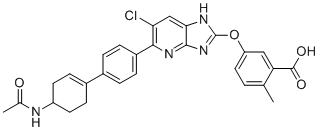
| DC74253 | MSG011 Featured |
MSG011 is a potent, pan AMPK isoform activator with EC50 of 140.4 nM, 248.9 nM, 553.4 nM, and 472.9 nM for α1β1γ1, α1β2γ1, α2β1γ1, and α2β2γ1, respectively.
More description
|
|
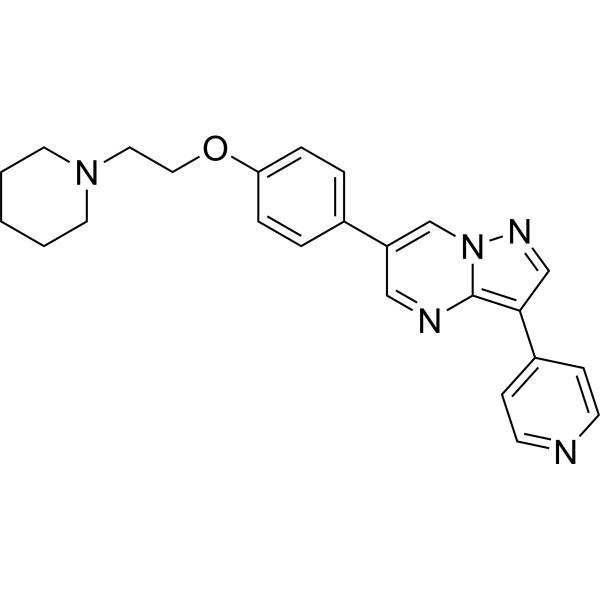
| DC8296 | Dorsomorphin(BML-275) Featured |
Dorsomorphin(Compound C; BML-275) has been shown to act as a potent and selective inhibitor of AMPK (AMP-activated protein kinase; Ki = 109 nM), induced by AICAR and metformin; also inhibits the bone morphogenetic protein type 1 receptors ACTR-I (ALK2), B
More description
|
|
| DC81116 | Nampt-IN-18 |
Nampt-IN-18 (Compound Q24) is an orally active NAMPT inhibitor with an IC50 of 8.0 nM against hNAMPT. Nampt-IN-18 inhibits NAMPT enzymatic activity. Nampt-IN-18 inhibits DNA synthesis and induces Apoptosis. Nampt-IN-18 exhibits anticancer activity against gastric cancer and colorectal cancer. Nampt-IN-18 can be used for the research of gastrointestinal cancers.
More description
|

|
| DC80519 | Desferricoprogen |
Desferricoprogen is a hydrophobic fungal iron chelator siderophore. Desferricoprogen reduces atherosclerotic plaque formation and inhibits lipid peroxidation in aortic roots in ApoE−/− mice on an atherogenic diet. Desferricoprogen can lower the level of oxidized LDL (oxLDL) and inhibit oxLDL-induced HO-1, CD36, and TNF-α mRNA expression. Desferricoprogen inhibits TNF-α-induced endothelial cell activation, VCAM-1, ICAM-1 experssion and preserves endothelial monolayer integrity. Desferricoprogen can be used for the research of atherosclerosis.
More description
|
|
| DC78339 | Tezampanel etibutil |
Tezampanel etibutil is an orally active AMPA/GluR antagonist. Tezampanel etibutil can be used in the research of pain, migraine, and neurological disorders.
More description
|
|
| DC78221 | ARUK2010489 |
ARUK2010489 (Compound 23) is a potent, selective and brain-penetrant NUAK1 inhibitor with a pIC50 of 8.7. ARUK2010489 also inhibits CDK2, CDK4 and CDK6 activity, with inhibitory rate of 7%, 39% and 26% at 1 μM. ARUK2010489 can be used for the research of neurological disease, such as Alzheimer’s disease (AD).
More description
|
|
| DC78220 | ARUK2010694 |
ARUK2010694 (Compound 20) is a potent and selective NUAK1 inhibitor with a pIC50 of 8.7. ARUK2010694 also inhibits CDK2, CDK4 and CDK6 activity, with inhibitory rate of 13%, 63% and 32% at 1 μM. ARUK2010694 can be used for the research of neurological disease, such as Alzheimer’s disease (AD).
More description
|
|
| DC77099 | UCB9386 |
UCB9386 is the selective and brain penetrant inhibitor for Nuak1 with a pIC50 of 10.1. UCB9386 inhibits Nuak2 and Kak2 with an inhibition rate of ca. 50% at 10 nM.
More description
|
|
| DC77098 | 4-PivO-NMT chloride |
4-PivO-NMT chloride is an indole-derived AMPK signaling pathway modulator that regulates neurogenesis or neurite outgrowth by modulating AMPK activity. 4-PivO-NMT chloride holds promise for research in the fields of neurological disorders, pain, and inflammation.
More description
|
|
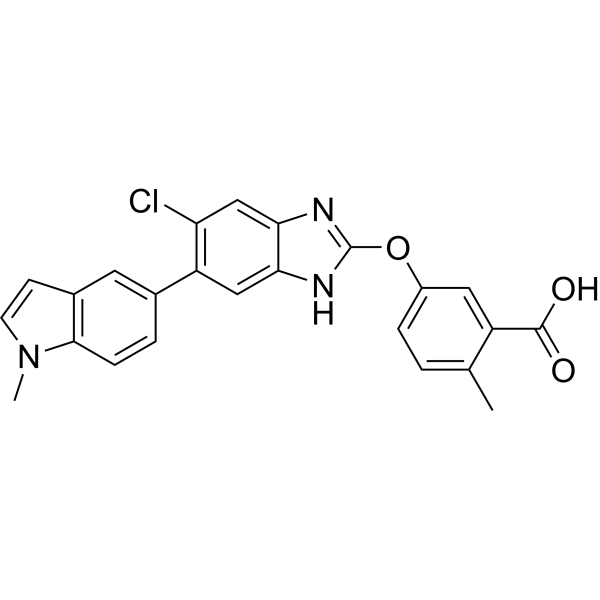
| DC11634 | EX-229 Featured |
EX229 is a small molecule AMPK activator that dose-dependently increases AMPK activity of α1-, α2-, β1- and β2-containing complexes at 50 uM
More description
|
|
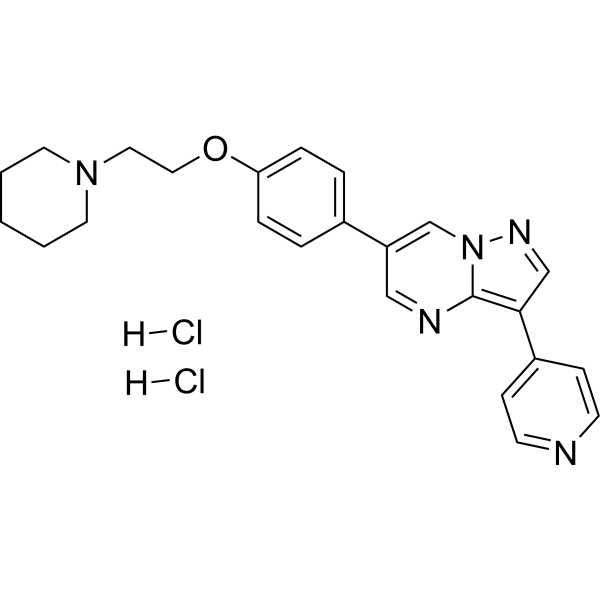
| DC7115 | Dorsomorphin dihydrochloride Featured |
Dorsomorphin 2Hcl (Compound C; BML-275) has been shown to act as a potent and selective inhibitor of AMPK (AMP-activated protein kinase; Ki = 109 nM), induced by AICAR and metformin; also inhibits ALK2, ALK3, and ALK 6 .
More description
|
|
| DC11129 | AMPK activator SC4 Featured |
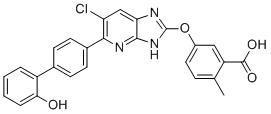
AMPK activator SC4 is a highly specific and potent activator of the α2β2-AMPK complexes, which are the predominant AMPK isoform complexes found in human skeletal muscle. SC4 demonstrates significant efficacy with EC50 values of 17.2 nM for the α2β2γ1 complex and 82.1 nM for the α2β2γ3 complex. These low EC50 values indicate that SC4 is effective at relatively low concentrations, making it a promising compound for targeting AMPK in skeletal muscle. This specificity and potency suggest potential therapeutic applications in conditions where AMPK activation is beneficial, such as metabolic disorders, muscle function, and energy homeostasis.
More description
|
|
| DC74251 | BI-9774 Featured |
BI-9774 (BI 9774) is a potent pan-AMPK activator with EC50 of 64 nM in an ADP-Glo kinase assay with human AMPK (α1β1γ1) and EC50 of 8 nM in a cellular GLUT4 translocation assay.
More description
|

|
| DC11405 | MK-3903 Featured |
MK-3903 is a potent and selective AMP-activated protein kinase (AMPK) activator with an EC50 of 8 nM.
generation of catalytically active enzyme.
More description
|

|
| DC74257 | ZLN-024 hydrochloride |
ZLN-024 hydrochloride is a potent, allosteric AMPK activator that has no effect on mitochondrial function or the ADP/ATP ratio, directly activate recombinant AMPK α1β1γ1 and its homologue α2β1γ1 with EC50 of 0.42 uM and 0.95 uM, respectively.
More description
|
|
| DC74256 | RX-375 |
RX-375 (RX375) is an indirect small-molecule activator of AMPK by directly binds to Prohibitins (PHB1 and PHB2), induces dissociation of AMPK-PHBs complex.
More description
|
|
| DC74255 | PXL770 monohydrate potassium salt |
PXL770 is a novel orally bioavailable, small-molecule direct AMPK activator with EC50 of 16.2, 42.1 and 64 nM for α1β1γ1, α1β1γ2 and α1β1γ3, directly increases AMPK activity by both allosteric activation and protection from dephosphorylation.
More description
|
|
| DC74254 | PXL770 |
PXL770 is a novel orally bioavailable, small-molecule direct AMPK activator with EC50 of 16.2, 42.1 and 64 nM for α1β1γ1, α1β1γ2 and α1β1γ3, directly increases AMPK activity by both allosteric activation and protection from dephosphorylation.
More description
|
|
| DC74252 | KI-301670 |
KI-301670 is a novel potent, specific NUAK1 inhibitor, disturbs NUAK1 signaling by targeting its ATP binding site, effectively inhibits the PI3K/AKT pathway in pancreatic cancer cells.
More description
|
|
| DC7047 | AICAR (Acadesine) Featured |
Acadesine results in accumulation of ZMP, which mimics the stimulating effect of AMP on AMPK and AMPK kinase. Phase 3.
More description
|

|
| DC71255 | MOTS-c Featured |
MOTS-c, a mitochondria-derived peptide (MDP), exerts antinociceptive and anti-inflammatory effects through activating AMPK pathway and inhibiting MAP kinases-c-fos signaling pathway.
More description
|

|
| DC10978 | BAY-3827 Featured |
BAY-3827 (BAY3827) is a potent, selective inhibitor of AMPK as tool compound to evaluate the therapeutic potential of AMPK inhibition in MYC-dependent tumors; strongly inhibits Acetyl-CoA carboxylase (ACC) phosphorylation in COLO 320DM and IMR-32 cells, but fails to inhibit the proliferation of cells with dysregulated c-MYC or N-MYC.
More description
|

|
| DC40041 | RSVA405 Featured |
RSVA405 is a potent, orally active activator of AMPK, with an EC50 of 1 μM. RSVA405 facilitates CaMKKβ-dependent activation of AMPK, inhibits mTOR, and promotes autophagy to increase Aβ degradation. RSVA405 has anti-inflammatory effects through the inhibition of STAT3 function. RSVA405 also can be used for the research of obesity.
More description
|

|
| DC72738 | YLF-466D Featured |
YLF-466D is an AMPK activator that inhibits platelet aggregation with IC50 of 84 μM.
More description
|

|
| DC11466 | PF-06409577 Featured |
PF-06409577 is a potent and selective allosteric activator of AMPK α1β1γ1 isoform with an EC50 of 7 nM.
More description
|

|
| DC12020 | MK-8722 Featured |
MK-8722 is a systemic, Direct Pan-Activator of AMP-Activated Protein Kinase.
More description
|

|
| DC39091 | IM156 Featured |
IM156, a metformin derivative, is a potent activator of AMPK that increases AMPK phosphorylation. IM156 blocks oxidative phosphorylation (OXPHOS) through the inhibition of complex I and increases apoptosis. IM156 ameliorates various types of fibrosis and
More description
|

|
| DC7705 | HTH-01-015 Featured |
HTH-01-015 is a selective inhibitor of NUAK1 kinase with an IC50 value of 100 nM.
More description
|

|
| DC7045 | A-769662 Featured |
A-769662 is a potent, reversible AMPK activator with EC50 of 0.8 μM, little effect on GPPase/FBPase activity.
More description
|

|
| DC72235 | Aldometanib |
Aldometanib (LXY-05-029) is an orally active aldolase inhibitor. Aldometanib can activate lysosomal adenosine monophosphate-activated protein kinase (AMPK) and decreases blood glucose. Aldometanib can be used for the research of metabolic homeostasis.
More description
|
|