To enhance service speed and avoid tariff delays, we've opened a US warehouse. All US orders ship directly from our US facility.
| Cat. No. | Product Name | Field of Application | Chemical Structure |
|---|---|---|---|
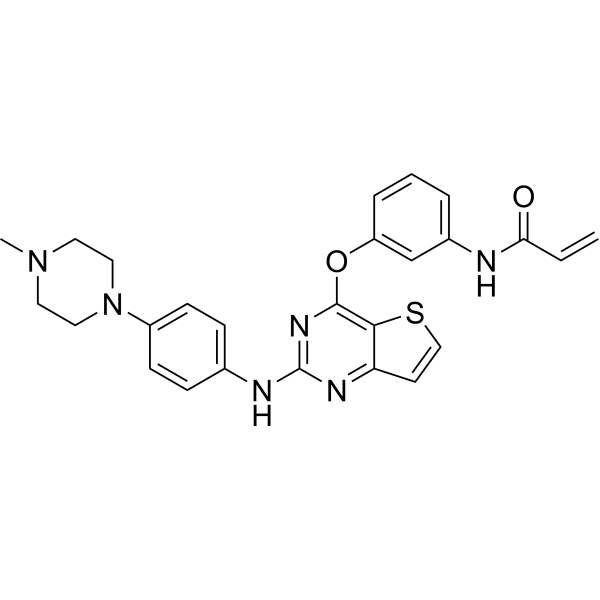
| DC57050 | DZD9008 Featured |
DZD9008 is an oral, potent, irreversible, wild type-selective EGFR TKI against EGFR or HER2 Exon20ins and other mutations.
More description
|

|
| DC8819 | Olmutinib (HM61713; BI-1482694) Featured |
HM-61713 (BI-1482694) is an orally available small molecule, mutant-selective inhibitor of epidermal growth factor receptor (EGFR) with potential antineoplastic activity.
More description
|
|
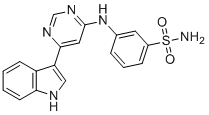
| DC70170 | AC3573 Featured |
AC3573 (AC-3573) is a potent, specific small molecule inhibitor of HER3.AC3573 abrogates HER2–HER3 signalling in cells and is more specific for HER3, inhibits NRG (heregulin)-induced HER3 phosphorylation with IC50 of 10 uM, abrogates the formation of the active HER2-HER3 heterodimer, inhibits oncogenic downstream signalling in SK-BR-3 breast cancer cells.
More description
|
|
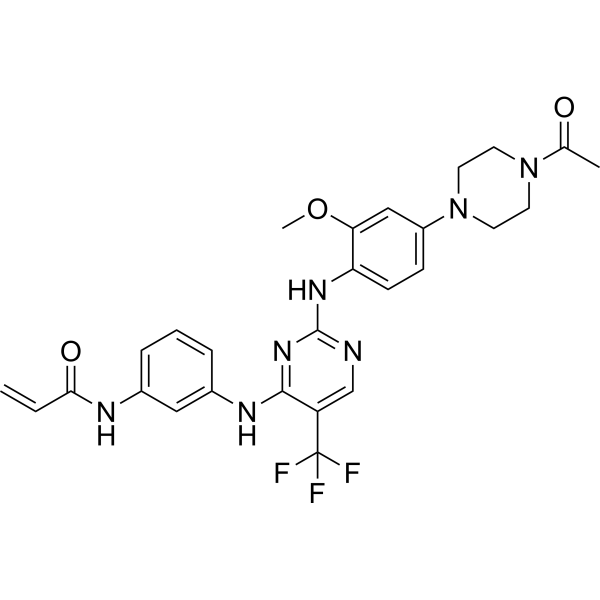
| DC7106 | Rociletinib (CO-1686) Featured |
CO-1686 is a novel, irreversible and orally delivered kinase inhibitor that specifically targets the mutant forms of EGFR including T790M(IC50=21 nM).
More description
|
|
| DC81653 | TLR8 agonist 10 |
TLR8 agonist 10 is a selective TLR8 agonist with an EC50 of 0.019 μM in humans. TLR8 agonist 10 activates TLR8-mediated signaling pathways. As a latency-reversing agent, TLR8 agonist 10 reactivates latent HIV-1 reservoirs. TLR8 agonist 10 activates innate cytotoxic natural killer cells to target HIV-infected CD4+ T cells. TLR8 agonist 10 is applicable to research related to HIV-1 infection.
More description
|
|
| DC81583 | Sulfiflumin |
Sulfiflumin (compound I) is a thiazolidine acaricide. Sulfiflumin can be used as a plant protection agent.
More description
|
|
| DC81572 | STAT6-IN-10 |
STAT6-IN-10 (example 10) is a signal transducer and activator of transcription 6 (STAT6) inhibitor with an EC50 of 0.002 μM. STAT6-IN-10 inhibits CCL17 secretion in peripheral human whole blood with an IC50 of 0.095 μM. STAT6-IN-10 can be used for dermatological condition and respiratory condition research.
More description
|
|
| DC81498 | SB2960 |
SB2960 is a receptor for activated protein C kinase 1 (RACK1) binder with a human KD of 5.65 μM. SB2960 can promote stress granule (SG) formation and exhibit potent antiviral activity across diverse viral species. SB2960 suppresses viral replication with minimal cytotoxicity by modulating host antiviral immune responses. SB2960 increases the thermal stability of RACK1 and reduces SARS-CoV-2 N protein levels. SB2960 enhances type I interferon (IFN-β) expression and inhibits RIG-I, ISG56, and RANTES expression. SB2960 can be used for the research of virus infection.
More description
|
|
| DC81438 | RANKL-IN-2 |
RANKL-IN-2 is an orally active RANKL inhibitor with Kd values of 3.21 μM and 4.625 μM in the SPR and MST assays, respectively. RANKL-IN-2 binds to RANKL to interfere with RANKL-RANK interaction. RANKL-IN-2 suppresses osteoclastogenesis by inhibiting ROS, MAPK and NF-κB pathways. RANKL-IN-2 inhibits osteoclastogenesis via inhibition of RANKL-induced osteoclast formation, bone resorption, and osteoclast-specific gene and protein expressions in vitro.RANKL-IN-2 prevents bone loss in ovariectomized osteoporosis mice.RANKL-IN-2 can be used for the research of osteoporosis.
More description
|
|
| DC81362 | PROTAC EZH2 Degrader-29 |
PROTAC EZH2 Degrader-29 (compound 66) is a is a PROTAC protein degrader targeting EZH2 with an IC50 of 24.53 μM against diffuse large B-cell lymphoma cells. PROTAC EZH2 Degrader-29 can be used in studies related to diffuse large B-cell lymphoma.
(Pink: EZH2 ligand ; Blue: MDM2 ligand ; Black: linker).
More description
|
|
| DC81186 | Nurr1/RXR agonist 1 |
Nurr1/RXR dual agonist 1 is a dual activator of Nurr1 (EC50 = 2.6 µM) and RXR with Ks of 0.6 and 1.1 µM, respectively. Nurr1/RXR dual agonist 1 exclusively activates the heterodimer response element DR5 by selectively destabilizing the Nurr1 homodimer and stabilizing the Nurr1:RXR heterodimer. Nurr1/RXR dual agonist 1 enhances expression of a specific subset of neuroprotective Nurr1 target genes while avoiding induction of genes associated with potential off-target effects in neuronal cells. Nurr1/RXR dual agonist 1 can be used for neurodegenerative diseases research.
More description
|
|
| DC81007 | MARY15 |
MARY15 is a pyridinylpiperazine-based derivative of MARY1. MARY15 activates uncoupled mitochondrial respiration and upregulates p-AKT (S473) phosphorylation in renal proximal tubule cells.
More description
|
|
| DC80872 | IVL 745 |
IVL 745 (XRP 1745A) is a very late antigen 4 (VLA-4, integrin α4β1) antagonist. IVL 745 reduces the airway inflammatory response of sensitized rats and sheep. IVL 745 can be used for airway inflammation and asthma research.
More description
|
|
| DC80857 | Influenza A virus-IN-19 |
Influenza A virus-IN-19 (Compound (S)-63) is an orally active, selective Influenza A virus inhibitor with an EC50 of 0.44 μM. Influenza A virus-IN-19 exhibits moderate binding affinity to Hemagglutinin, with a Kd of 5.66 μM. Influenza A virus-IN-19 inhibits trypsin-mediated cleavage of HA0, blocks the early viral entry process, and suppresses the replication of Influenza A virus. Influenza A virus-IN-19 improves the survival rate of mice in lethal influenza models. Influenza A virus-IN-19 can be used in studies related to Influenza A virus infection.
More description
|
|
| DC80855 | IND8 |
IND8 is a α7 nAChR activator and cognitive enhancer. IND8 mediates cognitive enhancement by activating α7 nAChR . IND8 improves spatial working memory, episodic short-term memory and spatial long-term memory in amnesic mice induced by Scopolamine. IND8 improves memory function in mice with delayed natural memory decline. IND8 can be used in research related to Alzheimer's disease.
More description
|
|
| DC80765 | HCN2 modulator-8 |
HCN2 modulator-8 is a pyrazolopyridine derivative and selective HCN2 inhibitor. HCN2 modulator-8 can be used for the research of pain, tinnitus, central nervous system disorders, psychiatric disorders, mood disorders.
More description
|
|
| DC80758 | Hancockiamide B |
Hancockiamide B (Compound 2) is a piperazine alkaloid. Hancockiamide B is isolated from the fungus Aspergillus hancockii.
More description
|
|
| DC80587 | E3 Ligase Ligand-linker Conjugate 226 |
E3 Ligase Ligand-linker Conjugate 226 is a synthetic E3 ligase ligand-linker conjugate that can be used to synthesize PROTACs, such as PROTAC IRAK3 degrader-2. GXF-111 is a IRAK PROTAC degrader with anti-tumor activity.
More description
|
|
| DC80384 | Cbz-QFR-kbt |
Cbz-QFR-kbt is a ketone-based benzothiazole ketone inhibitor of TMPRSS2, with an IC50 value of 0.42 nM. Cbz-QFR-kbt also has inhibitory activity against Matriptase, Hepsin, HGFA, and Factor Xa, with IC50 values of 1, 1.3, 85, and 85 nM respectively. Cbz-QFR-kbt shows significant inhibitory effects against SARS-CoV-2 and H1N1 (IC50 = 60 nM). Cbz-QFR-kbt can be used in antiviral research.
More description
|
|
| DC80320 | BMMP |
BMMP is an anti-HIV-1 agent and hnRNP M modulator. BMMP modulates hnRNP M function to suppress CD44 mRNA expression. BMMP induces abnormal uncoating of the HIV viral core at the post-entry step. BMMP suppresses migration of TGF-β-stimulated lung carcinoma cells. BMMP suppresses HIV-1 reverse transcription and replication without inhibiting virion release. BMMP exerts anti-HIV-1 activity via a mechanism distinct from CA protein-binding heterocyclic compounds. BMMP can be used for the research of human immunodeficiency virus infection and non-small cell lung cancer.
More description
|
|
| DC80236 | Antitrypanosomal agent 30 |
Antitrypanosomal agent 30 (compound 6b) is a trypanocidal agent with extremely low cytotoxicity against mouse macrophages. Antitrypanosomal agent 30 can be used for the research of Chagas disease.
More description
|
|
| DC79890 | (3S)Lenalidomide-5-methylpiperazine benzenesulfonate |
(3S)Lenalidomide-5-methylpiperazine benzenesulfonate is an E3 ligase ligand-linker conjugate containing a CRBN-based ligand and linker, which can be used to synthesize PROTAC.
More description
|
|
| DC77917 | MRC-G-001 |
MRC-G-001 is a Genipin derivative with an IC50 of 117 μM against A549 cancer cells. MRC-G-001 inhibits the phosphorylation of EGFR, JAK1, and STAT3, and modulates epithelial-mesenchymal transition (EMT)-related protein expression, thereby attenuating cell migration and invasion. MRC-G-001 induces cell cycle arrest and cell apoptosis. MRC-G-001 can be used for the study of cancers such as non-small-cell lung cancer.
More description
|
|
| DC77828 | BIEGi-1 |
BIEGi-1 is a potent and selective binary inhibitor of EGFR that effectively blocks EGFR-catalyzed nucleotide exchange and disrupts the EGFR–Rheb interaction. It robustly inhibits both EGFR kinase activity and mTORC1 signaling in EGFR-mutant cancer cells. This compound exhibits significant anti-proliferative effects with an IC50 of 17 nM for PC9 and 20 nM for HCC827.
More description
|
|
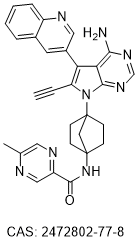
| DC77170 | Emupertinib Featured |
Emupertinib (example 37) is a potent EGFR inhibitor with IC50 values of <0.3 nM, 0.52 nM, 0.5 nM, 0.69 nM and 0.92 nM for EGFR (d746-750/T790M/C779S), EGFR (L858R/T790M/C797S), EGFR (d746-750/C797S), EGFR (L858R/C797S), and EGFR (wild-type), respectively.
More description
|
|
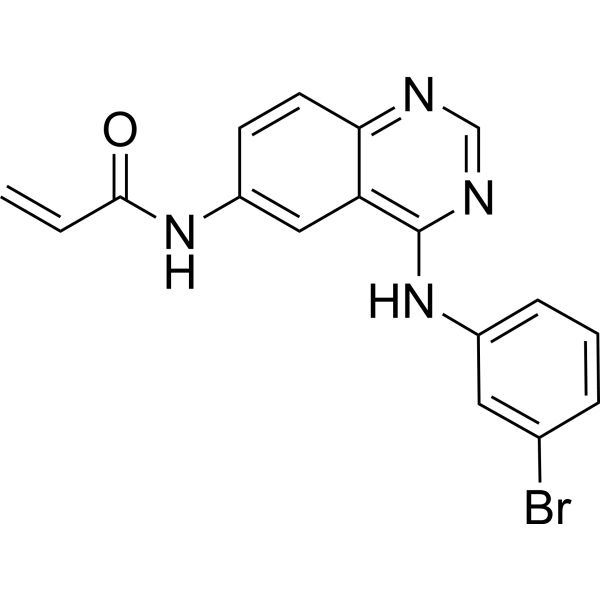
| DC9258 | PD168393 Featured |
PD168393 is potent, cell-permeable, irreversible and selective inhibitor of EGF receptor (EGFR) tyrosine kinase and ErbB2.
More description
|
|
| DC79687 | BBT-176 |
BBT-176 is an orally effective EGFR inhibitor. BBT-176 has inhibitory activity against multiple EGFR C797S mutant cell lines. BBT-176 is commonly used in cancer research.
More description
|
|
| DC79568 | BIEGi-1 |
BIEGi-1 is an EGFR inhibitor. BIEGi-1 effectively disrupts the EGFR-Rheb interaction in cells. BIEGi-1 robustly inhibits EGFR kinase activity (reduces p-Y1068-EGFR) as well as mTORC1 activation (reduces p-T389-S6K1) in EGFR-mutant cells. BIEGi-1 shows strong antiproliferative effects on EGFR-mutant PC9 and HCC827 cells with IC50 values of 17 nM and 20 nM, respectively. BIEGi-1 can be used for the study of cancers harboring EGFR mutations, such as non-small cell lung cancer (NSCLC).
More description
|
|
| DC79203 | EGFR ligand-14-PEG3-Boc |
EGFR ligand-14-PEG3-Boc contains EGFR ligand and linker. EGFR ligand-14-PEG3-Boc can be used for the synthesis of SJF-1521.
More description
|
|
| DC78457 | CGP-59326 |
CGP-59326 (TRX-13) is a highly potent and selective epidermal growth factor receptor (EGFR) tyrosine kinase inhibitor. CGP-59326 blocks the EGFR signaling pathwa, demonstrating highly selective inhibition of EGFR-dependent tumor cells. CGP-59326 is promising for research of cancers.
More description
|
|