To enhance service speed and avoid tariff delays, we've opened a US warehouse. All US orders ship directly from our US facility.
| Cat. No. | Product Name | Field of Application | Chemical Structure |
|---|---|---|---|
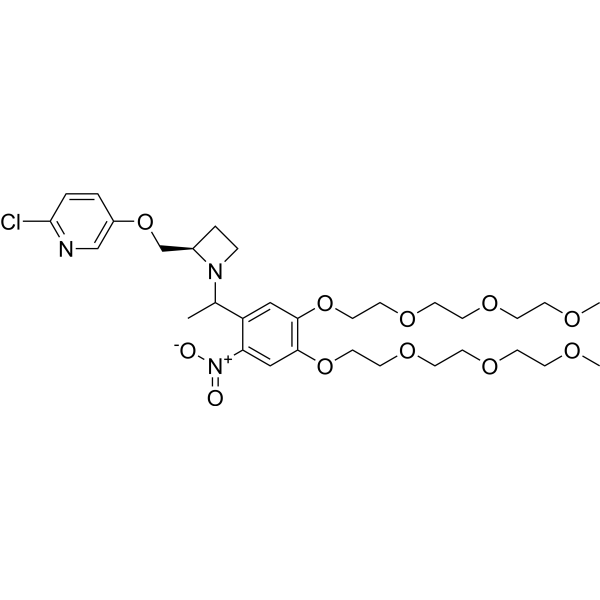
| DC46413 | DPNB-ABT594 Featured |
DPNB-ABT594 is a nitrobenzyl-caged ABT594 and activates nAChRs containing the α4β2 subunits with good selectivity than the α7 subunit. DPNB-ABT594 can be used to map the distribution of nAChRs on neurons of the medial habenula (MHb) and helps to gain a deeper understanding of the nAChR‐mediated Ca2+ signalling in the MHb.
More description
|
|
| DC81600 | TBC-4746 |
TBC-4746 is a α4β1/α4β7 integrin antagonist. TBC-4746 can be used in the research of asthma and multiple sclerosis.
More description
|

|
| DC81245 | Parsalmide |
Parsalmide is an orally active non-steroidal anti-inflammatory drug and gastroprotective agent, with an IC50 of 9.92 μM against COX-1 and 155 μM against COX-2. Parsalmide prevents gastric injury and reduces edema. Parsalmide can be used in the research of arthritis.
More description
|
|
| DC81141 | Neoambrosin |
Neoambrosin is a sesquiterpene lactone. Neoambrosin acts as a partial agonist of PPARγ and TRPA1 receptors, with no carbonic anhydrase inhibitory activity. Neoambrosin can be used in research on hypoglycemia, analgesia, anti-inflammation and anticancer effects.
More description
|
|
| DC80644 | FBPase-IN-6 |
FBPase-IN-6 (Compound 96) is an orally active FBPase inhibitor with an IC50 value of 1.769 μM. FBPase-IN-6 modulates AMPK/mTORC1/S6K signaling pathways. FBPase-IN-6 improves glucose tolerance, enhances insulin sensitivity, and promotes insulin secretion in type 2 diabetic mice.
More description
|
|
| DC80549 | DM-1157 |
DM-1157 is an orally active asymmetric bisquinoline heme inhibitor with a IC50 of 1.6 μM and a Kd of 1.7 μM. DM-1157 binds to heme dimers in solution, inhibits β-hematin formation, suppresses hemozoin formation in the digestive vacuole of Plasmodium falciparum, accumulates in the digestive vacuole of Plasmodium falciparum, induces enlargement of the digestive vacuole of Plasmodium falciparum, and inhibits the growth of Chloroquine-sensitive and resistant Plasmodium falciparum strains. DM-1157 can be used for the research of malaria and Plasmodium falciparum-type malaria.
More description
|
|
| DC80473 | COX-2/CaV2.2-IN-1 |
COX-2/CaV2.2-IN-1 is an orally active and selective dual COX-2/CaV2.2 inhibitor, exhibiting a COX-2 IC50 of 0.26 μM and a CaV2.2 IC50 of 0.29 μM. COX-2/CaV2.2-IN-1 suppresses inflammatory responses and inflammatory mediator (IL-6, TNF-α, NO) production. COX-2/CaV2.2-IN-1 produces pronounced analgesic effects in diverse models of inflammatory, neuropathic, and visceral pain. COX-2/CaV2.2-IN-1 can be used for the research of chronic pain.
More description
|
|
| DC80386 | CCL17-IN-1 |
CCL17-IN-1 (Compound Ex.132) is a CCL17 secretion inhibitor with an EC50 of 0.2 nM. CCL17-IN-1 can be used in the research of autoimmune diseases, dermatological conditions, and respiratory disorders.
More description
|
|
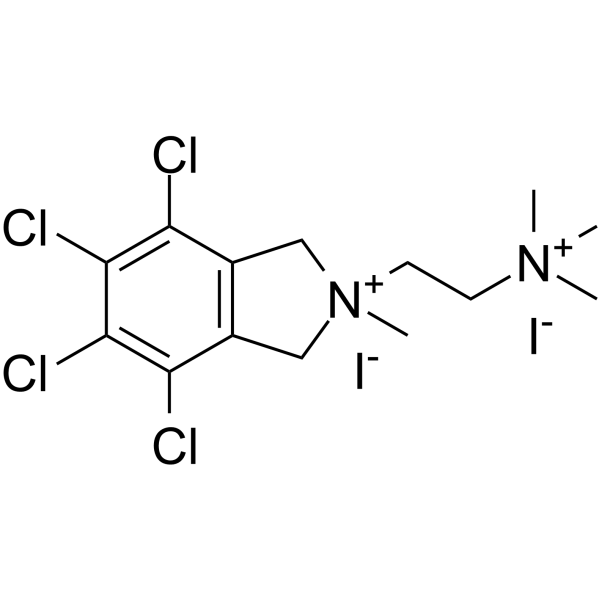
| DC71153 | Chlorisondamine diiodide Featured |
Chlorisondamine (diiodide) is a potent nicotinic acetylcholine receptor (nAChR) antagonist and a ganglion blocker. Chlorisondamine antagonizes some of nicotine's central actions in a potent, long-lasting and pharmacologically selective way.
More description
|
|
| DC72214 | Pyrantel Featured |
Pyrantel is an orally active anthelmintic and an agonist of the nicotinic acetylcholine receptor (nAChR). Pyrantel can cause spasmodic muscle paralysis in parasites. Pyrantel can be used in the study of parasitic infections such as ascariasis, hookworm infections, intestinal worms (pinworm infections), trichinosis and trichinosis.
More description
|
|
| DC79868 | F4-Trp |
F4-Trp (4,5,6,7-Tetrafluoro-L-tryptophan) is a ligand targeting the α3β4 nicotinic acetylcholine receptor (α3β4 nAChR). F4-Trp is promising for research of neurotransmission, addiction, and related diseases, such as neurological diseases.
More description
|
|
| DC79320 | WYE-103914 |
WYE-103914 is an orally active α7 nAChR (EC50 = 0.49 µM for rat α7 nAChR, EC50 = 0.57 µM for human α7 nAChR) agonist. WYE-103914 exhibits the ability to enhance memory in multiple cognitive models. WYE-103914 is used in combination with antipsychotic drugs. WYE-103914 can be used for research on schizophrenia.
More description
|
|
| DC78601 | SIB 1663 |
SIB 1663 is a conformationally restricted analog of nicotine. SIB-1663 selectively activatedα2β4 and α4β4 human recombinant neuronal nAChRs. SIB 1663 can increase DA and NE release. SIB 1663 can be used for the research of neurological disease.
More description
|
|
| DC78517 | Rivanicline hydrochloride |
Rivanicline (RJR-2403) hydrochloride is a neuronal nicotinic receptor agonist. Rivanicline hydrochloride is highly selective for the rat brain cortex nAChRs (Ki = 26 nM, EC50 of 732 nM) and α4β2 subtype (Ki = 26 nM, EC50 = 16 μM). Rivanicline hydrochloride can significantly restore the learning impairment and cognitive dysfunction. Rivanicline hydrochloride can be used for the study of neurodegenerative diseases (such as schizophrenia or Alzheimer's disease).
More description
|
|
| DC78516 | TC-2559 free base |
TC-2559 free base is a α4β2 nicotinic acetylcholine receptor (nAChR) agonists with an EC50 of 0.18 μM. TC-2559 free base shows much weaker potencies on the group of b4-containing nAChR subtypes, α2β4, α4β4 and α3β4 receptors, with EC50s in the range of 10-30 µM. TC-2559 free base can increase the discharge of dopamine cells in the ventral tegmental area (VTA) of rats in vitro, enhancing the excitability and aggressive behavior of VTA dopamine neurons. TC-2559 free base inhibits STAT3 to exert anti-inflammatory properties and relieves mice mechanical allodynia and improve rats cognitive deficits. TC-2559 free base can be used for the study of nerve pain.
More description
|
|
| DC78515 | (E/Z)-Rivanicline |
(E/Z)-Rivanicline ((E/Z)-RJR-2403, (E/Z)-Metanicotine) is the E/Z mixture of Rivanicline). Rivanicline is a neuronal nicotinic receptor (neuronal nicotinic receptor) agonist that is highly selective for the α4β2 subtype, Ki is 26 nM, which is more than 1000 times more inhibitory than α7 receptor.
More description
|
|
| DC78393 | T 588 |
T 588 is an orally active neuroprotective agent. T 588 can increase acetylcholine release from the frontal cortex and hippocampus and meliorate cognitive dysfunction. T 588 can protect cerebellar granule cells from glutamate neurotoxicity. T 588can be used for the research of neurological disease, such as Alzheimer's disease.
More description
|
|
| DC76782 | Soclenicant |
Soclenicant (BNC210) is an orally active α7 nAChR negative alteration modulator (NAM) with no apparent side effects. Soclenicant exhibits acute anxiolytic activity in rodent models of anxiety. Soclenicant inhibits rat and human α7 nAChR currents (in stably transfected cell lines) induced by acetylcholine, nicotine, choline, and the a7-specific agonist PNU-282987. CTT2274 is composed of a prostate-specific membrane antigen (PSMA)-binding scaffold, a biphenyl motif, a pH-sensitive phosphoramidate linker, and MMAE payload. CTT2274 shows selective binding to PSMA and delivers MMAE. CTT2274 inhibits prostate cancer.
More description
|
|
| DC76781 | Epibatidine |
Epibatidine is a α7nACh agonist with a Kd of 100 nM. Epibatidine can be used in the study of Alzheimer's, Parkinson's and schizophrenia.
More description
|
|
| DC76780 | Cypenamine hydrochloride |
Cypenamine hydrochloride is an antidepressant agent. Cypenamine binds to the human nAchR subtypes, α2β4, α3β4 and α4β4, with Ki values of 4.65 μM, 2.69 and 4.11 μM, respectively.
More description
|
|
| DC76779 | A85380 |
A 85380 is a novel, high affinity neuronal nicotinic acetylcholine receptor (nAChR) agonist. A 85380 exhibits selectivity for the α4β2 nAChR subtypes. A 85380 has a broad-spectrum analgesic profile.
More description
|
|
| DC76778 | (E/Z)-Acetamiprid |
(E/Z)-Acetamiprid is the E/Z mixture of Acetamiprid. Acetamiprid is a neonicotinoid insecticide used worldwide. Acetamiprid is a nicotinic acetylcholine receptor (nAChR) agonist, and is shown to be associated with neuromuscular and reproductive disorders.
More description
|
|
| DC73656 | RGH-560 |
RGH-560 (RGH560) is a potent, selective α7 nAChR positive allosteric modulator (PAM) with EC50 of 190 nM (Ca2+-influx).
More description
|
|
| DC73655 | MK4334 |
MK4334 is a potent, selective positive allosteric modulator (PAM) of the α7 nAChR with potential for treatment of Alzheimer's disease.
More description
|
|
| DC73654 | JWX-A0108 |
JWX-A0108 is a novel selective type I α7 nAChR positive allosteric modulator (PAM) with EC50 of 4.35 uM, shows no potentiation effect on α3β4 nAChR, α4β2 nAChR, or 5-HT3AR.
More description
|
|
| DC73653 | DM506 |
DM506 is a novel ibogamine derivative and inhibitor of α7 and α9α10 nicotinic acetylcholine receptors (nAChRs) with IC50 of 5.1 uM, 5.6 uM and 6.4 uM for α9α10, α7β2 and α7nAChR, respectively.
More description
|
|
| DC73652 | CVN417 |
CVN417 (CVN-417) is a potent, selective and brain-penetrant α6-containing nicotinic acetylcholine receptor (α6 nAChR) antagonist with Ca2+ flux IC50 of 86 nM.
More description
|
|
| DC73651 | Cris-104 |
Cris-104 is a selective α4β2* neuronal nAChR agonist, demonstrates antinociceptive and antihypersensitivity in rodent acute/inflammatory and chronic pain models.
More description
|
|
| DC73650 | AT1001 |
AT1001 (AT-1001) is a high affinity and selective α3β4 nAChR antagonist with Ki value of 2.4 nM, >90-fold selectivity over the other major subtypes (α4β2 and α7 nAChR).
More description
|
|
| DC73649 | AN317 |
AN317 is a functionally selective, partial agonist of α6β2-containing nicotinic acetylcholine receptor (nAChR) with pEC50 of 7.17 (α6/α3β2β3V9'S receptor) in cell-based assays, inhibits the effect of nicotine with IC50 of 1.1 uM.
More description
|
|