To enhance service speed and avoid tariff delays, we've opened a US warehouse. All US orders ship directly from our US facility.
| Cat. No. | Product Name | Field of Application | Chemical Structure |
|---|---|---|---|
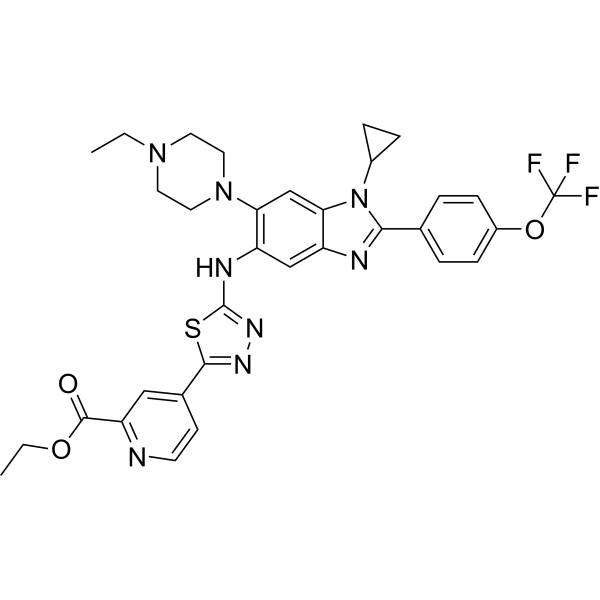
| DC81570 | STAT3-IN-53 Featured |
STAT3-IN-53 (Compound L20) is a STAT3 inhibitor with a Kd value of 6.16 μM. STAT3-IN-53 binds directly to the SH2 domain of STAT3, inhibits phosphorylation at the Y705 site without affecting the total STAT3 protein level, and suppresses the IL-6/JAK/STAT3 pathway. STAT3-IN-53 downregulates the transcription and expression of cyclin-D1 and c-Myc. STAT3-IN-53 induces cell cycle arrest and promotes Apoptosis. STAT3-IN-53 exhibits anticancer activity against colorectal cancer.
More description
|
|
| DC81558 | Sodium Channel-IN-7 |
Sodium Channel-IN-7 (Example 59) is a NaV1.7 voltage-gated sodium channel inhibitor.Sodium Channel-IN-7 binds to the VSD4 binding pocket of NaV1.7, with reduced interaction with Try1537.Sodium Channel-IN-7 can be used for the research of pain.
More description
|

|
| DC81432 | R-130823 |
R-130823 is an orally active, highly selective p38α inhibitor with an IC50 of 22 nM against p38α, an IC50 of 820 nM against p38β, and no activity against p38γ or p38δ. R-130823 downregulates downstream cartilage degradation and inflammatory mediators, and inhibits the release of MMP-13, MMP-1 and PGE2. R-130823 reduces hind paw swelling, improves hyperalgesia, and blocks arthritis progression.\nR-130823 is applicable to research related to osteoarthritis and rheumatoid arthritis.
More description
|
|
| DC81431 | R06039-696 |
R06039-696 is a neuropeptide S receptor (NPSR) agonist with an EC50 of 91 nM. R06039-696 can participate in regulating various biological functions such as arousal, stress and anxiety responses, memory processes, and food intake by activating NPSR.
More description
|
|
| DC81363 | PROTAC EZH2 Degrader-30 |
PROTAC EZH2 Degrader-30 (compound 67) is ais a PROTAC protein degrader targeting EZH2 with an IC50 of 6.22 μM against SU-DHL-6 cells. PROTAC EZH2 Degrader-30 can be used for the research of diffuse large B-cell lymphoma.
(Pink: EZH2 ligand ; Blue: MDM2 ligand ; Black: linker).
More description
|
|
| DC81226 | P53 mutant stabilizer-1 |
P53 mutant stabilizer-1 (compound 274) is a covalent mutant p53 stabilizer. P53 mutant stabilizer-1 can be used for the study of wild-type function of p53 mutants, such as cancers associated with p53 mutation.
More description
|
|
| DC81124 | NB-7 |
NB-7 (example 12) is a potent and orally active SARM1 inhibitor with an IC50 < 1 μM. NB-7 can be used for neurological disorders research.
More description
|
|
| DC80769 | HD202A |
HD202A is an orally active, selective dual inhibitor of MNK1/MNK2 (with IC50 values of 6.09 nM and 8.06 nM, and Kd values of 1.913 μM and 5.244 μM, respectively) that inhibits the MNK-eIF4E signaling pathway. By downregulating perilipin 2 and SCD1, while upregulating adipose triglyceride lipase and PPARγ coactivator 1α, HD202A enhances mitochondrial fatty acid oxidation and redox homeostasis. HD202A effectively suppresses body weight gain, hepatic lipid accumulation and elevation of serum lipids, significantly improves glucose tolerance and insulin sensitivity of the organism, and ameliorates inflammatory features. With these comprehensive pharmacological activities, HD202A exhibits great application potential in studies of metabolic dysfunction-associated steatotic liver disease.
More description
|
|
| DC80422 | Chaperone complex ligand 1 |
Chaperone complex ligand 1 is a chaperone ligand for HSP90. Chaperone complex ligand 1 can be connected to the MET ligand by a linker to synthesis of MET degrader OZD-MET 01.
More description
|
|
| DC80319 | BLT1-IN-1 |
BLT1-IN-1 is an orally active and selective BLT1 inhibitor with an IC50 of 8.7 nM and a Kd of 121 nM. BLT1-IN-1 exerts protective effects against acute lung injury and sepsis in in vivo models. BLT1-IN-1 can be used in research related to acute lung injury and sepsis.
More description
|
|
| DC79946 | 1,2-Linolein-3-caprylin |
1,2-Linolein-3-caprylin is an acylglycerol.
More description
|
|
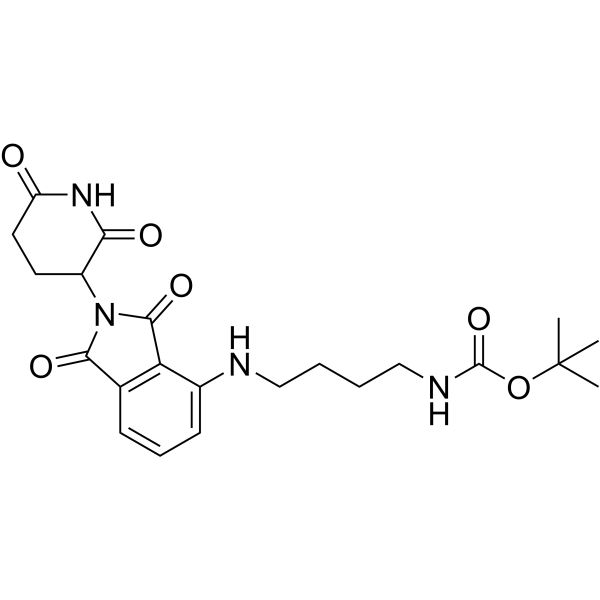
| DC71504 | Thalidomide-NH-C4-NH-Boc Featured |
Thalidomide-NH-C4-NH-Boc is a novel, potent, and selective class of Bromodomain-containing protein 4 (BRD4) and Bromodomain-containing protein 2 (BRD2) degrader for the development of therapeutics to treat cancers.
More description
|
|
| DC79850 | DW34 |
DW34 is an orally active pan-BRD4-D1 biased inhibitor with additional BRD4-D2 inhibitive activity. DW34 displays comparable inhibitive efficacy to I-BET151 (EC50 = 0.16 μM) with low nanomolar EC50 values of 0.14 μM. DW34 significantly reduces liver inflammation induced by LPS and APAP via reducing chemokine expression and cellular necrosis.
More description
|
|
| DC79522 | TAF1 ligand 1 |
TAF1 ligand 1 is a TAF1 ligand. TAF1 ligand 1 can be used as a Ligands for Target Protein for PROTAC synthesis, such as ZS3-046.
More description
|
|
| DC79518 | Repibresib |
Repibresib (VYN201) is a bromodomain and extra-terminal motif (BET) inhibitor. Repibresib shows antineoplastic activity.
More description
|
|
| DC79506 | KB-0118 |
KB-0118 (BBC0115) is an orally active BET bromodomain inhibitor. KB-0118 selective binds to BRD2 and BRD4 over BRD3, with Kd values of 36.7 μM for BRD2 BD1 and 47.4 μM for BRD4 BD1. KB-0118 inhibits pro-inflammatory cytokines, including TNF, IL-1β, and IL-23a and selectively suppresses Th17 cell differentiation. KB-0118 modulates Th17-driven inflammation occurs through epigenetic suppression of BRD4, confirmed by downregulation of STAT3 and BRD4 target genes. KB-0118 has immunomodulatory effects in inflammatory bowel disease (IBD) model.
More description
|
|
| DC79319 | ZnPc-O3-JQ1 |
ZnPc-O3-JQ1 is a light-triggered BRD4 degrader. Under illumination, ZnPc-O3-JQ1 generates reactive oxygen species (ROS) that degrades BRD4. The degradation of BRD4 results in downregulation of HIF-1α, thereby counteracting the photodynamic therapy (PDT) resistance induced by tumor hypoxia. ZnPc-O3-JQ1 exhibits both Type I and Type II PDT mechanisms.
More description
|
|
| DC79312 | LO-3-62 |
LO-3-62 is a PROTAC-like SMARCA2/4 degrader with a truncated fumaramide handle. LO-3-62 degrades SMARCA2/4 in cells.
More description
|
|
| DC79311 | LO-3-61 |
LO-3-61, a JQ-1 analog bearing a truncated fumaramide handle, is a PROTAC (proteolysis-targeting chimeras)-like BRD4 degrader. LO-3-61 degrades both the long and short isoforms of BRD4 CUL4DcAr16-dependently in cells. LO-3-61 shows selectivity for BRD3 and BRD4 degradation in MDA-MB-231 cells.
More description
|
|
| DC79281 | BTR2038 |
BTR2038 is a BRD9 degrader. BTR2038 induces targeted degradation of V5-tagged human BRD9. BTR2038 can be used for the study of biological processes and diseases associated with abnormal BRD9 protein function.
More description
|
|
| DC79072 | CDD-1154 |
CDD-1154 is an aminopyrimidine analog. CDD-1154 is a BRDT-BD2 inhibitor (IC50: 139 nM). CDD-1154 is used in male contraceptive research.
More description
|
|
| DC79071 | CDD-1498 |
CDD-1498 (Compound 12) is a potent inhibitor of BRDT-BD2. CDD-1498 has an IC50 of 978 nM against BRDT-BD2. CDD-1498 can be studied in research on nonhormonal contraceptive agent.
More description
|
|
| DC79070 | CDD-1128 |
CDD-1128 (Compound 11) is a potent inhibitor of BRDT-BD2. CDD-1128 has an IC50 of 521 nM against BRDT-BD2. CDD-1128 can be studied in research on nonhormonal contraceptive agent.
More description
|
|
| DC79069 | CDD-1147 |
CDD-1147 is a BRDT-BD2 inhibitor with an IC50 of 94 nM. CDD-1147 can be used in the research of non-hormonal contraceptives for men.
More description
|
|
| DC79068 | CDD-1349 |
CDD-1349 (Compound 15) is a BRDT-BD2/BRD4-BD2 selective inhibitor. CDD-1349is an analog with sixfold selectivity for BRDT-BD2 versus BRD4-BD2. CDD-1349 has an IC50 of 22 nM against BRDT. CDD-1349 can be studied in research on nonhormonal contraceptive agent.
More description
|
|
| DC79051 | CDD-1132 |
CDD-1132 (Compound 8) is a potent inhibitor of BRDT-BD2. CDD-1132 has an IC50 of 13 nM against BRDT-BD2. CDD-1132 can be studied in research on nonhormonal contraceptive agent.
More description
|
|
| DC78687 | DCB29 |
DCB29 is a selective inhibitor of the BPTF bromodomain, with an IC50 value of 13.2 μM. DCB29 can be used for the study of the treatment of BPTF-related diseases (such as bladder cancer, colorectal cancer, melanoma, leukemia, and other cancers).
More description
|
|
| DC78356 | Menin-MLL inhibitor MI-2 dihydrochloride |
Menin-MLL inhibitor MI-2 dihydrochloride is a competitive and selective Menin-MLL interaction inhibitor with an IC50 value of 446 nM and a Ki value of 158 nM. Menin-MLL inhibitor MI-2 dihydrochloride downregulates the expression of target genes such as HOXA9 and MEIS1, inhibits proliferation of leukemia cells and induces apoptosis and differentiation. Menin-MLL inhibitor MI-2 dihydrochloride is proming for rasearch of MLL-rearranged acute leukemias (e.g., AML, ALL).
More description
|
|
| DC78284 | MJ-26 |
MJ-26 is an inhibitor targeting Menin. MJ-26 has high binding affinity (Ki: 0.56 μM) and significant antiproliferative activity. MJ-26 works by inhibiting Menin-MLL interaction and inducing Menin protein degradation. MJ-26 has significant antitumor effects on acute myeloid leukemia (AML). MJ-26 can be used in AML research.
More description
|
|
| DC76328 | YDR1 |
YDR1 is a potent, selective and orally bioavailable Cereblon-based PROTAC and a degrader of SMARCA2 with DC50 of 60 nM at 48 hours. It exhibits antitumor activity in SMARCA4-mutant lung cancer xenograft models and can be used in research on non-small cell lung cancer.
More description
|
|