To enhance service speed and avoid tariff delays, we've opened a US warehouse. All US orders ship directly from our US facility.
| Cat. No. | Product Name | Field of Application | Chemical Structure |
|---|---|---|---|
| DC81486 | S-Adenosyl-L-ethionine |
S-Adenosyl-L-ethionine is S-Adenosyl-L-methione analog. S-Adenosyl-L-ethionine is able to replace S-Adenosyl-L-methione during HydG catalysis. HydG can utilize S-Adenosyl-L-ethionine as an effective alternative cosubstrate to S-Adenosyl-L-methione under normal enzymatic turnover conditions, producing the Ω intermediate and allowing efficient catalytic turnover of substrate L-tyrosine.
More description
|

|
| DC81484 | S-8666 |
S-8666 is an orally active uricosuric antihypertensive diuretic. The S-8666 has both S-(-)- and R-(+)-isomers. The diuretic and sodium-excretion activities of it are entirely dominated by the S-(-)-isomer, while the R-(+)-isomer shows no significant activity. S-8666 relies on the organic acid transport system to be secreted through the proximal tubule. S-8666 exhibits a clear uric acid excretion-promoting activity and diuretic effect in various species (such as rats and chimpanzees).
More description
|
|
| DC81445 | rel-ML123 |
rel-ML123 is a negative control probe of ML123 (trans-Racemate).
More description
|
|
| DC81250 | PD 168368 derivative-1 |
PD 168368 derivative-1 (Compound 16) is a derivative of PD 168368, with Ki values of 0.46 and 3.7 nM for the subtypes of bombesin receptor (BB₁ and BB₂). PD 168368 derivative-1 can be used for the study of various diseases, such as cancer, depression, and eating disorders.
More description
|
|
| DC81173 | NPSR1 modulator-1 |
NPSR1 modulator-1 is a NPSR1 modulator.
More description
|
|
| DC81107 | N2-Succinyl-L-ornithine |
N2-Succinyl-L-ornithine is a nucleoside metabolite.
More description
|
|
| DC80893 | JRN73958 |
JRN73958 is a PI3K/Akt, MAPK, and NF-κB inhibitor. JRN73958 decreases LPS/IFNγ-induced PI3K/Akt, MAPK, and NF-κB activity. JRN73958 can be used for the research of leukemia.
More description
|
|
| DC80695 | Ganglioside GT1b (porcine) ammonium |
Ganglioside GT1b (porcine) ammonium is a member of the ganglioside family. Ganglioside GT1b (porcine) ammonium acts as a protective signal against nerve injury-induced spinal synapse elimination. Ganglioside GT1b (porcine) ammonium induces HA synthesis and the phosphorylation of Akt/mTOR in orbital fibroblasts. Ganglioside GT1b (porcine) ammonium enhances porcine oocyte maturation and induces activation of EGFR and ERK1/2 signaling. Ganglioside GT1b (porcine) ammonium is a putative host cell receptor for the Merkel cell polyomavirus. Ganglioside GT1b (porcine) ammonium can be used for the researches of cancer, infection, immunology, endocrinology and neurological disease, such as Thyroid eye disease.
More description
|
|
| DC80668 | Fmoc-Asp(OMpe)-Cbz |
Fmoc-Asp(OMpe)-Cbz is a drug intermediate that can be used for the synthesis of Fmoc-Asp(OMpe)-OH.
More description
|
|
| DC80262 | ASK1-IN-12 |
ASK1-IN-12 is an ASK1 inhibitor with an IC50 of 6.3 nM. ASK1-IN-12 inhibits TNF-α-induced activation of the ASK1-p38/JNK pathway. ASK1-IN-12 can reduce free fatty acid-induced cholesterol increase, lipid droplet accumulation and improves hepatocellular steatosis. ASK1-IN-12 can be used for the research of non-alcoholic steatohepatitis (NASH).
More description
|
|
| DC80205 | Antibacterial agent 321 |
Antifungal agent 147 (compound 2) is a lipophilic antibacterial agent with dark toxicity. Antifungal agent 147 shows a phototoxic effect on S. aureus and E. coli. Antifungal agent 147 can penetrate the bacterial cell membrane and disturb its structure, leading to dark toxicity. Antifungal agent 147 can be used for bacteria infection research.
More description
|
|
| DC80160 | AEG40826 |
AEG40826 (HGS1029), a second mitochondria-derived activator of caspases (SMAC) mimetic, is an inhibitor of apoptosis (IAP) inhibitor. AEG40826 degrades cellular IAP1 (cIAP1) and blocks TNF-α pro-survival signaling. AEG40826 can be used for cancer research.
More description
|
|
| DC80129 | 9(E)-Monohexadecenoin |
9(E)-Monohexadecenoin is an acylglycerol.
More description
|
|
| DC80092 | 4-Methylthio-2-oxobutanoic acid |
4-Methylthio-2-oxobutanoic acid (MTOB) is an ornithine decarboxylase inhibitor. 4-Methylthio-2-oxobutanoic acid reduces ornithine decarboxylase protein levels and enzymatic activity. 4-Methylthio-2-oxobutanoic acid is formed in cells in the Met salvage pathway from methylthioadenosine. 4-Methylthio-2-oxobutanoic acid inhibits cancer cells growth. 4-Methylthio-2-oxobutanoic acid can be used for the research of cancer.
More description
|
|
| DC79895 | (4S,11R)-DiHDoHE |
(4S,11R)-DiHDoHE is a derivative of Dihydroxy-DHA.
More description
|
|
| DC79889 | (2Z,4E)-5-Hydroxypenta-2,4-diene-1,2,5-tricarboxylic acid |
(2Z,4E)-5-Hydroxypenta-2,4-diene-1,2,5-tricarboxylic acid is a 5-hydroxypenta-2,4-diene-1,2,5-tricarboxylic acid.
More description
|
|
| DC29184 | L-Dihydroorotic acid Featured |
L-Dihydroorotic acid can reversibly hydrolyze to yield the acyclic L-ureidosuccinic acid by dihydrowhey enzyme.
More description
|

|
| DC41297 | D-Valine Featured |
D-Valine is the enantiomer of L-Valine. L-Valine is one of 20 proteinogenic amino acids. L-Valine is an essential amino acid.
More description
|

|
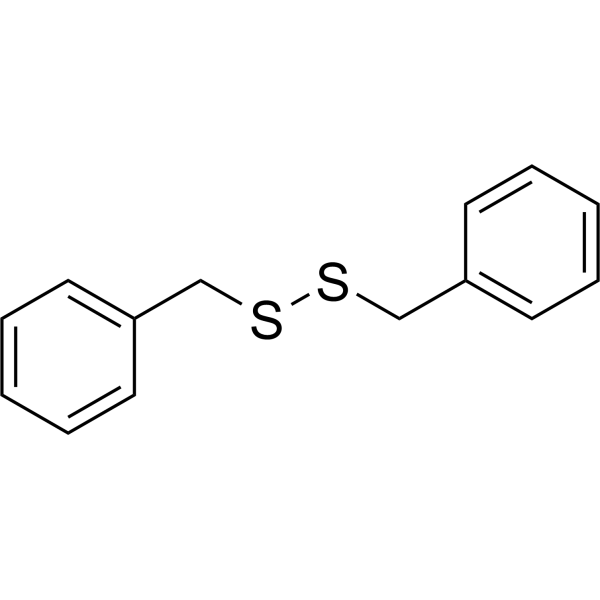
| DC42106 | Dibenzyl disulfide Featured |
Dibenzyl disulfide is an endogenous metabolite.
More description
|
|
| DC49409 | Glucose oxidase Featured |
Glucose oxidase is used in the food and beverage industry as a preservative and stabilizer and is commonly derived from the fungus Aspergillus niger. Glucose oxidase can react with intracellular glucose and oxygen (O2) to produce hydrogen peroxide (H2O2) and gluconic acid, which can cut off the nutrition source of cancer cells and consequently inhibit their proliferation.
More description
|
|
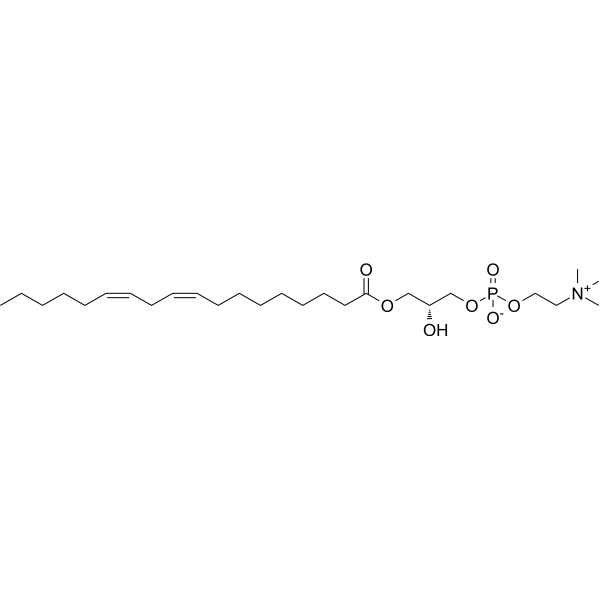
| DC44897 | Lysophosphatidylcholine 18:2 Featured |
Lysophosphatidylcholine 18:2 (1-Linoleoyl-2-Hydroxy-sn-glycero-3-PC), a lysophospholipid, is a potential biomarker identified from insulin resistance (IR) polycystic ovary syndrome (PCOS). Low plasma Lysophosphatidylcholine 18:2 also has been shown to predict impaired glucose tolerance, insulin resistance, type 2 diabetes, coronary artery disease, and memory impairment.
More description
|
|
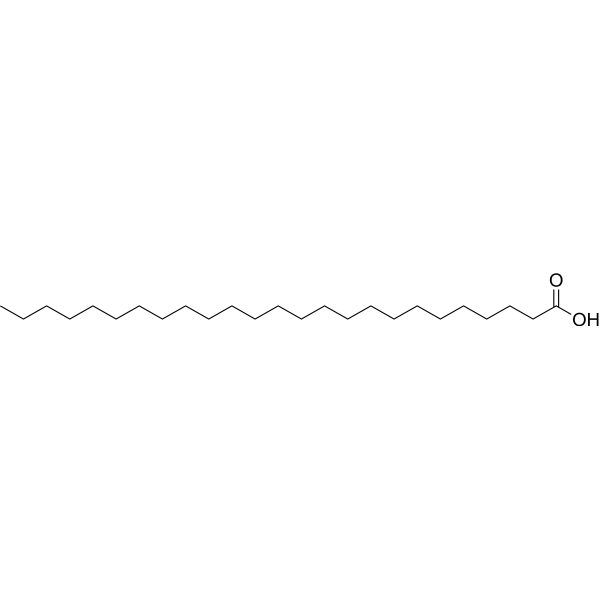
| DC28456 | Pentacosanoic acid Featured |
Pentacosanoic acid is a 25-carbon long-chain saturated fatty acid. Pentacosanoic is a conjugate acid of a pentacosanoate.
More description
|
|
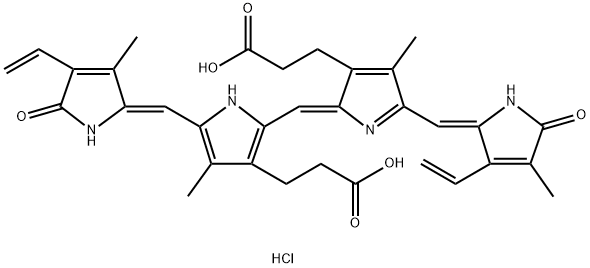
| DC49789 | Biliverdin hydrochloride Featured |
Biliverdin hydrochloride is a tetrapyrrolic, water-soluble compound formed by the breakdown of heme. Biliverdin hydrochloride can upregulate the activity of biliverdin reductase which is an enzyme that is a regulator of the innate immune system.
More description
|
|
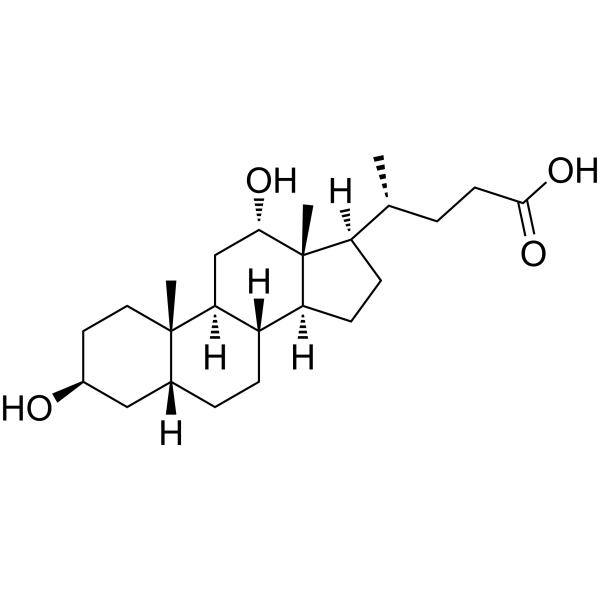
| DC76915 | 3-Epideoxycholic acid Featured |
3-Epideoxycholic acid is the microbial metabolite of Deoxycholic acid. 3-Epideoxycholic acid targets FXR of dendritic cells, reduces their immunostimulatory properties, promotes the generation of Treg cells, and exhibits anti-inflammatory activity. 3-Epideoxycholic acid promotes the growth of bacteria Bacteroides.
More description
|
|
| DC76973 | Δ2-trans-Hexadecenoic acid |
Δ2-trans-Hexadecenoic acid is a trans fatty acid isolated from the seed oil of Aster tataricus (Thunb.).
More description
|
|
| DC76972 | Tribromobisphenol A |
Tribromobisphenol A (Tri-BBPA; 2,2',6-Tribromobisphenol A) is a phenolic compound isolated from human breast milk.
More description
|
|
| DC76971 | Thalicpureine |
Thalicpureine (compound 12) is a secondary metabolite.
More description
|
|
| DC76970 | Succinyl CoA |
Succinyl CoA is an intermediate of the citric acid cycle. Succinyl CoA can be converted to succinic acid and can also combines with glycine to form δ-amino levulinic acid (ALA) to synthesize porphyrins (heme). Succinyl CoA can be used in the study of metabolic, neurological and haematological abnormalities (such as porphyrias) caused by nutritional vitamin B12 deficiency (resulting in a deficiency in Succinyl CoA synthesis).
More description
|
|
| DC76969 | SPP-037 |
SPP-037 is an orally active and selective inhibitor of ST6GAL1 (IC50: 3.59 μM). SPP-037 exhibits anti-MDA-MB-231 cell migration activity by inhibiting integrin α2,6-sialylation and integrin-FAK-paxillin pathway. SPP-037 has anti-tumor activity in MDA-MB-231 xenograft mouse model. SPP-037 can be used in breast cancer research.
More description
|
|
| DC76968 | Ribulose 1,5-bisphosphate |
Ribulose 1,5-bisphosphate (RuBP) is an intermediate in photosynthesis that can be metabolized to 3-phosphoglycerate by ribulose-1,5-bisphosphate carboxylase/oxygenase (Rubisco), a key enzyme in the Calvin-Benson-Bassham cycle.
More description
|
|