To enhance service speed and avoid tariff delays, we've opened a US warehouse. All US orders ship directly from our US facility.
| Cat. No. | Product Name | Field of Application | Chemical Structure |
|---|---|---|---|
| DC81717 | Valyllysine |
Valyllysine (Val-Lys) is a renoprotective peptide. Valyllysine can be found in G. chorda soluble proteins following hydrolysis by thermolysin. Valyllysine effectively ameliorates pathological renal injury.
More description
|

|
| DC81667 | Topoisomerase ll/ME-1-IN-1 |
Topoisomerase ll/ME-1-IN-1 (Compound 7a) is a Topoisomerase ll and ME-1 inhibitor with an IC50 of 5.03 μM against Topoisomerase ll. Topoisomerase ll/ME-1-IN-1 functionally inhibits the activity of Topoisomerase II and functionally blocks the activity of ME-1. Topoisomerase ll/ME-1-IN-1 induces Autophagy by upregulating the expression of Beclin-1 and LC3-II. Topoisomerase ll/ME-1-IN-1 promotes Apoptosis. Topoisomerase ll/ME-1-IN-1 exhibits antiproliferative activity against breast cancer cells and shows no toxicity to normal mammary epithelial cells. Topoisomerase ll/ME-1-IN-1 can be used in studies related to breast cancer (including triple-negative breast cancer).
More description
|
|
| DC81172 | N-Phosphotaurocyamine |
N-Phosphotaurocyamine (Taurocyamine phosphate) is a phosphagen in Arenicola, the stores of phosphotaurocyamine are an energy source which can be used for rapid regeneration of ATP.
More description
|
|
| DC81139 | NecroX-5 free base |
NecroX-5 free base is a derivative of the NecroX, reduces intracellular calcium concentration, and possesses anti-inflammatory and anti-cancer activity.
More description
|
|
| DC80999 | Man-GIcNAc-oxazoline |
Man-GIcNAc-oxazoline (compound 6) is an N-acetylglucosamine (GlcNAc) and azide-modified disaccharide that can be used to label antibodies. Man-GIcNAc-oxazoline can be synthesized as an ADC via click chemistry.
More description
|
|
| DC80684 | FXR agonist 16 |
FXR agonist 16 is a FXR agonist with an EC50 of 2.2 μM. FXR agonist 16 activates FXR transcriptional activity, upregulates SHP and BSEP, and downregulates Cyp7a1. FXR agonist 16 exhibits hepatoprotective activity and reduces AST and ALT levels in free fatty acid-induced hepatocellular injury models. FXR agonist 16 can be used for the research of liver injury.
More description
|
|
| DC80522 | Desmethylcitalopram hydrobromide |
Desmethylcitalopram hydrobromide (DCIT hydrobromide) is a drug impurity.
More description
|
|
| DC80407 | CDK9-IN-48 |
CDK9-IN-48 is a CDK9 inhibitor with an IC50 of 1.37 nM. CDK9-IN-48 inhibits the proliferation of various cancer cells. CDK9-IN-48 can be used in the research of cancers such as acute myeloid leukemia and prostate cancer.
More description
|
|
| DC80317 | BL-1021 |
BL-1021 is an orally active ion channel blocker. BL-1021 significantly reduces symptoms of neuropathic pain without noticeable sedation or cardiac arrhythmias. BL-1021 can be used in the research of acute and chronic pain.
More description
|
|
| DC80227 | Antiparasitic agent-30 |
Antiparasitic agent-30 is a potent adenosine kinase TbrAK modulator and antitrypanosomal agent. Antiparasitic agent-30 exhibits significant inhibitory activity against Trypanosoma brucei rhodesiense, while enhancing the activity of recombinant TbrAK(EC50=38 nM, Ka=75 nM-497 nM). Antiparasitic agent-30 exerts its pharmacological effects by eliminating intrinsic substrate inhibition and hyperactivating TbrAK in Trypanosoma brucei rhodesiense. Antiparasitic agent-30 serves as a valuable tool molecule for studying acute African human trypanosomiasis (sleeping sickness).
More description
|
|
| DC79832 | Org 30029 hydrochloride |
Org 30029 (hydrochloride) is a Ca2+ sensitizer with positive inotropic effect. Org 30029 (hydrochloride) can be used for the research of cardiovascular disease.
More description
|
|
| DC79720 | Hepoxilin A3 methyl ester |
Hepoxilin A3 methyl ester is the ester form of HxA3. Hepoxilin A3 methyl ester causes a receptor-induced rise in intracellular calcium through the release from intracellular stores in suspended human neutrophils.
More description
|
|
| DC79466 | S 16317 |
S 16317 is an orally active dihydropyridine derivative with low calcium channel affinity (Ki: 0.55 μM). S 16317 inhibits P-gp mediated efflux of ADR. S 16317 overcomes multidrug resistance in tumor.
More description
|
|
| DC79053 | SL-870495 |
SL-870495 is a calcium antagonist targeting L-type calcium channels. SL-870495 is promising for research of cardiovascular diseases such as hypertension and angina pectoris.
More description
|
|
| DC79018 | HM12 |
HM12 is a covalent inhibitor of L-/T-type calcium channels. HM12 can strongly inhibit the Cav1.2 (L-type) and Cav3.2 (T-type) calcium channels, and has selectivity for the N-type channels. HM12 produces an irreversible inhibition that persisted after washout. HM12 can be used to study diseases such as hypertension, pain, epilepsy, etc.
More description
|
|
| DC79017 | F-0401 |
F-0401 is a calcium antagonist with platelet-activating factor receptor (PAFR) antagonistic action. F-0401 can be used for the research of neurological disease, such as stroke.
More description
|
|
| DC78942 | Onychocin B |
Onychocin B is a cyclic tetrapeptide isolated from Onychocola sclerotica. Onychocin B is a calcium channel blocker with an IC50 of 7.1 μM for Cav1.2.
More description
|
|
| DC78901 | D-myo-Inositol-1,2,6-triphosphate sodium |
D-myo-Inositol-1,2,6-triphosphate (sodium) is one of the members in inositol phosphate family of second messengers that play an important role in transmitting cellular signals. D-myo-Inositol-1,2,6-triphosphate (sodium) can open calcium channels and increase intracellular calcium upon binding to its receptor on the endoplasmic reticulum.
More description
|
|
| DC78886 | D-myo-Inositol-2,3,5,6-tetraphosphate tetrasodium |
D-myo-Inositol-2,3,5,6-tetraphosphate (2,3,5,6-IP4) tetrasodium is a inositol phosphate. D-myo-Inositol-2,3,5,6-tetraphosphate tetrasodium can be used for the study of calcium channels.
More description
|
|
| DC78885 | D-myo-Inositol-2,4,5-triphosphate sodium salt |
D-myo-Inositol-2,4,5-triphosphate (Ins(2,4,5)P3) (sodium salt) is a second messenger produced in cells by phospholipase C-mediated hydrolysis of phosphatidylinositol-4,5-biphosphate. D-myo-Inositol-2,4,5-triphosphate (sodium salt) can open calcium channels and increase intracellular calcium upon binding to its receptors on the endoplasmic reticulum. D-myo-Inositol-2,4,5-triphosphate (sodium salt) also acts as a partial agonist at rat hepatic IP3 receptors. D-myo-Inositol-2,4,5-triphosphate (sodium salt) can be studied in research on calcium ions signaling pathway.
More description
|
|
| DC78872 | D-myo-Inositol-1,2,4,5,6-pentaphosphate sodium salt |
D-myo-Inositol-1,2,4,5,6-pentaphosphate (Ins(1,2,4,5,6)P5) sodium salt is one of several different inositol oligophosphate isomers involved in signal transduction. In human Jurkat T lymphocytes, Ins(1,2,4,5,6)P5 (sodium salt) is phosphorylated to InsP6 by 1/3 kinase. D-myo-Inositol-1,2,4,5,6-pentaphosphate sodium salt is involved in calcium signaling.
More description
|
|
| DC78869 | HCA-6 |
HCA-6 is a calcium-channel and P-glycoprotein blocker. HCA-6 can induce cancer cells apoptosis and increase anticancer activity of Cisplatin. HCA-6 also exhibits antibacterial activity against Bacillus subtilis. HCA-6 can be used for the research of cancer and infection, such as breast cancer.
More description
|
|
| DC78864 | D-myo-Inositol-1,2,3,5-tetraphosphate tetrasodium |
D-myo-inositol-1,2,3,5-tetraphosphate (Ins(1,2,3,5,6)-P5) tetrasodium is one of the Inositol phosphate isomers and can act as a soluble second messenger to participate in cellular calcium signaling.
More description
|
|
| DC78863 | D-myo-Inositol-1,2,4,5-tetraphosphate tetrasodium salt |
D-myo-Inositol-1,2,4,5-tetraphosphate (DL-Ins-(1,2,4,5)P4) tetrasodium is raracemic regioisomer of myo-inositol tetrakisphosphates (IP4s). D-myo-Inositol-1,2,4,5-tetraphosphate tetrasodium is an Ins(1,4,5)P3 receptor agonist with a Ki of 11 nM. D-myo-Inositol-1,2,4,5-tetraphosphate tetrasodium induces Ca2+ mobilization with an EC50 value of 0.22 μM in CHO cells.
More description
|
|
| DC78862 | Glycerophosphoinositol 4,5-diphosphate trisodium |
Glycerophosphoinositol 4,5-diphosphate (GroPI(4,5)P2) trisodium is a slowly metabolized analog of InsP3. Glycerophosphoinositol 4,5-diphosphate trisodium has an EC50 of 1.228 μM for inducing calcium release, with a degradation time constant of 13 seconds. Glycerophosphoinositol 4,5-diphosphate trisodium can be used to study the effect of InsP3 degradation on calcium signal recovery.
More description
|
|
| DC78800 | NAADP tetrasodium |
NAADP tetrasodium is a second messenger. NAADP tetrasodium releases Ca2+ from acidic endosomes and lysosomes. NAADP tetrasodium can be used to study cancer (such as oral squamous cell carcinoma, malignant melanoma) and angiogenesis-related diseases.
More description
|
|
| DC78409 | Wy 27569 |
Wy 27569 is an orally active vascular selective calcium channel blocker that can effectively lower blood pressure. Wy 27569 is a thromboxane synthase inhibitor that can reshape prostaglandin balance, reduce pro thrombotic TXA2, and increase anti thrombotic PGI2. Wy 27569 can be used for research on cardiovascular diseases such as hypertension and angina.
More description
|
|
| DC78178 | PD 175069 |
PD 175069 is a potent and selective N-type calcium channel antagonist with an IC50 of 0.32 μM. PD 175069 is efficacious in an audiogenic seizure model using DBA/2 mice. PD 175069 can be used for on neurological conditions such as neuropathic pain and stroke.
More description
|
|
| DC78009 | Bastadins-5 |
Bastadins-5 is a potent stabilizer for the open state of RYR1. Bastadins-5 enhances Ca2+-induced Ca2+ release. Bastadins-5 can be used in research on central nuclear disease and malignant hypothermia.
More description
|
|
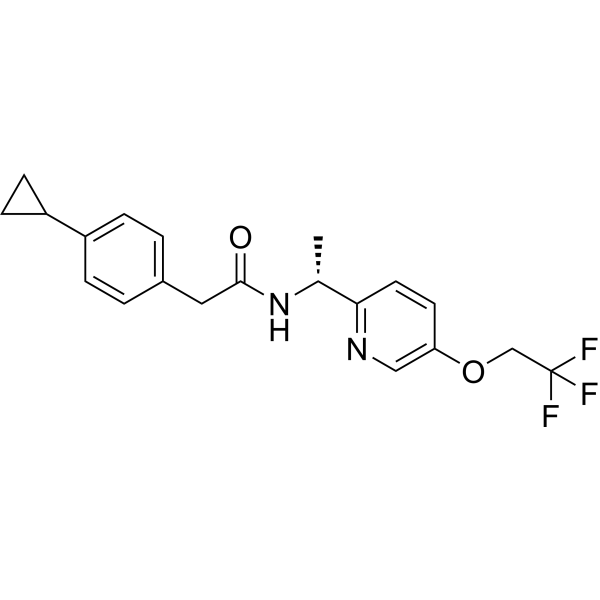
| DC40144 | TTA-A2 Featured |
TTA-A2 is a potent, selective and orally active t-type voltage gated calcium?channel antagonist with reduced pregnane X receptor (PXR) activation. TTA-A2 is equally potent against the Cav3.1 (a1G) and Cav3.2 (a1H) channels with IC50 values of 89 nM and 92 nM, respectively, at -80 and -100 mV holding potentials. TTA-A2 can be used for the research of a variety of human neurological diseases, including sleep disorders and epilepsy.
More description
|
|