To enhance service speed and avoid tariff delays, we've opened a US warehouse. All US orders ship directly from our US facility.
| Cat. No. | Product Name | Field of Application | Chemical Structure |
|---|---|---|---|
| DC79780 | (S)-SCH-23390 hydrochloride Featured |
(S)-SCH-23390 (hydrochloride) is the S-enantiomer of SCH-23390. SCH-23390 is a dopamine D1-like receptor antagonist (with Ki values of 0.2 nM and 0.3 nM for the D1 and D5 receptor subtypes, respectively).
More description
|
-SCH-23390 hydrochloride.gif)
|
| DC76520 | SCH-23390 Featured |
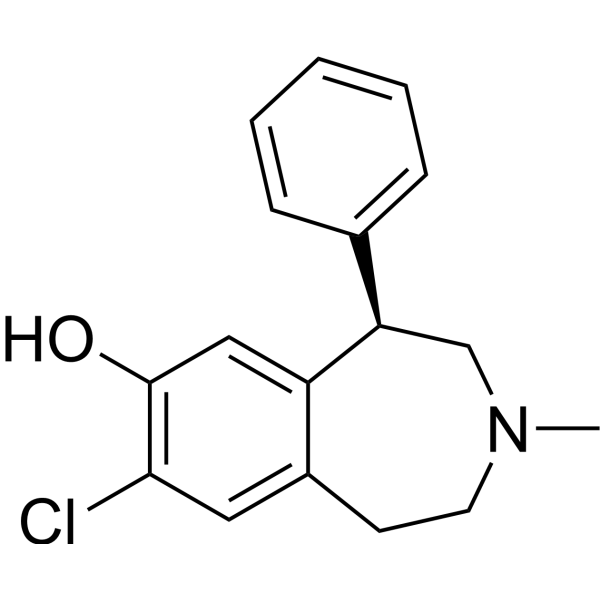
SCH-23390 is a dopamine D1-like receptor antagonist (with Ki values of 0.2 nM and 0.3 nM for the D1 and D5 receptor subtypes, respectively). SCH-23390 can shorten the latency period for cocaine-induced lever pressing behavior in rats. SCH-23390 can also eliminate generalized seizures caused by chemical convulsants, such as arecoline and strychnine, and is used in research on neurological disorders related to the dopamine system.
More description
|
|
| DC73426 | F17464 Featured |
F17464 is a dopamine D3 receptor preferential antagonist exhibiting high affinity for human dopamine receptor subtype 3 (hD3) (Ki=0.17 nM) and 5-HT1a (Ki=0.16 nM) and a >50 fold lower affinity for the human dopamine receptor subtype 2 short and long form (hD2s/l) (Ki=8.9 and 12.1 nM, respectively).
F17464 is a D3 receptor antagonist, 5-HT1a receptor partial agonist.
F17464 blocks ketamine induced morphological changes, an effect D3 receptor mediated, in human dopaminergic neurons. F17464 increases dopamine release in the rat prefrontal cortex and mouse lateral forebrain-dorsal striatum and seems to reduce the effect of MK801 on % c-fos mRNA medium expressing neurons in cortical and subcortical regions.
F17464 also rescues valproate induced impairment in a rat social interaction model of autism, with dose range 0.32-2.5 mg/kg i.p. in both rats and mice
More description
|

|
| DC81833 | Thiethylperazine |
Thiethylperazine is a phenothiazine derivative that acts as an oral dopamine D2-receptor and histamine H1-receptor antagonist. This compound functions as an ABCC1 activator and has been shown to decrease amyloid-β (Aβ) accumulation in mice. It exhibits anti-emetic, antipsychotic, and antimicrobial properties.
More description
|

|
| DC81748 | XAN-5 |
XAN-5 is a mitochondrial DNA G-quadruplex (mtG4) ligand with a Kd of 3.8 μM. XAN-5 selectively binds and stabilizes mtG4 structures, disrupting mitochondrial gene transcription and DNA replication. XAN-5 triggers mitochondrial dysfunction, ROS overproduction, G0 phase arrest and caspase-dependent apoptosis. XAN-5 inhibits autophagy and induces immunogenic cell death. XAN-5 inhibits tumor growth in a mouse liver cancer model while enhancing tumor-infiltrating CD4+ and CD8+ T cells. XAN-5 targets two cancer resistance mechanisms simultaneously. XAN-5 can be used for the research of liver cancer.
More description
|
|
| DC81608 | TEI-6122 |
TEI-6122 is a 7-thiaprostaglandin E1 derivative. TEI-6122 can reduce urinary protein and suppressthe increase of blood urea nitrogen. TEI-6122 can inhibit monocyte chemoattractant protein-1 induced chemotaxis. TEI-6122 can be used for the research of inflammation, such as nephritis.
More description
|
|
| DC81082 | MS 857 |
MS 857 is an orally active nonglycoside and nonsympathomimetic cardiotonic agent. MS 857 exhibits cardiac and coronary vasodilator effect.
More description
|
|
| DC80762 | HC278 |
HC278 is a selective TEAD1/TEAD3 PROTAC degrader. HC278 induces proteasome-dependent degradation by forming a stable ternary complex with CRBN/DDB1. HC278 is applicable to the research of mesothelioma.
More description
|
|
| DC80629 | Etimicin |
Etimicin is a fourth-generation semisynthetic aminoglycoside antibiotic. Etimicin exhibits broad spectrum of activity against gram-positive, gram-negative, and aminoglycoside-resistant bacterial strains, with lower ototoxicity and nephrotoxicity. Etimicin exerts rapid, concentration-dependent bactericidal activity against bacteria. Etimicin can be used for the research of bacterial infections.
More description
|
|
| DC80128 | 8-Oxo-Δ9-THC |
8-Oxo-Δ9-THC is an oxygenated tetrahydrocannabinol that can be found in Cannabis sativa L. variety CHPF-01.
More description
|
|
| DC80111 | 5-Hydroxymethyl flucloxacillin |
5-Hydroxymethyl flucloxacillin is an active metabolite of Flucloxacillin. 5-Hydroxymethyl flucloxacillin exhibits antibacterial activity.
More description
|
|
| DC80081 | 4-DMA-3'-OH-Chalcone |
4-DMA-3'-OH-Chalcone (compound 24) is a synthetic chalcone derivative and selective cytotoxic agent.4-DMA-3'-OH-Chalcone reduces viability of endometriotic cells, while preserving or enhancing viability of eutopic endometrial cells.4-DMA-3'-OH-Chalcone can be used for the research of endometriosis.
More description
|
|
| DC79916 | (Rac)-GSK2973980A |
(Rac)-GSK2973980A (Compound 215) is a DGAT1 inhibitor with an IC50 of 1.8 nM for hDGAT1. (Rac)-GSK2973980A can be used for research on obesity and obesity-related diseases.
More description
|
|
| DC7991 | Clozapine N-oxide Featured |
Clozapine N-oxide is a major metabolite of Clozapine noted to decrease SR-2A (5-HT2 serotonin receptor) density in vitro.
More description
|

|
| DC79807 | RU-24213 hydrochloride |
RU-24213 hydrochloride is a selective D-2 dopamine receptor agonist. RU-24213 hydrochloride is also a KAPPA-opioid receptor antagonist. RU-24213 hydrochloride induces stereotyped behaviors.
More description
|
|
| DC79806 | 7-Hydroxy-DPAT |
7-Hydroxy-DPAT (7-OH-DPAT) is a selective D3 dopamine receptor agonist. 7-Hydroxy-DPAT exhibits significant pharmacological activity in modulating locomotor behavior and dopamine metabolism within the brain. 7-Hydroxy-DPAT can be used for the research of neurological disease .
More description
|
|
| DC79790 | CNV-dopamine |
CNV-dopamine is a photoreleasable D2 receptor-selective agonist. CNV-dopamine activates D2 receptors and induces G protein-coupled inwardly rectifying potassium (GIRK) currents. CNV-dopamine is promising for research of disorders like Parkinson’s disease and addiction.
More description
|
|
| DC79784 | Zelandopam anhydrous |
Zelandopam (anhydrous) (YM435 (anhydrous)) is an orally active and selective agonist of the dopamine D1 receptor. Zelandopam (anhydrous) possesses potent renal vasodilatory properties and can effectively alleviate Cisplatin-induced acute renal failure.
More description
|
|
| DC79661 | PF-04363467 |
PF-04363467 is a highly preferring D3R antagonist. PF-04363467 produces dose-dependent changes in the EEG profile of freely moving rats. PF-4363467 attenuates opioid drug-seeking behavior without concomitant D2 side effects. PF-04363467 can be used for the study of addiction, cognitive and mental illness.
More description
|
|
| DC79411 | NGD 94-1 dimaleate |
NGD 94-1 (dimaleate) is a potent and selective dopamine D4 receptor antagonist. NGD 94-1 (dimaleate) shows high affinity for the cloned human D4.2 receptor (Ki = 3.6 nM). NGD 94-1 (dimaleate) modulates the cognitive functions of the frontostriatal system and regulates dopaminergic transmission in Phencyclidine (PCP)-induced monkeys. NGD 94-1 (dimaleate) can be used for neurological disease research[1][2].
More description
|
|
| DC79383 | AVE-5997 |
AVE-5997 is a selective b>D3 antagonist. AVE-5997 antagonizes MK-801)-induced hyperactivity. AVE-5997 can be used in the research of schizophrenia.
More description
|
|
| DC79212 | ARN25657 |
ARN25657 is a dual-acting D3R/GSK-3β modulator. ARN25657 has both partial D3R agonist activity (EC50 = 15.2 nM, Ki =1.5 nM) and potent GSK-3β inhibitor activity (IC50 = 19.3 nM). ARN25657 exhibits excellent GSK-3β selectivity over FYN, PKA, and CDK5/p35. ARN25657 inhibits P-glycoprotein (P-gP)-mediated acetoxymethyl calcein efflux and improves in vitro ADME properties while maintaining a balanced dual-target profile. ARN25657 is useful for studying bipolar disorder and related neuropsychiatric disorders.
More description
|
|
| DC79192 | PD 172760 |
PD 172760 is a selective D4 receptor antagonist. PD 172760 along with the action of other neurotransmitter receptors may be important in treating psychosis.
More description
|
|
| DC79162 | Dopamine D4 receptor ligand 3 |
Dopamine D4 receptor ligand 3 (Compound 16) is a dopamine D4 receptor (D4R) antagonist (pKi: 8.86). Dopamine D4 receptor ligand 3 has pIC50 values of 5.78, 5.55, and 6.17 for Go, Gi, and βArr2 sensors in HEK-293T cells, respectively. Dopamine D4 receptor ligand 3 inhibits the viability of three human glioma cell lines, U87 MG, T98G, and U251 MG. Dopamine D4 receptor ligand 3 induces ROS production and mitochondrial dysfunction in glioma cells.
More description
|
|
| DC79140 | YM-50001 |
YM-50001 is a potent and selective dopamine D4 receptor antagonist with a Ki 5.62 nM. YM-50001 can be used for the research of neurological disease .
More description
|
|
| DC79099 | UCSF34 |
UCSF34 (Compound 54) is a Haloperidol analogue. UCSF34 binds to the human D2L receptor, with an estimated pKi of 7.49. UCSF34 can be used in the research of schizophrenia.
More description
|
|
| DC79094 | Mivazerol |
Mivazerol is a selective α2-adrenoceptor agonist. Mivazerol has an anti-ischemic activity. Mivazerol decreases the spontaneous release of serotonin (5-HT) and significantly inhibits the immobilization stress-induced enhancement of norepinephrine (NE), dopamine (DA) and dihydroxyphenylacetic acid (DOPAC). Mivazerol can be used for myocardial ischemia research.
More description
|
|
| DC79040 | Y-20024 hydrochloride |
Y-20024 (hydrochloride) is an orally active D2 receptor antagonist with blood-brain barrier permeability. Y-20024 can inhibit Apomorphine-induced ADHD in mice. Y-20024 can inhibit Apomorphine-induced vomiting in dogs. Y-20024 has prolactin-promoting activity. Y-20024 can be used in research on neurological disorders such as ADHD and vomiting.
More description
|
|
| DC79037 | MLS6357 |
MLS6357 is a D3 dopamine receptor (D3R)-selective positive allosteric modulator (PAM)-antagonist. MLS6357 exhibits antagonist activity in the D3R-mediated and the BRET-based β-arrestin recruitment assay with IC50s of 13 and 14 μM, and no activity for other DAR subtypes (D1R/D2R/D4R/D5R) (IC50 > 100 μM). MLS6357 is also an antagonist in the D3R-mediated Go-BRET assay with an IC50 of 17 μM. MLS6357 can be used for the study of neuropsychiatric disorders, including substance use disorder.
More description
|
|
| DC79021 | 1192U90 |
1192U90 is an antipsychotic agent, dopamine D2 receptor antagonist as well as serotonin 5-HT1a receptor agonist. 1192U90 reduces the number of spontaneously firing neurons in the limbic dopamine system.
More description
|
|