 To enhance service speed and avoid tariff delays, we've opened a US warehouse. All US orders ship directly from our US facility.
| Cat. No. | Product Name | Field of Application | Chemical Structure |
|---|---|---|---|
| DC55000 | Jun8-76-3A Featured |
Jun8-76-3A is a potent and selective noncovalent SARS-CoV-2 Mpro inhibitor with Ki of 0.07 μM. Jun8-76-3A only selectively inhibits SARS-CoV-2 and SARS-CoV Mpro, but not other viral proteases and host proteases including calpain 1, cathepsins L and K, and trypsin.
More description
|

|
| DC73066 | NBCoV2 Featured |
NBCoV2 is a highly potent small molecule viral fusion inhibitor with potential pan-Coronavirus activity (SARS-CoV IC50=13.8 nM, SARS-CoV-2 IC50=22.8 nM, MERS-CoV IC50=77 nM, cell-based single-cycle assays).
NBCoV2 also has potent antiviral activity against all mutant pseudoviruses carrying single-, double-, or triple-mutations featured in the B.1.1.7 UK, B.1.351 RSA, and B.1.617.2 Delta variants (IC50=30-80 nM).
NBCoV2 completely preventing the induction of any virus-induced CPE (IC100=1.25 uM, SARS-CoV-2 (US_WA-1/2020)).
NBCoV2 bind to the S2 subdomain of the SARS-CoV-2 trimer, thus, inhibits the fusion of CoVs with the cell membran, and is specific for the SARS-CoV-2 S protein.
More description
|

|
| DC80018 | Mindeudesivir(VV116) Featured |
VV116 is an oral drug candidate of nucleoside analog against SARS-CoV-2.
More description
|
.gif)
|
| DC73047 | JC19 Featured |
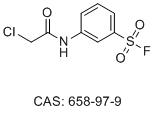
JC19 is a a cysteine-reactive small molecule degrader of SARS-CoV-2 nsp14 with DC50 of 8.7 uM in HEK293T cells.
More description
|
|
| DC81348 | PROTAC EGFR degrader 16 |
PROTAC EGFR degrader 16 (Compound 98) a selective EGFR PROTAC degrader with DC50 values of < 50 nM in NCI-H1975 (EGFR L858R-T970M), NCI-H3225 (EGFR L858R) and NCI-H1976 + CS (EGFR L858R-T970M-L797S). PROTAC EGFR degrader 16 can be used for the study of EGFR-driven cancerssuch as non-small cell lung cancer (Pink: EGFR ligand; Blue: CRBN ligand; Black: Linker; EGFR ligand + Linker).
More description
|

|
| DC81285 | PI3K/PIKK-IN-2 |
PI3K/PIKK-IN-2 (compound 2) is an inhibitor of PI3K/PIKK. PI3K/PIKK-IN-2 can be used in preparing antibody-drug conjugates (ADCs).
More description
|
|
| DC81230 | PAC-Phe-Val |
PAC-Phe-Val is a potent HIV-1 protease inhibitor with an IC50 value of 33.10 nM. PAC-Phe-Val forms stable and strong interactions with critical active site residues, contributing to its high inhibitory potency. PAC-Phe-Val can be used for HIV/AIDS research.
More description
|
|
| DC81225 | P5(PEG24)-OSu |
P5(PEG24)-Osu is a type of PROTAC linker and belongs to the PEG category. P5(PEG24)-Osu can be used for the synthesis of PROTAC molecules.
More description
|
|
| DC81192 | OC-C2-Cholesterol |
Cholesterol-conjugated OC prodrug (Compound 1b) is an orally active cholesterol-bound prodrug of Oseltamivir carboxylate. Cholesterol-conjugated OC prodrug has a protective effect against influenza virus infection. The Oseltamivir carboxylate released by the Cholesterol-conjugated OC prodrug has a longer duration of circulation than the Oseltamivir carboxylate released from Oseltamivir. Cholesterol-conjugated OC prodrug can be used in influenza research.
More description
|
|
| DC80865 | IRBM-Z-2 |
IRBM-Z-2 is a non-competitive, orally active Zika virus (ZIKV) NS2B-NS3 protease inhibitor, with IC50 values of 0.04 μM and 3.1 μM against the wild-type and I156T mutant strains, respectively. IRBM-Z-2 exhibits broad-spectrum anti-flavivirus potential, with IC50 values of 2.1 μM and 0.09 μM against the NS2B-NS3 proteases of dengue virus 2 (DENV2) and West Nile virus (WNV), respectively. IRBM-Z-1 inhibits ZIKV replication and alleviates virus-induced cytopathic effects. IRBM-Z-1 can be used in studies related to ZIKV infection.
More description
|
|
| DC80627 | Ethyl 7-aminoheptanoate hydrochloride |
Ethyl 7-aminoheptanoate hydrochloride is a PROTAC linker that can be used in the synthesis of PROTACs.
More description
|
|
| DC80483 | CQ80 |
CQ80 is a PEPD/XPNPEP1 inhibitor and selective CARD8 inflammasome activator. CQ80 has IC50 values of 0.91 μM for PEPD, 43 μM for XPNPEP1. CQ80 promotes the accumulation of Xaa-Pro peptides by inhibiting PEPD and XPNPEP1, releases the fragment of CARD8 for inflammasome formation, and induces pyroptosis via GSDMD cleavage. CQ80 can be used for research on inflammasome, CARD8-expressing cancer cells, HIV-1-infected cell clearance, acute myeloid leukemia (AML).
More description
|
|
| DC80328 | BMS-856 |
BMS-856 is a 17β-HSD3 inhibitor. BMS-856 inhibits enzymatic activity of 17β-HSD3, with IC50s of 60 and 300 nM respectively in the enzyme and whole cell assays.
More description
|
|
| DC80177 | ALDH3A1-IN-4 |
ALDH3A1-IN-4 is a selective ALDH3A1 inhibitor with an IC50 of 0.2 μM. ALDH3A1-IN-4 binds to the aldehyde-binding pocket of ALDH3A1 via hydrophobic interactions and van der Waals forces. ALDH3A1-IN-4 acts as a chemosensitizer that sensitizes ALDH3A1-expressing cancer cells to the antiproliferative effect of mafosfamide, but does not produce a sensitizing effect on non-cancer cells that do not express ALDH3A1. ALDH3A1-IN-4 is applicable to research related to lung adenocarcinoma and glioblastoma.
More description
|
|
| DC80167 | AgrC-IN-1 |
AgrC-IN-1 is an AgrC inhibitor with an IC50 of 3.5 μM against Staphylococcus aureus AgrC. AgrC-IN-1 competitively binds to AgrC, inhibiting its autophosphorylation activity in Staphylococcus aureus. AgrC-IN-1 inhibits quorum sensing in Staphylococcus aureus, blocking virulence factor production. AgrC-IN-1 can be used for the research of Staphylococcus aureus infections.
More description
|
|
| DC80032 | 24S,25-Epoxyzymosterol |
24S,25-Epoxyzymosterol is an oxysterol.
More description
|
|
| DC77919 | 2-Chloro-2′-deoxyadenosine monophosphate |
2-Chloro-2′-deoxyadenosine monophosphate is an anticoronavirus agent. It exhibits significant inhibitory effects against wild-type novel coronavirus, novel coronavirus variants (Beta, Delta, and Omicron strains), and other coronaviruses such as human coronavirus 229E, human coronavirus OC43, human coronavirus NL63, and mouse coronavirus MHV.
More description
|
|
| DC77908 | ALG-097558 |
ALG-097558 is an orally active 3CLpro inhibitor. ALG-097558 demonstrates pan-coronavirus activity against various SARS-CoV-2 variants as well as other human coronaviruses (HCoVs) such as SARS-CoV-1, α-HCoV 229E, and β-HCoV OC43. ALG-097558 demonstrates potent inhibition with IC50s of 2 nM (SARS-CoV-2 3CLpro) and 6 nM (229E 3CLpro). ALG-097558 demonstrates antiviral activity in the SARS-CoV-2 hamster infection model. ALG-097558 can be used for the study of viral infections[1].
More description
|
|
| DC77867 | RLA-3107 |
RLA-3107 is an artemisinin regioisomer that blocks ion channels, thereby preventing cations from entering the host cytoplasm. RLA-3107 is also a viroporin inhibitor.
More description
|
|
| DC79628 | (±)-Tuaimenal A |
(±)-Tuaimenal A ((+)-1) is a secondary metabolite and a derivative of Sesamol. (±)-Tuaimenal A has potent inhibitory activity against SARS-CoV-2 3CLpro with an IC50 of 33.3 μM. (±)-Tuaimenal A can be used for SARS-CoV-2 infection research.
More description
|
|
| DC79624 | AVI-6451 |
AVI-6451 is a novel orally effective SARS-CoV-2 Mac1 (IC50 = 28 nM) inhibitor. AVI-6451 can reduce viral load. AVI-6451 can be used for research on viral infections.
More description
|
|
| DC79577 | LRH-0003 |
LRH-0003 is an inhibitor of the Macrodomain 1 (Mac1) of nonstructural protein 3 (NSP3) from SARS-CoV-2, with an IC50 value of 1.7 μM. LRH-0003 can be used for the research antiviral infection targeting SARS-CoV-2.
More description
|
|
| DC79351 | AVI-4206 |
AVI-4206 is a selective Mac1 inhibitor with an lC50 of 64 nM. AVI-4206 reduces viral replication, restores an interferon response, and leads to a survival benefit in an animal model of SARS-CoV-2 infection. AVI-4206 can be used the study of SARS-CoV-2 infection.
More description
|
|
| DC79049 | FL-166 |
FL-166 is a SARS coronavirus main protease (Mpro) inhibitor (Ki: 40 nM). FL-166 exerts its inhibitory effect by targeting a cluster of serine residues near the active site of the protease. FL-166 can be used in the study of SARS-CoV.
More description
|
|
| DC78974 | TPG-20A |
TPG-20A is a SARS-CoV-2 main protease inhibitor with an IC50 of 27.8 nM. TPG-20A also inhibits MERS-CoV main protease. TPG-20A can be used for the research of infection, such as SARS-CoV-2.
More description
|
|
| DC78962 | TMP1 |
TMP1 is an orally active bispecific inhibitor of M pro (IC50 = 312.5 nM)/TMPRSS2 (IC50 = 1.28 μM, KD = 10.10 μM). TMP1 exhibits broad protection against different SARS-CoV-2 variants in vitro. TMP1 cross-protects against highly pathogenic coronaviruses (SARS-CoV-1, SARS-CoV-2, and MERS-CoV) in vivo and effectively blocks the transmission of SARS-CoV-2. TMP1 can inhibit infection by SARS-CoV-2 escape mutants that are resistant to Nivolumab. TMP1 can be used in coronavirus research.
More description
|
|
| DC78806 | M2 ion channel blocker-2 |
M2 ion channel blocker-2 (Compound 10) is a M2 channel blocker. M2 ion channel blocker-2 significantly blocks wild-type and mutant M2 (L27F and V27A) ion channels. M2 ion channel blocker-2 has potent antiviral activity against HCoV-229E (EC50: 4.7 μM in cytopathic effect) but not against influenza A virus. M2 ion channel blocker-2 has no significant inhibition of hERG and cytochrome P450 (CYP1A2, CYP2C19, and CYP3A4) activity.
More description
|
|
| DC78691 | BBH-4 |
BBH-4 is a SARS-CoV-2 major protease (MPro) inhibitor. BBH-4 can be used in SARS-CoV-2 infection research.
More description
|
|
| DC78510 | DNDI-6510 |
DNDI-6510 (Compound (S)-x38) is a non-covalent SARS-CoV-2 MPro inhibitor with a IC50 of 0.04 μM. DNDI-6510 has a potent antiviral activity across SARS-CoV-2 and its variants as well as a weak efficacy to SARS-CoV-1. DNDI-6510 significantly improves drug exposure in metabolically humanized mice model (8HUM).
More description
|
|
| DC78462 | MC12 |
MC12 is a thiazole-based derivative and a SARS-CoV-2 main protease inhibitor (IC50: 77.7 nM). MC12 exhibits inhibitory effects on both SARS-CoV and SARS-CoV-2 main proteases, with low cytotoxicity and good stability. MC12 can be used in the research of anti-COVID-19 drugs.
More description
|
|
