 To enhance service speed and avoid tariff delays, we've opened a US warehouse. All US orders ship directly from our US facility.
| Cat. No. | Product Name | Field of Application | Chemical Structure |
|---|---|---|---|
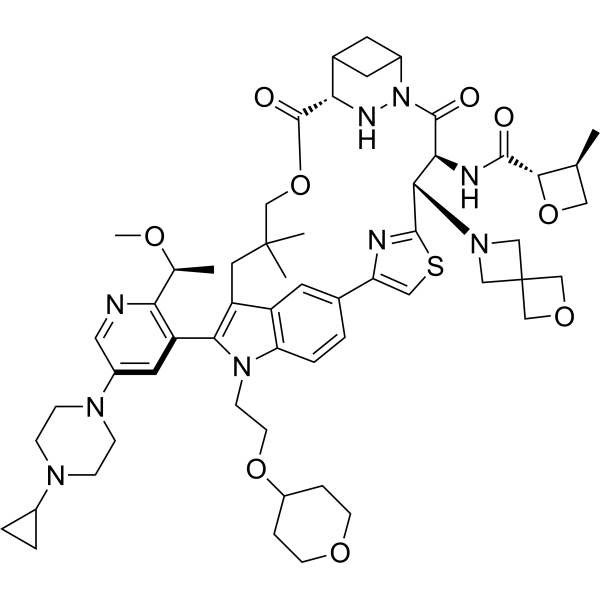
| DC77140 | RMC5127 Featured |
RMC-5127 is an orally active and brain-penetrant mutant-selective tri-complex RASG12V inhibitor. RMC-5127 non-covalently binds to cyclophilin A (CypA), forming a binary complex that engages RASG12V(ON) to form a high-affinity tri-complex, sterically inhibiting RAS binding . RMC-5127 inhibits the RAS pathway in KRASG12V mutant cancer cells, reducing cell proliferation and inducing apoptosis. RMC-5127 is promising for research of cancers with RAS mutations, such as non-small cell lung cancer.
More description
|
|
| DC74360 | BC-DXI-32982 Featured |
BC-DXI-32982 is a potent inhibitor of the interaction between DX2 and KRAS4B with a half-maximal inhibitory concentration (IC50) of 0.18 μM, showing little effect on the PRKACA-PRKAR2A interaction.
More description
|

|
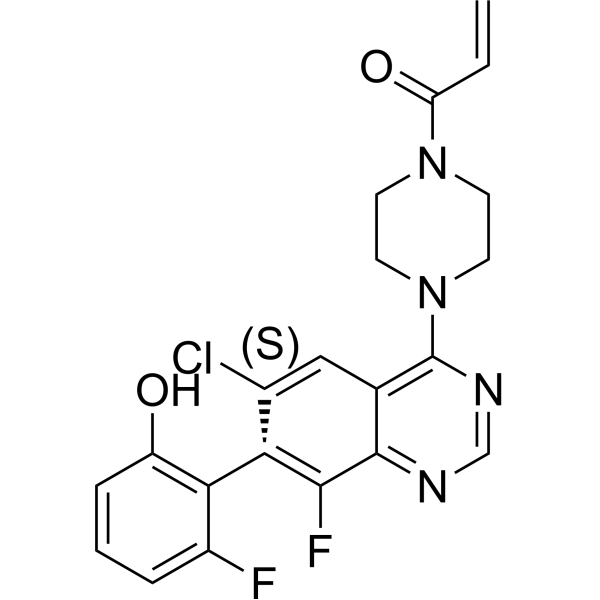
| DC10725 | ARS-1620 Featured |
ARS-1620 is a covalent compound with high potency and selectivity for KRAS-G12C.
More description
|
|
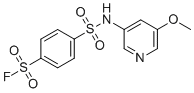
| DC70729 | Ral inhibitor 1 Featured |
Ral inhibitor 1 is a covalent inhibitor of RalB (Ras-like GTPase) activation, inhibits guanine exchange factor Rgl2-mediated nucleotide exchange of Ral GTPase, selectively inhibits Ral over Ras; Ral inhibitor 1 inhibits RalB/Rgl2 interaction through covalent reaction at Tyr-82 with IC50 of 49.5 uM; Ral (Ras-like) GTPases are directly activated by oncogenic Ras GTPases.
More description
|
|
| DC81697 | Tyrosinase-IN-50 |
Tyrosinase-IN-50 (Compound 14) is a Tyrosinase inhibitor (with a Tyrosinase IC50 of 0.06 μM in MNT-1 cells and a Tyrosinase IC50 of 0.16 μM in B16-F10 cells). Tyrosinase-IN-50 inhibits melanogenesis in multiple cell types. Tyrosinase-IN-50 can be used for the research of hyperpigmentation-related diseases.
More description
|

|
| DC81679 | TRPV4/TRPA1-IN-1 |
TRPV4/TRPA1-IN-1 is a TRPV4/TRPA1 inhibitor that suppresses TRPV4/TRPA1-mediated calcium influx. TRPV4/TRPA1-IN-1 alleviates pain behaviors in a mouse trigeminal stimulation pain model and inhibits inflammation and pain-related behaviors in a mouse acute pancreatitis model. TRPV4/TRPA1-IN-1 can be used in research on acute pancreatitis.
More description
|
|
| DC81631 | TGR5 agonist 10 |
TGR5 agonist 10 is a selective, allosteric and orally active Takeda G protein coupled receptor 5 (TGR5) agonist with EC50s of 0.8 μM and 0.6 μM for human TGR5 and mouse TGR5, respectively. TGR5 agonist 10 demonstrates selectivity for TGR5 over FXR. TGR5 agonist 10 activates hTGR5 and mTGR5 to induce cAMP accumulation, and positively modulates lithocholic acid functional activity and potency at hTGR5, with higher selectivity for cAMP formation over β-arrestin2 recruitment. TGR5 agonist 10 exerts glucose-lowering effects in Mus musculus oral glucose tolerance tests. TGR5 agonist 10 can be used for the research of diabetes.
More description
|
|
| DC81609 | Telomeric G4s ligand 2 |
Telomeric G4s ligand 2 is an orally active, selective ligand of telomeric G-quadruplex (G4), with an IC50 of 0.4 μM. Telomeric G4s ligand 2 binds to dimeric telomeric G4, inhibits the activities of DHX36 and BLM helicases. Telomeric G4s ligand 2 activates cGAS-STING and TERRA-ZBP1 pathways, inducing autophagy and G2/M cell cycle arrest, and exhibits antiproliferative effects across cancer cell lines. Telomeric G4s ligand 2 can be used for the study of colorectal cancer.
More description
|
|
| DC81587 | SY-589 |
SY-589 is an orally active DNA polymerase Polθ helicase domain inhibitor (IC50=2.29 nM) and DNA damage inducer. SY-589 inhibits the ATPase activity of the Polθ helicase domain and blocks the Polθ-mediated microhomology-mediated end joining (MMEJ) DNA repair pathway (IC50=0.85 nM). SY-589 also induces the accumulation of DNA double-strand breaks by increasing γ-H2AX levels. SY-589 exerts antiproliferative effects on BRCA2-deficient cells and is used in the research of HR-deficient tumors.
More description
|
|
| DC81582 | Sucrose dilaurate |
Sucrose dilaurate acts as an emulsifier, dispersant and stabilizer. Sucrose dilaurate reduces the release of HMGB1 from UVB-irradiated keratinocytes. Sucrose dilaurate inhibits melanogenesis and decreases bilirubin levels. Sucrose dilaurate induces autophagy in human epidermal keratinocytes, thereby reducing carboxymethyl lysine (CML) levels. Sucrose dilaurate reduces the secretion of insulin-like growth factor-binding protein 3 (IGFBP3) and nerve growth factor (NGF) by senescent keratinocytes. Sucrose dilaurate is investigated as an emulsifier, dispersant or stabilizer in the cosmetics, food and pharmaceutical industries.
More description
|
|
| DC81520 | SePP |
SePP is a blood-brain barrier-permeable NMDAR antagonist and dopamine/norepinephrine reuptake inhibitor, with a Ki of 28.7 nM for rat NMDAR. SePP exerts anticonvulsant effects. SePP can be used in research related to fragile X syndrome.
More description
|
|
| DC81439 | Rapamycin-butyl ester |
Rapamycin-butyl ester (Sirolimus-butyl ester) (Compound 9) is a derivative of Rapamycin. Rapamycin-butyl ester exhibits antiproliferative effects against liver cancer cells and renal cancer cells. Rapamycin-butyl ester can be used in research related to liver cancer and renal cancer.
More description
|
|
| DC81391 | PROTAC PLK1 Degrader-3 |
PROTAC PLK1 Degrader-3 (Compound DD-1) is a PLK1 PROTAC degrader based on the N-deglycosylation pathway, with a Kd value of 2.2 μM. The cell penetration ability of PROTAC PLK1 Degrader-3 is limited and a higher concentration is required to achieve significant degradation effects. PROTAC PLK1 Degrader-3 can be used for research on non-small cell lung cancer.
(Pink: PLK1 ligand ; Blue: Ligands for E3 Ligase ligand ; Black: linker).
More description
|
|
| DC81302 | PKMYT1-IN-12 |
PKMYT1-IN-12 (Compound 4) is a selective inhibitor of PKMYT1, with an IC₅₀ of 2.6 nM. PKMYT1-IN-12 can effectively inhibit the phosphorylation of CDK1, with an IC₅₀ of 44 nM. PKMYT1-IN-12 is a target protein ligand that can be used for the synthesis of PROTAC D16-M1P2.
More description
|
|
| DC81239 | PARP1-IN-48 |
PARP1-IN-48 (Compound 61) is a highly selective PARP1 (PARP1 IC50 = 3 nM, PARP2 IC50 = 170 nM) inhibitor. PARP1-IN-48 can be used for research on cancer, viral infections, and metabolic conditions.
More description
|
|
| DC81185 | NTPDase/NPP1-IN-1 |
NTPDase/NPP1-IN-1 is an ectonucleotidase (NTPDase) and nucleotide pyrophosphatase/phosphodiesterase 1 (NPP1) inhibitor, with IC50 values of 0.28, 0.92, 0.82 and 0.73 μM against h-NTPDase1, h-NTPDase2, h-NTPDase3 and h-NPP1, respectively. NTPDase/NPP1-IN-1 is a membrane-interacting agent that localizes to the plasma membrane and interacts with cancer cells. NTPDase/NPP1-IN-1 can be used in the research of breast cancer.
More description
|
|
| DC81140 | NEK7 degrader-3 |
NEK7 degrader-3 is an orally active and brain-penetrant NEK7 molecular glue degrader with a DC50 of 33.1 nM. NEK7 degrader-3 mediates interaction between NEK7 and E3 ligase cereblon, promoting proteasomal degradation of NEK7 and attenuating NLRP3 inflammasome-mediated inflammatory responses. NEK7 degrader-3 inhibits caspase-1 activity, cytokine release of IL-1β, IL-1α, and IL-18, and pyroptotic plasma membrane permeabilization. NEK7 degrader-3 shows antiinflammatory activity in an LPS-induced neuroinflammation mouse model. NEK7 degrader-3 can be used for the research of neuroinflammation.
More description
|
|
| DC81091 | Mu opioid receptor antagonist 9 |
Mu opioid receptor antagonist 9 is potent, selective and CNS-pentrant mu-opioid receptor (MOR) antagonist with a Ki of 77.3 nM. Mu opioid receptor antagonist 9 exhibits selectivity over kappa-opioid receptor (KOR), and delta-opioid receptor (DOR). Mu opioid receptor antagonist 9 effectively blocks the antinociceptive effects of psychoactive substances. Mu opioid receptor antagonist 9 can reverse psychoactive substances-induced respiratory depression in mice. Mu opioid receptor antagonist 9 can be used for the research of Opioid Use Disorder (OUD).
More description
|
|
| DC81084 | MS2928 |
MS2928 is a selective SETD8 inhibitor with an IC50 of 0.14 μM against SETD8 methyltransferase activity. MS2928 reduces cellular H4K20me1 levels and inhibits proliferation of SETD8-overexpressing multiple myeloma cells. MS2928 inhibits tumor growth in xenograft mouse models of SETD8-overexpressing multiple myeloma. MS2928 can be used for the study of SETD8 biological functions and multiple myeloma.
More description
|
|
| DC80936 | Lamivudine triphosphate TEA |
Lamivudine triphosphate (3TCTP) TEA is a phosphorylated Lamivudine (a nucleoside analogue). Lamivudine triphosphate TEA inhibits the reverse transcriptase of HIV or HBV viruses to block viral replication by chain termination. Lamivudine triphosphate TEA is also an inhibitor of the RdRp activity of the NS5B subunit of the HCV. Lamivudine triphosphate TEA can be incorporated into the nascent RNA by the SARS-CoV-2 RdRp, thus halting mutations in the nascent SARS-CoV-2 RNA.
More description
|
|
| DC80930 | KY0418 |
KY0418 is a selective GPX4 inhibitor. KY0418 selectively and covalently modifies the selenocysteine residue of GPX4 and inhibits GPX4 activity. KY0418 induces ferroptosis and suppresses cell proliferation. KY0418 can be used for the study of ferroptosis and cancer.
More description
|
|
| DC80888 | JNK2/MKK7 PPI-IN-1 |
JNK2/MKK7 PPI-IN-1 is an orally active JNK2 inhibitor with an IC50 of 0.99 μM and a Kd of 81.6 μM. JNK2/MKK7 PPI-IN-1 inhibits JNK2 kinase activity, disrupts JNK2-MKK7 protein-protein interaction, and reduces c-Jun phosphorylation. JNK2/MKK7 PPI-IN-1 inhibits LPS-induced overexpression of inflammatory cytokines IL-6 and TNF-α. JNK2/MKK7 PPI-IN-1 can be used for the research of acute lung injury.
More description
|
|
| DC80845 | IKZF2-degrader 3 |
IKZF2-degrader 3 (compound 6) is a molecular glue IKZF2 degrader with a DC50 of 2.0 nM.
More description
|
|
| DC80649 | Ferroptosis inducer-13 |
Ferroptosis inducer-13 is a 5′-prenylated chalcone derivative that effectively induces ferroptosis in human non-small cell lung cancer (NSCLC) cells by altering the activity of the Nrf2/xCT/GPX4 pathway. Ferroptosis inducer-13 exhibits potent anti-proliferative effects in vitro, and inhibits tumour growth in a NSCLC mouse model. Ferroptosis inducer-13 can be used for NSCLC research.
More description
|
|
| DC80601 | EGFR-IN-197 |
EGFR-IN-197 is an EGFR inhibitor with IC50 values of 19.5 nM and 12.0 nM against EGFRL858R/T790M and EGFRL858R/T790M/C797S, respectively. EGFR-IN-197 arrests the cell cycle of NCI-H1975 cells at the G2/M phase, while inhibiting their proliferation, colony formation and migration; it also inhibits mitochondrial translocation and upregulates mitochondrial H2S levels. EGFR-IN-197 disrupts anti-apoptotic signaling pathways by regulating apoptosis-related proteins; it induces DNA damage and activates pro-apoptotic pathways to trigger apoptosis. EGFR-IN-197 can be used in studies related to non-small cell lung cancer (NSCLC).
More description
|
|
| DC80579 | DZX19 |
DZX19 (Compound C02) is an orally active, selective TRK inhibitor with a TRKA IC50 value of 1.32 nM, a TRKB IC50 of 2.28 nM, and a TRKC IC50 of 4.05 nM. DZX19 inhibits the kinase activities of wild-type TRKA, TRKA mutants (G595R, F589L, G667C), wild-type TRKB, and wild-type TRKC, and suppresses the phosphorylation of TRKA as well as its downstream AKT and ERK signaling pathways. DZX19 induces apoptosis. DZX19 inhibits tumor growth in a colorectal cancer xenograft mouse model. DZX19 is applicable for the research of colorectal cancer.
More description
|
|
| DC80546 | Dipotassium [2,2'-biquinoline]-4,4'-dicarboxylate |
Dipotassium [2,2'-biquinoline]-4,4'-dicarboxylate is a metal-organic framework (MOF).
More description
|
|
| DC80428 | CHIR-29498 |
CHIR-29498 is an antibacterial peptoid. CHIR-29498 is active against both Gram-positive and Gram-negative bacteria. CHIR-29498 can be used for the study of fatal Staphylococcus aureus.
More description
|
|
| DC80403 | SHOC2-RAS PPI-IN-1 |
SHOC2-RAS PPI-IN-1 (compound 6) is a non-covalent competitive inhibitor that disrupts the SHOC2-RAS protein-protein interaction. It exhibits an IC50 of 0.048 μM and a KD of 0.065 μM against NRASQ61R. The compound inhibits the SMP phosphatase complex, resulting in elevated CRAFS259 phosphorylation and subsequent blockade of the MAPK signaling pathway (evidenced by reduced pMEK and pERK levels). This inhibition induces tumor cell cycle arrest and apoptosis. SHOC2-RAS PPI-IN-1 serves as a research tool for investigating NRASQ61R-mutant malignancies including melanoma and colorectal cancer.
More description
|
|
| DC80259 | Artecanin |
Artecanin is a SARS-CoV-2 main protease (Mpro) inhibitor with predicted high gastrointestinal absorption and oral bioavailability, and no predicted hepatotoxicity, carcinogenicity, mutagenicity or cytotoxicity. Artecanin interacts with His41 and Cys145, the key amino acid residues in the active site of Mpro, blocks the cleavage and maturation of viral precursor proteins, and forms a stable complex with Mpro. Artecanin blocks the invasion of SARS-CoV-2. Artecanin is applicable to the research of COVID-19.
More description
|
|
