 To enhance service speed and avoid tariff delays, we've opened a US warehouse. All US orders ship directly from our US facility.
| Cat. No. | Product Name | Field of Application | Chemical Structure |
|---|---|---|---|
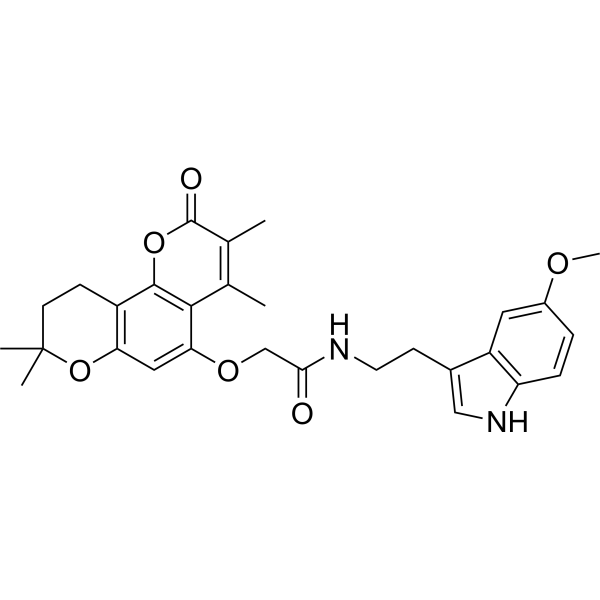
| DC70660 | NPD4928 Featured |
NPD4928 (NPD 4928) is a small molecule that enhances ferroptosis via inhibition of ferroptosis suppressor protein 1 (FSP1).NPD4928 enhanced the sensitivity of various cancer cells to GPX4 inhibitor RSL3.
More description
|
|
| DC81824 | GPX4-IN-5 |
GPX4-IN-5 covalently inhibits GPX4 with an IC50 of 0.12 μM. This compound induces ferroptosis and exhibits anti-tumor activity. It has potential applications in triple-negative breast cancer (TNBC) research.
More description
|

|
| DC81713 | USP1-IN-16 |
USP1-IN-16 is a USP1 inhibitor with an USP1-UAF1 IC50 value of 0.002 μM. USP1-IN-16 can be used in the research of USP1-related malignancies.
More description
|
|
| DC81659 | TMLZ-G46 |
TMLZ-G46 is an orally active ZNF207 inhibitor with blood-brain barrier penetration ability, with a Kd value of 68 nM. TMLZ-G46 inhibits cancer cell proliferation, stemness, migration and invasion, induces G0/G1 cell cycle arrest and apoptosis, and suppresses colony formation. TMLZ-G46 can be used in glioma research.
More description
|
|
| DC81468 | RNA polymerase-IN-4 |
RNA polymerase-IN-4 is a RNA polymerase inhibitor with an EC50 of 22.81 nM. RNA polymerase-IN-4 exhibits potent anti-influenza virus activity (EC50 = 3.76 nM), relatively low cytotoxicity (CC50 = 29.91 μM). RNA polymerase-IN-4 can be used for the research of infection, such as influenza virus infection.
More description
|
|
| DC81395 | PROTAC SKP2 Degrader-1 |
PROTAC SKP2 Degrader-1 is a PROTAC degrader targeting SKP2, with a Kd value of 6.28 μM. PROTAC SKP2 Degrader-1 induces targeted degradation of SKP2 via the ubiquitin-proteasome system. PROTAC SKP2 Degrader-1 stabilizes the expression of SOCS1 and regulates the expression of immunoproteasomes through the JAK/STAT pathway, thereby inhibiting tumor cell proliferation. PROTAC SKP2 Degrader-1 is applicable for cancer-related research.
(Pink: COX and NF-κB ligand ; Blue: Ligands for E3 Ligase and VHL ligand ; Black: linker ).
More description
|
|
| DC81303 | PLAGL2-IN-1 |
PLAGL2-IN-1 is a inhibitor of pleiomorphic adenoma-like protein 2 (PLAGL2) with a Kd of 2.23 µM. PLAGL2-IN-1 suppresses PLAGL2 transcriptional activity, induces G0/G1 cell cycle arrest, and apoptosis, thereby inhibiting hepatocellular carcinoma (HCC) cell proliferation. PLAGL2-IN-1 disrupts extracellular matrix organization and suppresses the PI3K-AKT pathway by reducing AKT phosphorylation. PLAGL2-IN-1 inhibits tumor growth in an HCCLM3 xenograft mouse model. PLAGL2-IN-1 can be used for the research of HCC.
More description
|
|
| DC81115 | Nampt-IN-17 |
Nampt-IN-17 is an selective orally active NAMPT inhibitor with a human NAMPT IC50 of 17 nM and Ki of 25.9 nM. Nampt-IN-17 depletes intracellular NAD+ and ATP, disrupts mitochondrial membrane potential, suppresses cell proliferation, self-renewal, invasion, and migration, induces cell-cycle arrest and apoptosis. Nampt-IN-17 exhibits selective activity against NAPRT-deficient gastric cancer cells. Nampt-IN-17 can be used for the research of NAPRT-deficient gastric cancer.
More description
|
|
| DC80973 | LSD1-IN-49 hydrochloride |
LSD1-IN-49 hydrochloride (Compound (±) 1) is an irreversible LSD1/KDM1A inhibitor with an IC50 of 29 nM against hLSD1. LSD1-IN-49 hydrochloride irreversibly inhibits the enzymatic activity of LSD1 by forming an adduct with flavin adenine dinucleotide (FAD) in the binding pocket of LSD1. LSD1-IN-49 hydrochloride is applicable to research related to schizophrenia, autism spectrum disorder and Huntington's disease.
More description
|
|
| DC80764 | HCN2 modulator-6 |
HCN2 modulator-6 is a HCN2 ion channel inhibitor has an IC50 of 7 nM. HCN2 modulator-6 inhibits HCN2 ion channel activity. HCN2 modulator-6 can be used for the research of pain, inflammatory pain, neuropathic pain, tinnitus, central nervous system disorders, psychiatric disorders, mood disorders.
More description
|
|
| DC80492 | CTR/AMYR modulator-2 |
CTR/AMYR modulator-2 (Example 107) is a receptor 3 for pancreatic amyloid peptide (bAMY3R) agonist, and its EC50 for stimulating cAMP production in cells is <500 nM. CTR/AMYR modulator-2 is also a receptor for calcitonin (bCTR) agonist, with its EC50 being <5000 nM. CTR/AMYR modulator-2 can be used for research on type 2 diabetes and obesity.
More description
|
|
| DC79791 | NPB-1575 |
NPB-1575 is a potent, orally active and brain-penetrant anti-inflammatory agent. NPB-1575 mitigates neuroinflammation and resists ferroptosis by activating the IRS2/Nrf2/NF-κB axis. NPB-1575 shows protective effect against cerebral ischemic injury and improves the neurological functional prognosis. NPB-1575 can be used for the study of ischemic stroke.
More description
|
|
| DC79025 | LIBX-A402 |
LIBX-A402 (Compound 15b) is a selective ACSL4inhibitor with an IC50 of 0.33 μM. LIBX-A402 significantly protects MDA-MB-231 and LUHMES cells from ferroptosis. LIBX-A402 can be used for cancer, ischemia-reperfusion injury and neurodegenerative diseases like Parkinson’s disease research.
More description
|
|
| DC79024 | LIBX-A403 |
LIBX-A403 (Compound 21) is a highly selective acyl-CoA synthetase long-chain family member 4 (ACSL4) inhibitor (IC50=0.049 μM). LIBX-A403 blocks ACSL4-mediated ferroptosis-promoting phospholipid remodeling. LIBX-A403 is promising for research of cancers (e.g., triple-negative breast cancer) and neurodegenerative diseases (e.g., Parkinson’s disease).
More description
|
|
| DC79001 | 1,4-Naphthoquinone-NH-C2-NH-Trolox |
1,4-Naphthoquinone-NH-C2-NH-Trolox is a brain-penetrant Trolox-vitamin K conjugate with neuroprotective activity. 1,4-Naphthoquinone-NH-C2-NH-Trolox can inhibit oxytosis, ferroptosis, ATP depletion and ROS production. 1,4-Naphthoquinone-NH-C2-NH-Trolox selective suppresses M1 markers expression. 1,4-Naphthoquinone-NH-C2-NH-Trolox can be used for the research of neurological disease, such as Alzheimer’s disease (AD).
More description
|
|
| DC78673 | L14-8 |
L14-8 is a potent ferroptosis inducer. L14-8 promotes PLK1 degradation via ubiquitination, increasing TP53 phosphorylation to enhance SAT1 transcription, thereby triggering ferroptosis and cancer cell death. L14-8 can be used for the study of advanced prostate cancer.
More description
|
|
| DC78265 | afi-FSP1-1 |
afi-FSP1-1 is a Ferroptosis suppressor protein 1 (FSP1) inhibitor with an Ki of 0.283 μM. afi-FSP1-1 has a superior binding capacity to FSP1-FAD-NAD+. afi-FSP1-1 can induces ferroptosis in cancer cells. afi-FSP1-1 can be used for cancers research.
More description
|
|
| DC78162 | DTUN |
DTUN is a lipophilic hyponitrite radical initiator and can initiates lipid peroxidation. DTUN is a tool for research of ferroptosis.
More description
|
|
| DC76153 | UAMC-4821 |
UAMC-4821 is an inhibitor for ferroptosis with an IC50 of 5.2 nM. UAMC-4821 scavenges free radicals, blocks the lipid peroxidation, inhibits ML162. Emavusertib maleate is an orally active inhibitor for IRAK4 (IC50=57 nM) and FLT3. Emavusertib maleate inhibits NF-κB and MyD88 signaling pathways, reduces the generation of pro-inflammatory cytokines like IL-6 and IL-10, thereby exhibiting anti-inflammatory and anti-proliferative activities against cancer cells, leading to cell apoptosis. Emavusertib maleate exhibits antitumor activity in mouse model.
More description
|
|
| DC76152 | Pro-GA |
Pro-GA is a γ-Glutamylcyclotransferase (GGCT) inhibitor and a cell-permeable diester-type pro-drug with anticancer activity, GGCT is a key enzyme in glutathione metabolism and is involved in the ferroptosis pathway. Pro-GA exhibits an IC50 of 57 μM against the bladder cancer cell line T24 and can be utilized in cancer research.
More description
|
|
| DC76151 | NYY-6a |
NYY-6a is a Ferroptosis inhibitor. NYY-6a shows significant inhibitory activity against RSL3-induced ferroptosis across 786-O and HT-1080 cells with EC50s of 52 and 50 nM, respectively. NYY-6a functions as a radical trapping antioxidant (RTA) with efficacy of diminishing lipid peroxidation comparable to ferrostatin-1 and liproxtatin-1. NYY-6a is potential for ferroptosis related pathologies reasearch.
More description
|
|
| DC76150 | Ferroptosis inducer-7 |
Ferroptosis inducer-7 is an orally active and selective ferroptosis inducer via inositol 1,4,5-trisphosphate receptor (IP3R)/calcium release-activated calcium channel protein (ORAI). Ferroptosis inducer-7 exhibits a notable effect in alleviating anemia symptoms, suppressing bone marrow CTLs activation, and improving hematopoietic function in immune-mediated bone marrow failure. Ferroptosis inducer-7 can be studied in research for aplastic anemia.
More description
|
|
| DC76149 | Ferroptocide |
Ferroptocide is a cell death inducer that triggers ferroptosis and has anti-tumor activity. Ferroptocide can induce oxidative stress, leading to G2/M cell cycle arrest and apoptosis activation in LNCaP cells, while also effectively inhibiting the cell viability of both LNCaP and TRAMP-C1 cells. Ferroptocide can be used to study its capability to induce mitochondrial autophagy and to trigger immunogenic cell death (ICD) in prostate cancer cells.
More description
|
|
| DC76148 | FerroLOXIN-1 |
FerroLOXIN-1 is a potent inhibitor of 15LOX-2 that selectively blocked production of pro-ferroptotic HOO-ETE-PE and protected against RSL3-induced ferroptosis. FerroLOXIN-1 closely interacted therein with 15LOX-2 only, and in particular with Y154, N155, W158.
More description
|
|
| DC76147 | CT-1 |
CT-1 is a derivative of Cryptotanshinone. CT-1 is a ferroptosis inducer. CT-1 promotes the interaction between NCOA4 and ferritin by targeting FTH1, triggering ferritinophagy-mediated ferroptosis. CT-1 has anticancer activity against triple-negative breast cancer (TNBC). CT-1 induces ferroptosis in both N2-type tumor-associated neutrophils (TANs) and TNBC cancer cells.
More description
|
|
| DC10839 | CIL56(CA3) Featured |
CIL56 is a small molecule that induces cellular ferroptosis through production of iron-dependent reactive oxygen species (ROS).
More description
|

|
| DC74585 | N6F11 Featured |
N6F11 is a ferroptosis inducer, and can trigger the degradation of glutathione peroxidase 4 (GPX4) specifically in cancer cells. N6F11 can be used for ferroptosis study.
More description
|

|
| DC44907 | SRS11-92 Featured |
SRS11-92, a Ferrostatin-1 (Fer-1) analogue, is a potent ferroptosis inhibitor. SRS11-92 inhibits ferroptotic cell death induced by Erastin in HT-1080 human fibrosarcoma cells (EC50=6 nM).
More description
|

|
| DC73112 | LOC1886 |
LOC1886 is a small molecule allosteric inhibitor of GPX4, inhibits enzymatic activity of GPX4 in HT1080 cell lysates with Ki of 102 uM, degrades GPX4 to induce ferroptosis, binds covalently to C66 of GPX4.
More description
|
|
| DC73111 | FSEN1 |
FSEN1 (Ferroptosis Sensitizer 1) is a specific small molecule, uncompetitive inhibitor of ferroptosis suppressor protein 1 (FSP1) with IC50 of 133 nM, sensitizes cancer cells to ferroptosis.
More description
|
|
