To enhance service speed and avoid tariff delays, we've opened a US warehouse. All US orders ship directly from our US facility.
| Cat. No. | Product Name | Field of Application | Chemical Structure |
|---|---|---|---|
| DC70175 | AEP07 Featured |
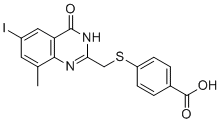
AEP07 (AEP 07) is a selective small molecule inhibitor of PARP4 (vPARP) inhibitor with IC50 of 0.8 uM, >12-fold selective over other PARP family members.
More description
|
|
| DC81465 | RIPK1-IN-39 |
RIPK1-IN-39 (compound 2) is a potent and selective RIPK1 inhibitor (IC50 = 69.40 nM) exhibiting >100-fold selectivity over RIPK3 (IC50 = 6946 nM). RIPK1-IN-39 protects HT-22 and HT-29 cells from necroptosis by inhibiting the phosphorylation and activation of the RIPK1-RIPK3-MLKL pathway. RIPK1-IN-39 demonstrates neuroprotective effects in a rat model of middle cerebral artery occlusion (MCAO). RIPK1-IN-39 can be used for acute ischemic stroke (AIS) research.
More description
|

|
| DC81304 | Plenolin |
Plenolin is an anticancer agent. Plenolin exhibits inhibitory activity against human epidermoid carcinoma cells. Plenolin shows in vivo antitumor activity against ascites carcinosarcoma and lymphocytic leukemia in rodent models. Plenolin can be used for research related to ascites tumors and leukemia.
More description
|
|
| DC81251 | PD-1/PD-L1-IN-60 |
PD-1/PD-L1-IN-60 is the counterpart of the small-molecule immuno-probe [18F] LG‑8, and the two together enable integrated immuno-diagnosis and therapy. PD-1/PD-L1-IN-60 exhibits potent anti-tumor activity in mouse models of melanoma and lung cancer with high PD‑L1 uptake. PD-1/PD-L1-IN-60 can be used for relevant research on melanoma and lung cancer.
More description
|
|
| DC81094 | Multitarget AD-IN-7 |
Multitarget AD-IN-7 is an orally active multi-target anti-AD compound. Multitarget AD-IN-7 exhibits inhibitory activity against GSK-3β and GSK-3α (IC50 = 0.66, 0.83 nM). Multitarget AD-IN-7 upregulates the expression of p-GSK-3β-Ser9, inhibits the phosphorylation of tau-Ser396, targets Aβ1-42, chelates pathogenic metal ions, scavenges ABTS•+, upregulates the expression of β-catenin and neurogenesis biomarkers, and promotes neurite outgrowth. Multitarget AD-IN-7 improves motor ability in Alzheimer's disease zebrafish. Multitarget AD-IN-7 is applicable to research related to Alzheimer's disease.
More description
|
|
| DC80612 | Elsulfavirine sodium |
Elsulfavirine sodium (R-1206 sodium) is an orally active human carbonic anhydrase (carbonic anhydrase, CA) inhibitor and an allosteric inhibitor of HIV-1 non-nucleoside reverse transcriptase (NNRT). Elsulfavirine sodium also targets and blocks the interaction between adenylosuccinate lyase (ADSL) and insulin-induced gene proteins INSIG1/2, blocks SREBP-1-mediated de novo lipid synthesis, and inhibits the proliferation of liver cancer cells. The combination of Elsulfavirine sodium and Lenvatinib produces a synergistic anti-tumor effect. Elsulfavirine sodium is converted into the active metabolite VM1500A in vivo, blocks the DNA polymerase activity of reverse transcriptase, and inhibits HIV-1 replication. Elsulfavirine sodium exhibits a Ki of 1960 nM-52400 nM against human carbonic anhydrase isoforms including I, VII, VI, VA, VB, IX, XIII, XIV. Elsulfavirine sodium is used in studies related to HIV-1 infection and liver cancer.
More description
|
|
| DC80479 | CP-85958 |
CP-85958 is a specific leukotriene D4 (LTD4) receptor antagonist. CP-85958 can be used in the research of inflammatory diseases such as asthma.
More description
|
|
| DC80424 | CHF-6333 xinafoate |
CHF-6333 xinafoate is a neutrophil elastase (NE) inhibitor (IC50 = 0.21 nM; KD = 0.16 nM). CHF6333 xinafoate retains its activity in both human (IC50 = 0.22 nM) and rat (IC50 = 3.63 nM) proteases. CHF6333 xinafoate exhibits inhibitory activity against Proteinase 3 (IC50 = 22 nM). CHF-6333 xinafoate can be used for the study of bronchiectasis (BE).
More description
|
|
| DC80414 | CG-1521 |
CG-1521 is a histone deacetylase (HDAC) inhibitor that stabilizes Ac-Lys373 P53, increases P21 levels and HDAC2 degradation. CG-1521 can inhibit proliferation, induce cell cycle arrest and apoptosis. CG-1521 promotes Bax translocation to the mitochondria and cleavage. CG-1521 downregulates KIF4, Aurora B and Nek2 protein expression and DNA synthesis. CG-1521 can be used for the research of prostate cancer and inflammatory breast cancer.
More description
|
|
| DC80352 | BTK-IN-48 |
BTK-IN-48 is a BTK inhibitor with an IC50 of 1.14 μM. BTK-IN-48 inhibits recombinant BTK and c-Src, and exerts moderate inhibitory effects on LCK, BMX/ETK, FLT3 and PIM1. BTK-IN-48 can be used in the research of B-cell malignancies and autoimmune diseases.
More description
|
|
| DC80139 | ABC transporter modulator-1 |
ABC transporter modulator-1 (Compound I-5) is an ABC transporter expression enhancer. ABCC6 modulator-1 upregulates the expression of wild-type ABCC6, wild-type ABCB4, and ABCA4P1380L mutant, with an EC50 of <1 μM for all.
More description
|
|
| DC73215 | Mortaparib Featured |
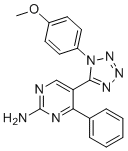
Mortaparib is a dual inhibitor of mortalin-PARP1 interaction, and a p53 activating cytotoxic compound, induces activation of growth arrest and apoptosis signaling in cancer cells in vitro and in vivo.
More description
|
|
| DC21390 | NMS-P293 Featured |
NMS-P293 (also known as NMS-03305293) is an innovative, second-generation oral small molecule inhibitor specifically targeting PARP1. Developed by Nerviano Medical Sciences, it distinguishes itself from first-generation PARP inhibitors through its high selectivity for PARP1 over PARP2, which significantly reduces hematological toxicities like bone marrow suppression.A defining feature of NMS-P293 is its non-trapping mechanism; by inhibiting enzyme activity without trapping PARP on DNA, it offers a superior safety profile that allows for effective combination with DNA-damaging chemotherapies. Furthermore, it possesses exceptional blood-brain barrier (BBB) permeability, making it a leading candidate for treating primary CNS tumors like glioblastoma and brain metastases.
More description
|

|
| DC79785 | CU-TZD-20 |
CU-TZD-20 is a PARP-1 inhibitor. CU-TZD-20 has a high affinity for binding to the PARP-1 catalytic domain and good structural stability. CU-TZD-20 competitively occupies NAD+ binding sites and forms stable interactions with key catalytic residues. CU-TZD-20 can be used for cancer research.
More description
|
|
| DC79644 | 8-ET-NAD+ sodium |
8-ET-NAD+ (sodium) is the derivative of NAD+. 8-ET-NAD+ (sodium) can be used in screening of PARP1 gatekeeper mutations. 8-ET-NAD+ (sodium) can be studied in research on cancer.
More description
|
|
| DC79618 | OUL312 |
OUL312 is a potent PARP10 inhibitor (IC50 = 20 nM), showing more than 75-fold greater selectivity for PARP15(IC50 = 1500 nM). OUL312 is also at least 18-fold higher than all other human enzymes in the family. OUL312 has a good ADME profile, is able to enter cells, is not toxic, and effectively rescues human cells from PARP10-induced apoptosis at sub-micromolar concentrations. OUL312 can be used for the study of cervical cancer.
More description
|
|
| DC79613 | iRucaparib-TP3 |
iRucaparib-TP3 is a selective PARP1 degrader (DC50=36 nM). iRucaparib-TP3 is promising for research of oncology (e.g., BRCA-mutated cancers) and neurodegenerative diseases.
More description
|
|
| DC79601 | CEP-6800 |
CEP-6800 is an inhibitor of PARP-1 with chemopotentiating ability. CEP-6800 attenuates irinotecan- and Temozolomide-induced poly(ADP-ribose) accumulation in LoVo as well as HT29 xenografts. CEP-6800 can suppress Calu-6 tumor growth. CEP-6800 can be studied in anti-cancer research.
More description
|
|
| DC79585 | PARP14 inhibitor 2 |
PARP14 inhibitor 2 (Compound 3) is an orally active and highly selective PARP14 inhibitor with an IC50 value of <30 nM. PARP14 inhibitor 2 inhibits the mono-ADP-ribosyltransferase activity of PARP14 and regulates IFN-γ and IL-4 signaling, reversing protumor macrophage polarization and inhibiting anti-tumor inflammatory responses. PARP14 inhibitor 2 is promising for research of PARP14-related diseases such as tumors, atopic dermatitis and autoimmune diseases.
More description
|
|
| DC79517 | INH2BP |
INH2BP is a poly(ADP-ribose) polymerase (PARP) inhibitor with antioxidant and anti-apoptotic activities. INH2BP reduces the production of intracellular reactive oxygen species (ROS), modulates the expression of apoptosis-related proteins such as Bax, Bcl-2 and cleaved caspase-3 and enhances cell survival through the activation of the ERK1/2 and p38 MAPK signaling pathways. INH2BP is promising for research of cardiovascular diseases.
More description
|
|
| DC79497 | RBN010860 |
RBN010860 (example 150) is a potent PARP7 inhibitor with an IC50 of <0.1 μM. RBN010860 can be used for the study of cancer.
More description
|
|
| DC79116 | KWZY-11 |
KWZY-11 (Compound 11) is a potent PARP/CDK6 dual inhibitor with IC50 values of 156.8, 197.3, and 13.3 nM for PARP1, PARP2, and CDK6, respectively. KWZY-11 inhibits tumor cell proliferation by regulating the Wnt/β-catenin signaling pathway. KWZY-11 induces excessive DNA damage and apoptosis in MDA-MB-231 breast cancer cells.
More description
|
|
| DC78983 | NU1064 dihydrochloride |
NU1064 (dihydrochloride) is an inhibitor of PARP. NU1064 (dihydrochloride) potentiates the cytotoxicity of DNA-methylating agent (MTIC) in a concentration-dependent manner.
More description
|
|
| DC78709 | Lotixparib |
Lotixparib (Example 1) is an inhibitor of poly(ADP-ribose)polymerase-1 (PARP-1). Lotixparib has cytoprotective effect against a retinal disease. Lotixparib can be studied in research for PARP-1-associated diseases.
More description
|
|
| DC78500 | ZINC000081009201 |
ZINC000081009201 is a potent poly(ADP-ribose) polymerase 1 (PARP1) inhibitor with an IC50 value of 1.4767 μM. ZINC000081009201 is promising for research of triple-negative breast cancer (TNBC).
More description
|
|
| DC78385 | A-620223 |
A-620223 is a PARP-1 inhibitor with a Ki of 8 nM against PARP-1 and EC50 of 3 nM in a whole cell assay. A-620223 demonstrates good in vivo efficacy in a B16F10 subcutaneous murine melanoma model in combination with Temozolomide (TMZ) and in an MX-1 breast xenograph model in combination with Cisplatin. A-620223 can be used for the studies of melanoma and breast cancer.
More description
|
|
| DC78194 | DDO3602 |
DDO3602 is a PARP1 HEMTAC degradation agent mediated by HSP90. DDO3602 has good anti-tumor activity and tumor selectivity. DDO3602 induces G2/M phase arrest, DNA damage, and inhibits cell migration by degrading PARP1 in MCF-7 cells (IC50 = 187 nM). DDO3602 can be used for research on cancer such as breast cancer.
More description
|
|
| DC76253 | ZINC43120769 |
ZINC43120769 is a PARP1 inhibitor. ZINC43120769 can be used in prostate cancer (PC) research.
More description
|
|
| DC76252 | ZINC20906412 |
ZINC20906412 is a poly(ADP-ribose) polymerase-10 (PARP10) inhibitor. ZINC20906412 can be used for the research of cancer.
More description
|
|
| DC76251 | TDI-012804 |
TDI-012804 is a TNKS2 inhibitor that selectively inhibits intracellular endogenous TNKS2 protein. TDI-012804 increases the expression of AXIN1 protein in cells that are heterozygous (Tnks1HET) and completely knocks out (Tnks1KO) for TNKS1. TDI-012804 inhibits the proliferation of ApcQ1405X/Tnks1KO organoids (EC50 of 59.1 nM) and is selectively toxic to Tnks1KO AKP-G12D and AKP-G13D organoids.
More description
|
|