Alternate TextTo enhance service speed and avoid tariff delays, we've opened a US warehouse. All US orders ship directly from our US facility.
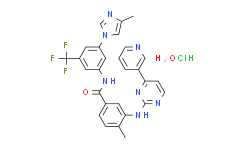

Nilotinib monohydrochloride monohydrate

  Cat. No.:  DC24182   Featured
Chemical Structure
923288-90-8
For research use only. We do not sell to patients.
We match the best price and quality on market.
Email:order@dcchemicals.com  sales@dcchemicals.com
Tel:+86 21 58447131
We are official vendor of:
  • 20
  • 19
  • 18
  • 17
  • 16
  • 15
  • 14
  • 12
  • 11
  • 10
  • 9
  • 8
  • 13
  • 6
  • 5
  • 4
  • 3
  • 2
  • 1
More than 5000 active chemicals with high quality for research!
Field of application
A potent, selective, orally available inhibitor of both native and mutant Bcr-Abl with IC50 of 20-80 nM.
Cas No.: 923288-90-8
Chemical Name: Nilotinib HCl hydrate
Synonyms: Nilotinib hcl monohydrate;Nilotinib monohydrochloride monohydrate;4-methyl-N-[3-(4-methylimidazol-1-yl)-5-(trifluoromethyl)phenyl]-3-[(4-pyridin-3-ylpyrimidin-2-yl)amino]benzamide,hydrate,hydrochloride;Nilotinib (monohydrochloride monohydrate);Nilotinib HCl Hydrate;Epothilone B;4-methyl-N-[3-(4-methyl-imidazol-1-yl)-5-trifluoromethyl-phenyl]-3-(4-pyridin-3-yl-pyrimidin-2-ylamino)-benzamide monohydrochloride monohydrate;5JHU0N1R6K;Nilotinib hydrochloride hydrate;Nilotinib hydrochloride hydrate (JAN);Nilotinib hydrochloride monohydrate;Tasigna (TN);UNII-5JHU0N1R6K
SMILES: O.Cl.CC1N=CN(C2C=C(NC(C3C=CC(C)=C(NC4=NC=CC(C5C=CC=NC=5)=N4)C=3)=O)C=C(C(F)(F)F)C=2)C=1
Formula: C28H25ClF3N7O2
M.Wt: 584
Purity: >98%
Sotrage: 2 years -20°C Powder, 2 weeks 4°C in DMSO, 6 months -80°C in DMSO
Description: Nilotinib monohydrochloride monohydrate is a second generation tyrosine kinase inhibitor (TKI), is significantly more potent against BCR-ABL than Imatinib, and is active against many Imatinib-resistant BCR-ABL mutants.
Target: Bcr-Abl[1]
In Vivo: The percentage of tumor growth inhibition (TGI) is 83.8% for Imatinib and 69.6% for Nilotinib in the GK1X xenograft line (n.s.). In the GK2X xenograft line, TGI is 83.0% for Imatinib and 85.3% for Nilotinib (n.s.). Additionally, the GK3X xenograft line TGI is 31.1% for Imatinib and 47.5% for Nilotinib (n.s.). These results suggest that, except for the GK1X xenograft line, Nilotinib shows equivalent or higher antitumor effects than Imatinib[2]. Nilotinib has a significant healing effect on the macroscopic and microscopic pathologic scores and ensures considerable mucosal healing in the indomethacin-induced enterocolitis rat model. While Nilotinib decreased the PDGFR α and β levels and apoptotic scores in the colon, it did not have a significant effect on the weight and TNF-α levels. Further experimental investigations could provide more definitive evidence for humans[3].
In Vitro: The novel, selective Abl inhibitor, Nilotinib (AMN107), is designed to interact with the ATP-binding site of BCR-ABL with a higher affinity than Imatinib. In addition to being significantly more potent compared with Imatinib (IC50<30 nM), Nilotinib also maintains activity against most of the BCR-ABL point mutants that confer Imatinib resistance[1]. Nilotinib demonstrates significant antitumor efficacy against GIST xenograft lines and Imatinib-resistant GIST cell lines. The parent cell lines GK1C and GK3C show Imatinib sensitivity with IC50 of 4.59±0.97 µM and 11.15±1.48 µM, respectively. The Imatinib-resistant cell lines GK1C-IR and GK3C-IR show Imatinib resistance with IC50 values of 11.74±0.17 µM (P<0.001) and 41.37±1.07 µM (P<0.001), respectively[2].
Cell Assay: The human GIST cell lines GK1C and GK3C, and the Imatinib-resistant cell lines GK1C-IR and GK3C-IR are plated in 96-well microplates and cultured for 12 h before exposure to Imatinib (1-100 µM) or Nilotinib (1-100 µM) for 72 h. The cells are quantified by the WST-8 assay. The optical density (OD) is determined with Sunrise rainbow. The rate of inhibition is calculated as follows: % of inhibition=(OD of treated group-blank)/(OD of control group-blank)×100%. The concentration of tested drugs resulting in 50% growth inhibition (IC50) is calculated[2].
Animal Administration: Mice[2] The GIST xenograft lines GK1X, GK2X and GK3X in nude mice are used. These xenograft lines are maintained by continual passage in BALB/cSLc-nu/nu mice. Mice bearing GK1X, GK2X and GK3X tumors (6-8 mice per group) are treated daily with vehicle or 40 mg/kg Imatinib or Nilotinib for 4 weeks. Tumor volume (TV) is determined from caliper measurements of tumor length (L) and width (w) according to the formula LW2/2. TV is determined every two to three days and on the day of evaluation. Mice are sacrificed and the percentage of tumor growth inhibition (TGI) is calculated as follows: TGI (%)=[1-(mean of treatment group tumor volume on evaluation day-mean of treatment group tumor volume on day 1)/(mean of control group tumor volume on evaluation day-mean of control group tumor volume on day 1)]×100. Rats[3] Female Wistar albino rats, weighing 226-243 g (mean weight, 241.09 g), for use in this study. Nilotinib, administered 20 mg/kg/d in two divided doses, is administered to the Nilotinib group of rats (n=7) for 13 d through an orogastric tube, beginning on the same day as indomethacin administration. Blood and tissue samples for pathological examination are obtained from all rats under ether anesthesia at the end of the 13-d period. All animals are then sacrificed by decapitation.
References: [1]. Weisberg E, et al. Beneficial effects of combining nilotinib and imatinib in preclinical models of BCR-ABL+ leukemias. Blood. 2007 Mar 1;109(5):2112-20. [2]. Sako H, et al. Antitumor effect of the tyrosine kinase inhibitor Nilotinib on gastrointestinal stromal tumor (GIST) and Imatinib-resistant GIST cells. PLoS One. 2014 Sep 15;9(9):e107613. [3]. Dervis Hakim G, et al. Mucosal healing effect of nilotinib in indomethacin-induced enterocolitis: A rat model. World J Gastroenterol. 2015 Nov 28;21(44):12576-85.
Cat. No. Product name Field of application
DC31074 Isopropyl myristate Isopropyl myristate is the ester of isopropyl alcohol and myristic acid.
DC79609 NCGC00685960 NCGC00685960 is a Nicotinamide N-methyltransferase (NNMT) inhibitor with an IC50 < 10  nM. NCGC00685960 has potent antitumor activity. NCGC00685960 increases H3K27 trimethylation levels in ovarian cancer cells and inhibits α-SMA expression in NNMT-expressing ovarian fibroblasts. NCGC00685960 reduces 1-MNA levels, reverses SAM and H3K27 hypomethylation and significantly impairs collagen contractility in cancer-associated fibroblasts (CAFs). NCGC00685960 can be used for cancers research.
DC77831 Vicadrostat Vicadrostat (compound 29 A) is a potent and selective inhibitor of aldosterone synthase(CYP11B2) with an IC50 of 16 nM. It exhibits potential in renal disease, diabetic nephropathy, cardiovascular diseases and fibrotic disorder research.
DC77813 Zeltociclib Zeltociclib is a cyclin-dependent kinase inhibitor with antitumor effects.
DC77714 S3226 S3226 is an inhibitor for Na+/H+ exchange subtype 3 (NHE3) with an IC50 of 0.2 µmol/L in rat NHE3 transfected fibroblasts. S3226 exhibits protective activity in rat ischemia-induced acute renal failure models.
DC77387 AUR1545 AUR1545 is a selective degrader of KAT2A and KAT2B. AUR1545 can be used in the cancer research, including studies on AML (Acute myeloid leukemia), SCLC (Small-cell carcinoma), and NEPC (Neuroendocrine Prostate Cancer).
DC77822 JNJ-77242113 (Icotrokinr) Icotrokinra (JNJ-77242113, JNJ-2113, PN-235) is an orally available and selective antagonist of the IL-23 receptor. It also inhibits IL-23–induced STAT3 phosphorylation in peripheral blood mononuclear cells with an IC50 of 5.6 pM and suppresses IL-23–induced IFN-γ production in NK cells with an IC50 of 18.4 pM. It also exhibits anti-inflammatory activity in a TNBS-induced colitis model in rats and holds potential for studying psoriasis, psoriatic arthritis, and inflammatory bowel disease.
DC77088 T025 T025 is as an orally available and potent inhibitor of Cdc2‐like kinases (CLKs) with an IC50s of 0.93 nM, 1 nM, 14 nM, 1.5 nM for CLK1, CLK2, CLK3, DYRK1B respectively. It exhibits anti‐tumor efficacy and can be used in MYC‐driven cancer research.
DC75868 AZ14133346 AZ14133346 (compound 36) is a potent and selective inhibitor of EGFR Exon20 insertions, with the IC50 of 85 nM. AZ14133346 plays an important role in cancer research.
DC75865 TI17 ​​TI17​​ represents a novel class of targeted anticancer agents that specifically disrupt DNA damage repair mechanisms in malignant cells.
X
