
 To enhance service speed and avoid tariff delays, we've opened a US warehouse. All US orders ship directly from our US facility.
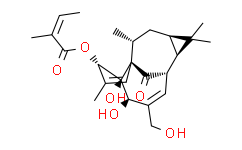



| Cas No.: | 75567-37-2 |
| Chemical Name: | [(1S,4S,5R,6R,9R,10S,12R,14R)-5,6-Dihydroxy-7-(hydroxymethyl)-3,11,11,14-tetramethyl-15-oxo-4-tetracyclo[7.5.1.01,5.010,12]pentadeca-2,7-dienyl] (Z)-2-methylbut-2-enoate |
| Synonyms: | Ingenol-3-angelate;I3A;I3A, PEP005;2-Butenoic acid, 2-methyl-, (1ar,2S,5R,5as,6S,8as,9R,10ar)-1A,2,5,5A,6,9,10,10A-octahydro-5,5A-dihydroxy-4-(hydroxymethyl)-1,1,7,9-tetramethyl-11-oxo-1H-2,8A-methanocyclopenta[A]cyclopropa[E]cyclodecen-6-yl ester, (2Z)-;3-Angeloylingenol;3-Ingenyl angelate;Euphorbia factor an1;Euphorbia factor H1;Ingenol 3-angelate;Ingenol mebutate;PEP 005;(1S,4S,5S,6R,9R,10R,12R,14R)-5,6-Dihydroxy-7-(hydroxymethyl)-3,11,11,14-tetramethyl-15-oxotetracyclo[7.5.1.01,5.010,12]pentadeca-2,7-dien-4-yl (2Z)-2-methyl-2-butenoate;3-Indolyl-b-D-galactopyranoside;3-O-angeloylingenol;A-D-galactopyranoside;indican (glucoside);Indoxyl;(1aR,2S,5R,5aS,6S,8aS,9R,10aR)-5,5a-Dihydroxy-4-(hydroxymethyl)-1,1,7,9-tetramethyl-11-oxo-1a,2,5,5a,6,9,10,10a-octahydro-1H-2,8a-methanocyclopenta[a]cyclpropa[e][10]annulen-6-yl (2Z)-2-methylbut-2-enoate;Ingenol-3-angelate Ingenol Mebutate;A12963;[(1S,4S,5R,6R,9R,10S,12R,14R)-5,6-Dihydroxy-7-(hydroxymethyl)-3,11,11,14-tetramethyl-15-oxo-4-tetrac |
| SMILES: | C\C=C(C)/C(=O)O[C@@H]1[C@]2(O)[C@]3(C=C1C)C(=O)[C@@H](C=C(CO)[C@H]2O)[C@@H]4C(C)(C)[C@@H]4C[C@H]3C |
| Formula: | C25H34O6 |
| M.Wt: | 430.5 |
| Purity: | >98% |
| Sotrage: | 2 years -20°C Powder, 2 weeks 4°C in DMSO, 6 months -80°C in DMSO |
| Description: | Ingenol 3-Angelate is an active ingredient in Euphorbia peplus, acts as a potent PKC modulator, with Kis of 0.3, 0.105, 0.162, 0.376, and 0.171 nM for PKC-α, PKC-β, PKC-γ, PKC-δ, and PKC-ε, respectively, and has antiinflammatory and antitumor activity. |
| Target: | PKC-β:0.105 nM (Ki) PKC-γ:0.162 nM (Ki) PKC-ε:0.171 nM (Ki) PKC-α:0.3 nM (Ki) PKC-δ:0.376 nM (Ki) |
| In Vitro: | Ingenol Mebutate (Ingenol 3-angelate) is an active ingredient in Euphorbia peplus, acting as a potent PKC activator, with Kis of 0.3, 0.105, 0.162, 0.376, and 0.171 nM for PKC-α, PKC-β, PKC-γ, PKC-δ, and PKC-ε, respectively. Ingenol Mebutate also EC50s of 13 ± 2.4 nM (PKC-α), 4.37 ± 0.4 nM (PKC-βI), 10.5 ± 2.2 nM (PKC-βII), 38.6 ± 2.9 nM (PKC-δ), 1.08 ± 0.01 nM (PKC-ε), 0.9 ± 0.13 nM (PKC-μ) in WEHI-231 cells, 198 ± 12.5 nM (PKC-α), 69.1 ± 8.2 nM (PKC-βI), 4.6 ± 0.4 nM (PKC-ε) and 1 nM (PKC-μ) in HOP-92 cells, 635 ± 245 nM (PKC-α), 146 ± 35 nM (PKC-βI), 4.7 ± 0.7 nM (PKC-δ), 1.1 ± 0.5 nM (PKC-ε), and 30 nM (PKC-μ) in Colo-205 cells. Ingenol Mebutate sensitizes WEHI-231 cells, HOP-92 and Colo-205 cells, with IC50s of 1.41 ± 0.255 nM, 3.24 ± 2.01 nM, and 11.9 ± 1.307 nM, respectively[1]. Ingenol Mebutate (PEP005; 20 nM) actions are PKC-δ dependent, induces apoptosis in primary AML marrow blasts but not in normal myeloblasts[2]. Ingenol Mebutate (PEP005) activates PKCδ and inhibits PKCα. Colo205-R cells (IC50: >10 μM) are >300-fold more resistant to Ingenol Mebutate than parental Colo205-S cells[3]. |
| Cell Assay: | KG1a cells are transiently transfected with EGFP-tagged mouse PKC-δ subcloned into pEGFP-N1 plasmid using an Amaxa nucleofection apparatus. Cells are treated with Ingenol Mebutate (0.2 μM-20 μM) 24 hours after transfection. Cell viability in EGFP-positive cells is assessed and loss of viability confirmed in the total cell culture by MTT assay after 3 days. Briefly, 24 hours after transfection, 2 × 10⁴ cells are plated in 5 wells in 96-well plates and exposed to 0, 0.2, 2, and 20 μM Ingenol Mebutate. At 72 hours, 20 μL MTT substrate at 5 mg/mL is added and plates are incubated at 37°C. After 3 hours, 150 μL media is removed and replaced with 200 μL dimethyl sulfoxide (DMSO). Absorbance at an optical density (OD) of 550 nm is read on a plate reader and corrected for absorbance obtained from blank media controls[2]. |
| References: | [1]. Kedei N, et al. Characterization of the interaction of ingenol 3-angelate with protein kinase C. Cancer Res. 2004 May 1;64(9):3243-55. [2]. Hampson P, et al. PEP005, a selective small-molecule activator of protein kinase C, has potent antileukemic activity mediated via the delta isoform of PKC. Blood. 2005 Aug 15;106(4):1362-8. [3]. Ghoul A, et al. Epithelial-to-mesenchymal transition and resistance to ingenol 3-angelate, a novel protein kinase C modulator, in colon cancer cells. Cancer Res. 2009 May 15;69(10):4260-9. |