 To enhance service speed and avoid tariff delays, we've opened a US warehouse. All US orders ship directly from our US facility.
| Cat. No. | Product Name | Field of Application | Chemical Structure |
|---|---|---|---|
| DC8259 | PF0477736 Featured |
PF 477736 is a CHK inhitor with Ki values of 0.49 and 47 nM for Chk1 and Chk2 respectively. A proprietary compound targeting cell cycle checkpoint kinase 1 (chk1) with potential chemopotentiation activity
More description
|

|
| DC8768 | HMN-214 Featured |
HMN-214(IVX214) is a potent PLK1 inhibitor an average IC50 of 0.12 μM.
More description
|

|
| DC7325 | CYC116 Featured |
CYC116 is a potent inhibitor of Aurora A/B with Ki of 8.0 nM/9.2 nM.
More description
|

|
| DC10056 | AZ9482 Featured |
AZ9482, a potent and selective PARP inhibitor featuring an amide linkage to a 2-piperazinyl-3-cyano-pyridine.
More description
|

|
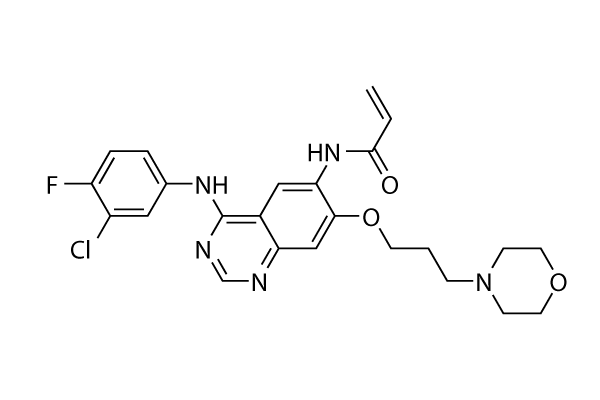
| DC8553 | Canertinib Featured |
Canertinib (CI-1033) is a pan-ErbB inhibitor for EGFR and ErbB2 with IC50 of 1.5 nM and 9.0 nM, no activity to PDGFR, FGFR, InsR, PKC, or CDK1/2/4. Phase 3. CI-1033 shows excellent potency for irreversible inhibition of erbB2 autophosphorylation in MDA-MB
More description
|
|
| DC49061 | ATR-IN-6 |
ATR-IN-6 is a potent inhibitor of ATR. ATR is a class of protein kinases involved in genome stability and DNA damage repair, and is a member of the PIKK family. ATR-IN-6 has the potential for the research of ATR kinase-mediated diseases such as proliferative diseases and cancer (extracted from patent WO2021233376A1, compound A22).
More description
|

|
| DC49052 | OM-153 |
OM-153 is a potent tankyrase inhibitor with IC50s of 13 and 2 nM for tankyrase 1 and tankyrase 2, respectively. OM-153 shows inhibition of WNT/β-catenin signaling and proliferation in COLO 320DM.
More description
|
|
| DC49034 | CDK9-IN-13 |
CDK9-IN-13 (compound 38) is potent and selective CDK9 inhibitor, with an IC50 of <3 nM. CDK9-IN-13 exhibits short half-lives in rodents.
More description
|
|
| DC49031 | ATR-IN-5 |
ATR-IN-5 is a potent inhibitor of ATR. ATR is a class of protein kinases involved in genome stability and DNA damage repair, and is a member of the PIKK family. ATR-IN-5 has the potential for the research of ATR kinase-mediated diseases such as proliferative diseases and cancer (extracted from patent CN112047938A, compound D24).
More description
|
|
| DC49019 | ATR-IN-10 |
ATR-IN-10 is a potent and highly selective inhibitor of ataxia telangiectasia mutated and Rad3-Related (ATR) kinase with an IC50 value of 2.978 μM.
More description
|
|
| DC48977 | CDK6/PIM1-IN-1 |
CDK6/PIM1-IN-1 is a potent and balanced dual CDK6/PIM1 inhibitor with IC50 values of 39 and 88 nM, respectively. CDK6/PIM1-IN-1 inhibits CDK4 (IC50=3.6 nM). CDK6/PIM1-IN-1 significantly inhibits acute myeloid leukemia (AML) cell proliferation, arrest cell cycle at the G1 phase, and promote cell apoptosis. CDK6/PIM1-IN-1 exhibits potent anti-AML activity.
More description
|
|
| DC48974 | SKLB-197 |
SKLB-197 showed an IC50 value of 0.013 μM against ATR but very weak or no activity against other 402 protein kinases. It displayed potent antitumor activity against ATM-deficent tumors both in vitro and in vivo.
More description
|
|
| DC48973 | CPT-Se4 |
CPT-Se4, a selenoprodrug of Camptothecin (CPT), shows improved potency in killing cancer cells and inhibiting tumor growth. CPT-Se4 decreases the GSH/GSSG ratio and total thiols, elevates the ROS level in Hep G2 cells, and eventually induces apoptosis of cancer cells. CPT-Se4 shows cytotoxicity against HeLa, Hep G2, A549, and SMMC-7721 cells (IC50= 2.54-6.4 μM).
More description
|
|
| DC48969 | OM-1700 |
OM-1700 is a potent tankyrase inhibitor with IC50s of 127 and 14 nM for tankyrase 1 and tankyrase 2, respectively. OM-1700 reduces cell growth in the colon cancer cell line COLO 320DM (GI50=650 nM).
More description
|
|
| DC48949 | PARP-1/2-IN-1 |
PARP-1/2-IN-1 is a potent PARP-1/2 inhibitor with IC50 of 0.51 nM and 23.11 nM, respectively.
More description
|
|
| DC48926 | CPT-Se3 |
CPT-Se3, a selenoprodrug of Camptothecin (CPT), shows improved potency in killing cancer cells and inhibiting tumor growth. CPT–Se3 decreases the GSH/GSSG ratio and total thiols, elevates the ROS level in Hep G2 cells, and eventually induces apoptosis of cancer cells. CPT-Se3 shows cytotoxicity against HeLa, Hep G2, A549, and SMMC-7721 cells (IC50= 2.19-4.7 μM).
More description
|
|
| DC48904 | ROCK2-IN-5 |
ROCK2-IN-5 (compound 1d) is a hybrid compound containing structural fragments of the Rho kinase inhibitor fasudil and the NRF2 inducers caffeic and ferulic acids. ROCK2-IN-5 has good multitarget profile and good tolerability. ROCK2-IN-5 has the potential for thr research of Amyotrophic lateral sclerosis (ALS) with a SOD1 mutation.
More description
|
|
| DC48827 | ATR-IN-7 |
ATR-IN-7 is a potent inhibitor of ATR. ATR is a class of protein kinases involved in genome stability and DNA damage repair, and is a member of the PIKK family. ATR-IN-7 has the potential for the research of ATR kinase-mediated diseases such as proliferative diseases and cancer (extracted from patent WO2021238999A1, compound 1).
More description
|
|
| DC48784 | E7016 |
E7016 (GPI 21016) is an orally available PARP inhibitor. E7016 can enhance tumor cell radiosensitivity in vitro and in vivo through the inhibition of DNA repair. E7016 acts as a potential anticancer agent.
More description
|
|
| DC48750 | DNA-PK-IN-7 |
DNA-PK-IN-7 is a potent DNA-PK inhibitor with an IC50 of 1 nM (WO2021104277A1, compound 5).
More description
|
|
| DC48599 | CK7 |
CK7, a Cdk2/9 inhibitor, can be used for the synthesis of Nek1 inhibitor BSc5231 and BSc5367.
More description
|
|
| DC48556 | NSC 107512 |
NSC 107512 is a potent inhibitor of cyclin-dependent kinase 9 (CDK9). NSC 107512 is a class of sangivamycin-like molecules (SLM). NSC 107512 inhibits growth and induces apoptosis of multiple myeloma tumors.
More description
|
|
| DC48437 | Methyl methanesulfonate |
Methyl methanesulfonate (MMS), a DNA alkylating agent, modifies both guanine (to 7-methylguanine) and adenine (to 3-methlyladenine) to cause base mispairing and replication blocks, respectively.
More description
|
|
| DC8517 | BS194 Featured |
BS-194 is a selective and potent CDK inhibitor, which inhibits CDK2, CDK1, CDK5, CDK7, and CDK9 with IC50 values of 3, 30, 30, 250, and 90 nM respectively.
More description
|

|
| DC9365 | MLN8054 Featured |
MLN8054 is a potent and selective inhibitor of Aurora A with IC50 of 4 nM; exhibits more than 40-fold selective for Aurora A than Aurora B.
More description
|

|
| DC9050 | Melphalan Featured |
Melphalan(Sarcolysin; L-PAM) is a chemotherapy drug belonging to the class of nitrogen mustard alkylating agents; attaches the alkyl group to the guanine base of DNA.
More description
|

|
| DC9366 | AMG 900 Featured |
AMG 900 is a potent and highly selective pan-Aurora kinases inhibitor for Aurora A/B/C with IC50 of 5 nM/4 nM /1 nM; >10-fold selective for Aurora kinases than p38α, Tyk2, JNK2, Met and Tie2.
More description
|

|
| DC9309 | AZD-0156 Featured |
AZD-0156 is an orally bioavailable ataxia telangiectasia mutated (ATM) kinase inhibitor, with potential chemo-/radio-sensitizing and antineoplastic activities.
More description
|

|
| DC10906 | AZ31 Featured |
AZ31 is a novel ATM inhibitor.
More description
|

|
| DC11706 | R-10015 Featured |
A potent, selective inhibitor of human LIMK1 with IC50 of 38 nM .
More description
|

|
