
 To enhance service speed and avoid tariff delays, we've opened a US warehouse. All US orders ship directly from our US facility.
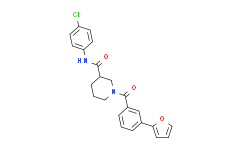



| Cas No.: | 1443437-74-8 |
| Chemical Name: | N-(4-Chlorophenyl)-1-(3-(furan-2-yl)benzoyl)piperidine-3-carboxamide |
| Synonyms: | CCG 203971;CCG-203971;N-(4-Chlorophenyl)-1-[3-(2-furanyl)benzoyl]-3-piperidinecarboxamide;N-(4-chlorophenyl)-1-(3-(furan-2-yl)benzoyl)piperidine-3-carboxamide;C23H21ClN2O3;compound 8a [PMID: 23707258];N-(4-chlorophenyl)-1-[3-(furan-2-yl)benzoyl]piperidine-3-carboxamide;CCG203971;GTPL6763;SYN5162;AOB2799;HERLZBNILRVHQN-UHFFFAOYSA-N;BCP20795;BDBM50436236;AK668175;B4921 |
| SMILES: | ClC1C([H])=C([H])C(=C([H])C=1[H])N([H])C(C1([H])C([H])([H])N(C(C2=C([H])C([H])=C([H])C(C3=C([H])C([H])=C([H])O3)=C2[H])=O)C([H])([H])C([H])([H])C1([H])[H])=O |
| Formula: | C23H21ClN2O3 |
| M.Wt: | 408.8774 |
| Sotrage: | 2 years -20°C Powder, 2 weeks 4°C in DMSO, 6 months -80°C in DMSO |
| Description: | CCG-203971 is a second-generation RhoA/myocardin-related transcription factor A (MRTF-A) inhibitor. CCG-203971 potently targets RhoA/C-activated serum response element (SRE)-luciferase (IC50=6.2 μM). |
| In Vivo: | CCG-203971 is tested in a Bleomycin skin injury model. Bleomycin is administered in 50 μL of DMSO intraperitoneally. Preliminary studies show that Bleomycin administered in this manner is well tolerated at 100 mg/kg twice a day. Intradermal Bleomycin for 2 weeks along with the DMSO control (50 μL i.p.) results in marked dermal thickening (P<0.0001) compared with the PBS+DMSO group, which does not receive Bleomycin. CCG-203971 treatment strongly and significantly (P<0.001) suppresses the Bleomycin-induced skin thickening in this model. Skin collagen amounts, assessed by measurement of hydroxyproline content, show similar results. Bleomycin injections promote collagen deposition (P<0.01) and CCG-203971 is able to block this effect (P<0.05)[2]. |
| In Vitro: | CCG-203971, a second-generation Ras homolog gene family, member A (RhoA)/myocardin-related transcription factor A (MRTF-A)/serum response factor (SRF) pathway inhibitor, represses both matrix-stiffness and transforming growth factor beta–mediated fibrogenesis as determined by protein and gene expression in a dose-dependent manner. CCG-203971 significantly represses TGF-β- induced MKL1 expression at 25 μM concentration[1]. Human dermal fibroblasts are plated onto 96-well plates and allowed to grow for 3 days in the presence of 30 μM CCG-203971 or DMSO vehicle. Viable cell density is assessed through enzymatic reduction of the water-soluble tetrazolium dye WST-1. Scleroderma dermal fibroblasts proliferate faster than normal cells, and this is inhibited by CCG-203971[2]. |