
 To enhance service speed and avoid tariff delays, we've opened a US warehouse. All US orders ship directly from our US facility.
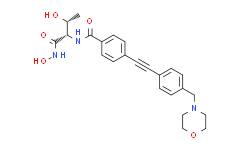



| Cas No.: | 728865-23-4 |
| Chemical Name: | CHIR-090 |
| Synonyms: | CHIR-090;CHIR 090;N-[(2S,3R)-3-hydroxy-1-(hydroxyamino)-1-oxobutan-2-yl]-4-[2-[4-(morpholin-4-ylmethyl)phenyl]ethynyl]benzamide;(2S,3R)-N-(2-hydroxy-1-hydroxycarbamoylpropyl)-4-(4-morpholin-4-ylmethylphenylethynyl)benzamide;C90;CHEBI:49528;CHEMBL260091;CS-0973;DB07536;HY-15460;N-{(1s,2r)-2-Hydroxy-1-[(Hydroxyamino)carbonyl]propyl}-4-{[4-(Morpholin-4-Ylmethyl)phenyl]ethynyl}benzamide;N-((2S,3R)-3-Hydroxy-1-(hydroxyamino)-1-oxobutan-2-yl)-4-((4-(morpholinomethyl)phenyl)ethynyl)benzamide;CHIR090;CHIR 090;CHIR090;BCP06103;3541AH;BDBM50200120 |
| SMILES: | O1C([H])([H])C([H])([H])N(C([H])([H])C2C([H])=C([H])C(C#CC3C([H])=C([H])C(=C([H])C=3[H])C(N([H])[C@]([H])(C(N([H])O[H])=O)[C@@]([H])(C([H])([H])[H])O[H])=O)=C([H])C=2[H])C([H])([H])C1([H])[H] |
| Formula: | C24H27N3O5 |
| M.Wt: | 437.4883 |
| Sotrage: | 2 years -20°C Powder, 2 weeks 4°C in DMSO, 6 months -80°C in DMSO |
| Description: | CHIR-090 is a potent, slow, tight-binding inhibitor of the LpxC deacetylase. It binds to E. coli LpxC with a Ki of 4.0 nM. |
| In Vivo: | CHIR-090 is a potent antibiotic against E. coli and inhibits E. coli LpxC activity in vitro in the low nM range. E. coli W3110 colonies resistant to 1 μg/mL CHIR-090 are not observed without prior chemical mutagenesis. A strain of E. coli W3110 is able to grow on LB agar plates containing 1 to 10 μg/mL CHIR-090, which is 4 to 40 times above the MIC of 0.25 μg/mL under our conditions for wild-type E. coli W3110. The doubling time of W3110RL is 40 min in the presence of 1 μg/mL CHIR-090, which is exactly the same rate as wild-type in the absence of inhibitor. Wild-type cells stopped growing after about 2 h in the presence of 1 μg/mL CHIR-090[1]. |
| In Vitro: | CHIR-090 is a potent, slow, tight-binding inhibitor of the LpxC deacetylase from the hyperthermophile Aquifex aeolicus, and it has excellent antibiotic activity against P. aeruginosa and E. coli, as judged by disk diffusion assays. CHIR-090 is also a two-step slow, tight-binding inhibitor of Escherichia coli LpxC with Ki=4 nM. CHIR-090 at low nM levels inhibits LpxC orthologues from diverse Gram-negative pathogens, including Pseudomonas aeruginosa, Neisseria meningitidis, and Helicobacter pylori. In contrast, CHIR-090 is a relatively weak competitive and conventional inhibitor (lacking slow, tight-binding kinetics) of LpxC from Rhizobium leguminosarum (Ki=340 nM), a Gram-negative plant endosymbiont that is resistant to this compound. An E. coli construct in which the chromosomal lpxC gene is replaced by R. leguminosarum lpxC is resistant to CHIR-090 up to 100 μg/mL, or 400 times above the minimal inhibitory concentration for wild-type E. coli. CHIR-090, a very potent, slow, tight-binding inhibitor of Aquifex aeolicus LpxC, the sequence of which is 31 % identical to E. coli LpxC. CHIR-090 has remarkable antibiotic activity against E. coli and P. aeruginosa, comparable to ciprofloxacin, as judged by disk diffusion assays[1]. |