
 To enhance service speed and avoid tariff delays, we've opened a US warehouse. All US orders ship directly from our US facility.
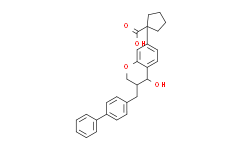



| Cas No.: | 158081-99-3 |
| Chemical Name: | Cyclopentanecarboxylicacid,1-[(3S,4R)-3-([1,1'-biphenyl]-4-ylmethyl)-3,4-dihydro-4-hydroxy-2H-1-benzopyran-7-yl]- |
| Synonyms: | Cyclopentanecarboxylicacid,1-[(3S,4R)-3-([1,1'-biphenyl]-4-ylmethyl)-3,4-dihydro-4-hydroxy-2H-1-benzopyran-7-yl]-;CP 105696;Cyclopentanecarboxylicacid, 1-[3-([1,1'-biphenyl]-4-ylmethyl)-3,4-dihydro-4-hydroxy-2H-1-benzopyran-7-yl]-,(3S-trans)-;Pfizer 105696;(+)-1-(3S,4R)-[3-(4-Phenylbenzyl)-4-hydroxychroman-7-yl]cyclopentane carboxylic acid;1-[(3S,4R)-3-([1,1′-Biphenyl]-4-ylmethyl)-3,4-dihydro-4-hydroxy-2H-1-benzopyran-7-yl]-cyclopentanecarboxylic acid;CP-105696;CP105696 |
| SMILES: | O=C(C1(C2=CC=C3[C@H](O)[C@@H](CC4=CC=C(C5=CC=CC=C5)C=C4)COC3=C2)CCCC1)O |
| Formula: | C28H28O4 |
| M.Wt: | 428.51952 |
| Purity: | >98% |
| Sotrage: | 2 years -20°C Powder, 2 weeks 4°C in DMSO, 6 months -80°C in DMSO |
| Description: | CP-105696 is a potent and selective Leukotriene B4 Receptor antagonist, with an IC50 of 8.42 nM. |
| In Vivo: | At a dose of 50 mg/kg/day (28 days), B10.BR (H2k) allografts transplanted into C57Bl/6 (H2b) recipients are significantly protected, as reflected by the mean survival time versus control grafts (27±20 days [n=10] vs. 12±6 days [n=14]; P=0.0146). Using an induction protocol (day -1 to day 3), CP-105696 at 100 mg/kg/day significantly prolongs allograft survival (33±23 days [n=9]; P=0.0026), but CP-105696 at 10 mg/kg/day does not (18±16 days [n=8]; P=0.1433). Syngeneic grafts survive indefinitely (n=11). Immunohistological evaluation of allografts at rejection reveals a mononuclear cell infiltrate composed primarily of CD3+ and CD11b+ (Mac-1+) cells, which are infrequent in syngeneic grafts. Allografts from mice treated with CP-105696 at 50 or 100 mg/kg/day demonstrat a selective reduction in β2-integrin (Mac-1) expression on monocytes/macrophages, as demonstrated by CD11b staining density compared with allograft controls[2]. |
| In Vitro: | CP-105696 is a structurally novel, selective and potent LTB4 receptor antagonist. In vitro, CP-105696 inhibits [3H]LTB4 (0.3 nM) binding to high-affinity LTB4 receptors on human neutrophils with an lC50 value of 8.42±0.26 nM. Scatchard analyses of [3H]LTB4 binding to these high-affinity receptors indicate that CP-105696 acts as a noncompetitive antagonist. CP-105696 inhibits human neutrophil chemotaxis mediated by LTB4 (5 nM) in a noncompetitive manner with an IC50 value of 5.0±2.0 nM. Scatchard analyses of [3H]LTB4 binding to low-affinity receptors on neutrophils indicate that CP-105696 acts as a competitive antagonist at this receptor, and inhibition of LTB4-mediated CD11b upregulation on human neutrophils is competitively inhibited by CP-105696 (pA2=8.03±0.19). CP-105696 at 10 μM does not inhibit either human neutrophil chemotaxis or CD11b upregulation mediated through alternate (i.e., C5a, lL-8, PAF) G-protein coupled chemotactic factor receptors. In isolated human monocytes, LTB4 (5 nM)-mediated Ca2+ mobilization is inhibited by CP-105696 with an lC50 value of 940±70 nM[1]. |
| Animal Administration: | Mice[2] Allogeneic donor hearts are harvested after intravenous heparinization of donor B10.BR mice (H2k) and are preserved via retrograde perfusion with cold cardioplegia solution into the left ventricle. Recipient C57Bl/6 mice (H2b) are prepared by ligating the lumbar vessels and isolating the abdominal aorta and vena cava; donor hearts are sutured in place by microvascular anastomoses of the donor aorta and pulmonary artery to the recipient aorta and inferior vena cava, respectively. CP-105696 is evaluated in a 28-day treatment protocol (50 mg/kg/day), a high-dose (100 mg/kg/day) induction protocol (day -1 to day 3), and a low-dose (10 mg/kg/day) induction protocol (day -1 to day 3). In all study groups, drug is administered orally in a 0.5% methylcellulose vehicle. In parallel studies, treatment of C57Bl/6 (H2b) recipients bearing B10.BR (H2k) cardiac allografts given FK506 (2 mg/kg/day for 28 days), our standard control immunosuppressant, significantly prolongs allograft survival (mean survival time [MST], 40±18 days [n=9]; P=0.0002)[2]. |
| References: | [1]. Showell HJ, et al. The in vitro and in vivo pharmacologic activity of the potent and selective leukotriene B4 receptor antagonist CP-105696. J Pharmacol Exp Ther. 1995 Apr;273(1):176-84. [2]. Weringer EJ, et al. Antagonizing leukotriene B4 receptors delays cardiac allograft rejection in mice. Transplantation. 1999 Mar 27;67(6):808-15. |