
 To enhance service speed and avoid tariff delays, we've opened a US warehouse. All US orders ship directly from our US facility.
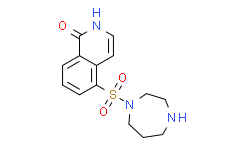



| Cas No.: | 105628-72-6 |
| Chemical Name: | 5-((1,4-Diazepan-1-yl)sulfonyl)isoquinolin-1(2H)-one |
| Synonyms: | 5-((1,4-Diazepan-1-yl)sulfonyl)isoquinolin-1(2H)-one;Hydroxyfasudil;1(2H)-Isoquinolinone,5-[(hexahydro-1H-1,4-diazepin-1-yl)sulfonyl]-;5-(1,4-diazepan-1-ylsulfonyl)-2H-isoquinolin-1-one;HA 1100 HYDROCHLORIDE;HA 1100;HA-1100;HFS;5-[(Hexahydro-1H-1,4-diazepin-1-yl)sulfonyl]-1(2H)-isoquinolinone |
| SMILES: | O=C1NC=CC2=C1C=CC=C2S(=O)(N3CCNCCC3)=O |
| Formula: | C14H17N3O3S |
| M.Wt: | 307.36808 |
| Purity: | >98% |
| Sotrage: | 2 years -20°C Powder, 2 weeks 4°C in DMSO, 6 months -80°C in DMSO |
| Description: | Hydroxyfasudil is a ROCK inhibitor, with IC50s of 0.73 and 0.72 μM for ROCK1 and ROCK2, respectively. |
| In Vivo: | Hydroxyfasudil (10 mg/kg, i.p.) significantly increases both the average and maximal voided volumes in SD rats. Hydroxyfasudil also significantly decreases the maximal detrusor pressure[2]. Hydroxyfasudil (3 mg/kg, i.p) inhibits hypercontractility induced by norepinephrine in spontaneously hypertensive rats (SHRs). Furthermore, Hydroxyfasudil (3, 10 mg/kg, i.p) significantly ameliorates decreased penile cGMP contents in rats[3]. |
| In Vitro: | Hydroxyfasudil is a ROCK inhibitor, with IC50s of 0.73 and 0.72 μM for ROCK1 and ROCK2, respectively. Hydroxyfasudil also less potently inhibits PKA, with an IC50 of 37 μM, 50-fold higher than those of the ROCKs. Hydroxyfasudil increases eNOS mRNA levels, with an EC50 value of 0.8 ± 0.3 μM. Hydroxyfasudil (0-100 μM) concentration-dependently increases eNOS activity and stimulates NO production in human aortic endothelial cells (HAEC). Hydroxyfasudil (10 μM) increases the half-life of eNOS mRNA from 13 to 16 hours, but does not affect eNOS promoter activity at concentrations from 0.1 to 100 μM[1]. |
| Animal Administration: | Micturition behavior is studied after intraperitoneal injection of either Hydroxyfasudil (10 mg/kg) or a corresponding volume of saline. Each rat is placed in a metabolic cage containing a urine collection funnel that is placed over an electronic balance. The balance is connected to a personal computer via a multiport controller and used to measure the cumulative weight of the collected urine. Every 150 s during a continuous 24-h period, the computer samples and records the data for the micturition frequency and volumes. The micturition reflex parameters that are collected includ: urine volume per micturition, maximal micturition volume, micturition frequency, and total urine output in the Hydroxyfasudil- or vehicle-treated animals. Each monitoring session started at 18.00 hours. Prior to being placed in the metabolic cage at the start of each experimental period, the animals receive either a single injection of Hydroxyfasudil (10 mg/kg) dissolved in saline or an injection of saline without the inhibitor[2]. |
| References: | [1]. Rikitake Y, et al. Inhibition of Rho kinase (ROCK) leads to increased cerebral blood flow and stroke protection. Stroke. 2005 Oct;36(10):2251-7. Epub 2005 Sep 1. [2]. Masago T, et al. Effect of the rho-kinase inhibitor hydroxyfasudil on bladder overactivity: an experimental rat model. Int J Urol. 2009 Oct;16(10):842-7. [3]. Saito M, et al. Hydroxyfasudil ameliorates penile dysfunction in the male spontaneously hypertensive rat. Pharmacol Res. 2012 Oct;66(4):325-31. |