
Alternate TextTo enhance service speed and avoid tariff delays, we've opened a US warehouse. All US orders ship directly from our US facility.
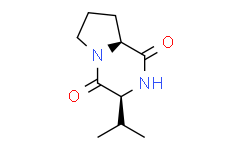

Cyclo(L-Pro-L-Val)

  Cat. No.:  DC26050   Featured
Chemical Structure
2854-40-2
For research use only. We do not sell to patients.
We match the best price and quality on market.
Email:order@dcchemicals.com  sales@dcchemicals.com
Tel:+86 21 58447131
We are official vendor of:
  • 20
  • 19
  • 18
  • 17
  • 16
  • 15
  • 14
  • 12
  • 11
  • 10
  • 9
  • 8
  • 13
  • 6
  • 5
  • 4
  • 3
  • 2
  • 1
More than 5000 active chemicals with high quality for research!
Field of application
Cyclo(L-Pro-L-Val) is a diketopiperazine that has been found in the marine sponge T. ignis, the bacterium B. pumilus, and the fungus A. fumigatus, among others.
Cas No.: 2854-40-2
Chemical Name: Pyrrolo[1,2-a]pyrazine-1,4-dione,hexahydro-3-(1-methylethyl)-, (3S,8aS)-
Synonyms: Pyrrolo[1,2-a]pyrazine-1,4-dione,hexahydro-3-(1-methylethyl)-, (3S,8aS)-;(3S,8aS)-3-propan-2-yl-2,3,6,7,8,8a-hexahydropyrrolo[1,2-a]pyrazine-1,4-dione;Cyclo(-Pro-Val);(3S,8aS)-3-Isopropylhexahydropyrrolo[1,2-a]pyrazine-1,4-dione;cyclo(-L-pro-L-val-);cyclo-(L-Val-L-Pro)
SMILES: CC([C@H]1C(N2CCC[C@H]2C(N1)=O)=O)C
Formula: C10N2O2H16
M.Wt: 196.2462
Purity: >98%
Sotrage: 2 years -20°C Powder, 2 weeks 4°C in DMSO, 6 months -80°C in DMSO
Description: Cyclo(L-Pro-L-Val) is a diketopiperazine that has been found in the marine sponge T. ignis, the bacterium B. pumilus, and the fungus A. fumigatus, among others.It is active against the bacteria S. aureus and B. subtilis (MICs = 16.3 and 18.2 µg/ml, respectively) but not E. coli (MIC = >20 µg/ml).Cyclo(L-Pro-L-Val) inhibits activation of a LuxR-dependent E. coli biosensor by the quorum-sensing molecule 3-oxo-hexanoyl-homoserine lactone (IC50 = 0.4 mM) and activates violacein pigment production in the LuxR-dependent C. violaceum acyl homoserine lactone reporter strain CV026.However, it does not activate or inhibit lacZ-based reporter fusions in S. liquefaciens or A. tumefaciens.
Cat. No. Product name Field of application
DC82301 IC-8 IC8 is an ionizable cationic lipid. It has been used in combination with other lipids for the formation of lipid nanoparticles (LNPs). Immunization with severe acute respiratory coronavirus 2 (SARS-CoV-2) spike glycoprotein mRNA in IC8- and manganese-containing LNPs induces IgG responses to SARS-CoV-2 Delta and Omicron variants in mice.1 Administration of mRNA encoding B7-H3 X CD3 bispecific T cell engaging (BiTE) antibodies in IC8-containing LNPs reduces tumor growth in MV4-11 and A375 mouse xenograft models.
DC75721 CL2A-SN38 (Govitecan) CL2A-SN38 is a SN38 derivative with a peptide-linker which can easily react with antibody to form an antibody-drug conjugate (ADC). CL2A-SN-38 is composed of a potent a DNA Topoisomerase I inhibitor SN-38 and a linker CL2A to make antibody drug conjugate (ADC). CL2A-SN-38 provides significant and specific antitumor effects against a range of human solid tumor types. CL2A is a noncleavable complicated PEG8- and triazole-containing PABC-peptide-mc linker. CL2A is cleavable through pH sensitivity, giving rise to bystander effect, and binds the antibody at a cysteine residue via a disulfide bond. .
DC47877 tri-GalNAc-COOH (acetylation) tri-GalNAc-COOH acetylation is the acetylated and modified form of tri-GalNAc-COOH. tri-GalNAc-COOH acetylation can be used for the synthesis of LYTAC.
DC46965 Tri-GalNAc-COOH tri-GalNAc-COOH is an asialoglycoprotein receptor (ASGPR) ligand that can be used for LYsosome TArgeting Chimera (LYTAC) research.
DC46471 RP101988 RP101988, the major active metabolite of Ozanimod, is a selective, potent S1PR1 (sphingosine-1-phosphate receptor 1) agonist, with EC50s of 0.19 nM and 32.8 nM for S1PR1 and S1PR5, respectivlely.
DC37901 PD-173212 PD-173212 is a small molecule N-type calcium channel blocker.
DC37333 N,N-Diethyl-p-toluamide N,N-Diethyl-p-toluamide is a mosquito repellent.
DC37321 AI3-15902 AI3-15902 is a biochemical.
DC37283 Methyl phenylcarbamate Methyl phenylcarbamate is a biochemical.
DC37252 Ampyrone Ampyrone is a metabolite of AMINOPYRINE with analgesic and anti-inflammatory properties. It is used as a reagent for biochemical reactions producing peroxides or phenols. Ampyrone stimulates LIVER MICROSOMES and is also used to measure extracellular water.
X