| DC60979 |
Ionizable lipid-3 (SM-102 analogue)
|
Ionizable lipid-3( SM-102 analogu) is a cationic lipid for nucleic acid delivery, with the ability to form lipid nanoparticle mRNA vaccines that exhibit in vitro stability and immunostimulatory activity.This SM-102 analogue retains the ionizable tertiary amine and asymmetric hydrophobic architecture while replacing the ester linkages with carbonate groups and repositioning the hydroxyl functionality. These modifications are designed to tune biodegradability, membrane interactions, and LNP delivery performance. |
| DC60978 |
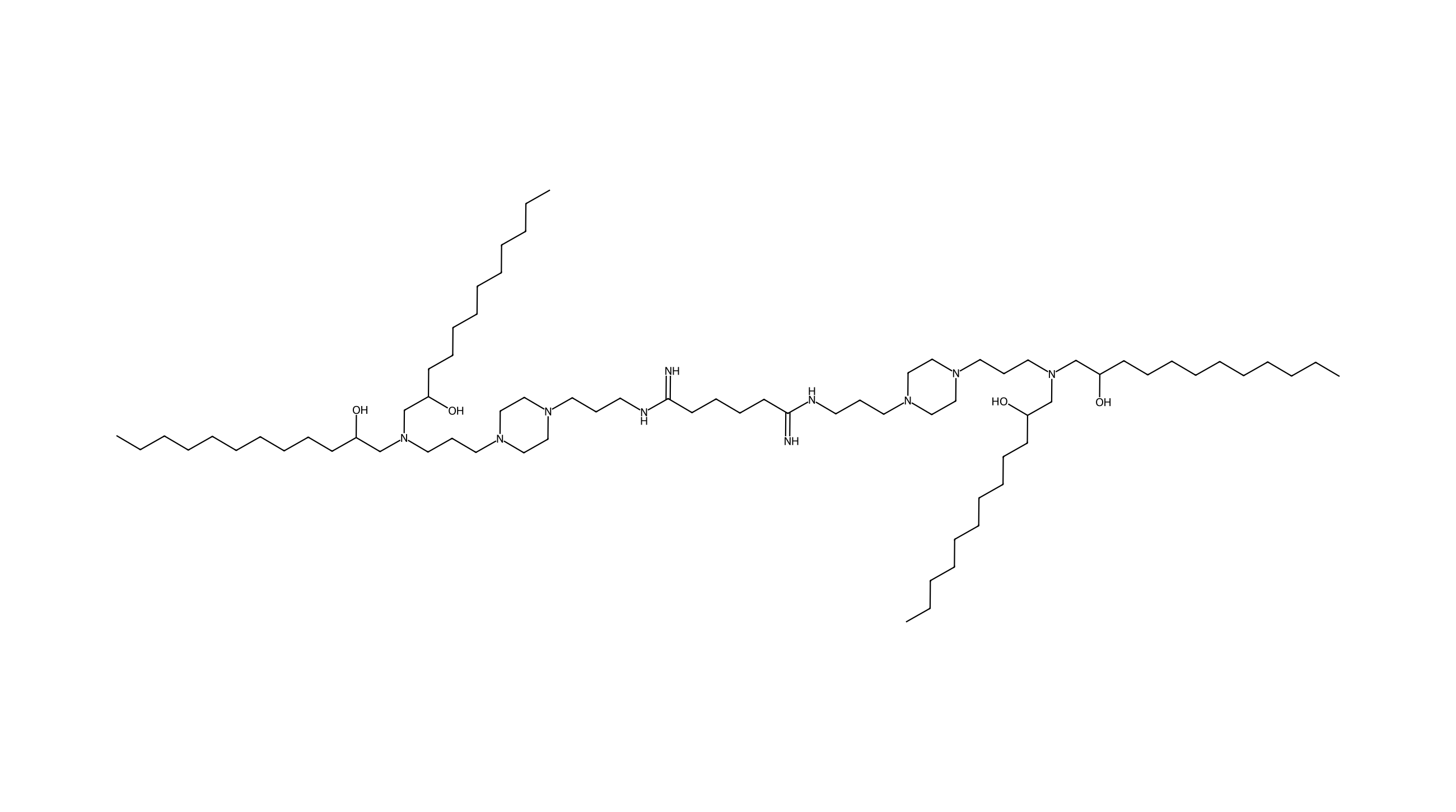
C12-2aN
|
C12-2aN is a crosslinked ionizable lipid developed for mRNA vaccine delivery and dendritic-cell metabolic reprogramming. Its structure combines two piperazine-based ionizable amine cores, a bis-amidine crosslinker, and four hydroxylated C12 hydrophobic tails. When formulated with DOPE, cholesterol, and C14-PEG2000, C12-2aN LNPs enhanced mRNA endosomal escape and activated AMPK–mTORC2-dependent glycolysis, supporting dendritic-cell maturation and antigen presentation. In preclinical mouse studies, C12-2aN LNPs generated robust humoral and cellular immune responses in SARS-CoV-2 RBD and OVA cancer-vaccine models. The formulation also demonstrated reduced liver-associated off-target expression and lower acute inflammatory markers than the tested control formulations. C12-2aN is a preclinical research lipid intended for evaluating metabolically active mRNA vaccine delivery systems. |
| DC60965 |
Ionizable lipid-2 (ALC-0315 analogue)
|
Ionizable lipid-2 is a cationic lipid for nucleic acid delivery, with the ability to form lipid nanoparticle mRNA vaccines that exhibit in vitro stability and immunostimulatory activity.This ALC-0315 analogue retains its ionizable tertiary amine, hydroxybutyl headgroup, and dual branched hydrophobic tails, while replacing the two ester linkages with carbonate groups. This modification may alter hydrolytic stability, biodegradability, membrane interactions, and overall LNP delivery performance. |
| DC60950 |
FL0445
|
FL0445 is a biodegradable, multi-branched ionizable lipid featuring an ionizable amine-containing headgroup together with ester and carbonate linkages. When formulated with DOPE, cholesterol, and a PEG lipid, FL0445-LNP enabled efficient delivery of both linear mRNA and structurally constrained capped circular RNA (Cap-cirRNA). In the reported study, the optimized formulation produced substantially higher in vitro protein expression than benchmark LNPs based on MC3, SM-102, or ALC-0315 and demonstrated functional nucleic-acid delivery following intravenous, intramuscular, and subcutaneous administration in mice. The platform was also evaluated for mRNA vaccination, ASO-mediated gene silencing, pDNA delivery, and GLP-1-encoding Cap-cirRNA. FL0445-LNP induced comparatively low inflammatory cytokine responses and showed favorable single-dose tolerability in the tested mouse models, supporting its further evaluation as a versatile preclinical delivery lipid for mRNA, circular RNA, and other nucleic-acid modalities. |
| DC67785 |
KC3-OA
|
KC3-OA, chemically known as 3-((S)-2,2-di((Z)-octadec-9-en-1-yl)-1,3-dioxolan-4-yl)-N,N-dimethylpropan-1-amine, is an ionizable cationic lipid (ICL) optimized for lipid nanoparticle (LNP) formulations in nucleic acid delivery, particularly for mRNA vaccines. It features a unique structure with mono-unsaturated alkyl chains (C18:1), which enhances oxidative stability compared to polyunsaturated analogs like KC3, while maintaining efficient membrane fusion and endosomal escape capabilities. In LNP compositions, KC3-OA is typically incorporated at 46–54 mol% of total lipids, with an N/P ratio of 4–6 relative to mRNA, ensuring high encapsulation efficiency and transfection potency.
Experimental data demonstrate that KC3-OA-based LNPs achieve superior mRNA expression in human dendritic cells, outperforming alternatives like KC3-PA or KC3-01 in both in vitro and in vivo models. For instance, in FIG. 2, KC3-OA LNPs showed ~2-fold higher mCherry expression at low mRNA doses (0.1 μg/mL) due to improved cellular uptake and reduced degradation. Its synergy with anionic phospholipids like DPPS (5 mol%) further enhances dendritic cell targeting via receptor-mediated internalization, leading to robust CD4+ and CD8+ T-cell responses against Mycobacterium tuberculosis antigens. This balance of stability, efficiency, and immunogenicity makes KC3-OA a leading candidate for next-generation vaccines. |
| DC67558 |
AMG1541
|
AMG-1541 is a degradable cyclic amino alcohol ionizable lipid optimized for mRNA vaccine delivery using lipid nanoparticles (LNPs). Formulated typically with DOPE, cholesterol, and PEG-lipids, AMG 1541 LNPs have a diameter of ~85 nm, PDI of 0.107, and encapsulation efficiency of 67%, ensuring stability and efficient mRNA delivery. In vitro, it outperforms benchmarks like SM-102, showing enhanced transfection in cells such as C2C12 and PBMCs. In vivo, intramuscular administration in mice results in robust protein expression within 6 hours and induces potent immune responses, including high antibody titers and Th1-biased T-cell activation, with minimal inflammation. Mechanistically, its β-hydroxyl groups form hydrogen bonds with mRNA phosphate backbones, facilitating endosomal escape. AMG1541 degrades rapidly under enzymatic conditions, reducing long-term toxicity, and is effective for vaccines targeting pathogens like influenza and SARS-CoV-2, making it a promising candidate for clinical applications. |
| DC80066 |
306Oi10
|
306Oi10 is a branched ionizable lipid that can be used to construct lipid nanoparticles (LNPs) for delivering messenger RNA. The surface ionization of lipid nanoparticles is related to the effectiveness of mRNA delivery. The tail of 306Oi10 has a one-carbon branch, which provides it with stronger surface ionization compared to lipids with linear tails, thereby enhancing its mRNA delivery efficacy. 306Oi10 can be used in research related to mRNA delivery. |

 To enhance service speed and avoid tariff delays, we've opened a US warehouse. All US orders ship directly from our US facility.