
Alternate TextTo enhance service speed and avoid tariff delays, we've opened a US warehouse. All US orders ship directly from our US facility.
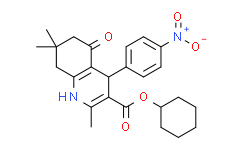

FLI-06

  Cat. No.:  DC7415   Featured
Chemical Structure
313967-18-9
For research use only. We do not sell to patients.
We match the best price and quality on market.
Email:order@dcchemicals.com  sales@dcchemicals.com
Tel:+86 21 58447131
We are official vendor of:
  • 20
  • 19
  • 18
  • 17
  • 16
  • 15
  • 14
  • 12
  • 11
  • 10
  • 9
  • 8
  • 13
  • 6
  • 5
  • 4
  • 3
  • 2
  • 1
More than 5000 active chemicals with high quality for research!
Field of application
FLI-06 is a novel potent and selective small molecule intercepting Notch signaling and the early secretory pathway (EC50 ~2.3 μM).
Cas No.: 313967-18-9
Chemical Name: FLI 06
Synonyms: FLI 06;FLI-06;3-​Quinolinecarboxylic acid, 1,​4,​5,​6,​7,​8-​hexahydro-​2,​7,​7-​trimethyl-​4-​(4-​nitrophenyl)​-​5-​oxo-​, cyclohexyl ester;Fli-06?;1,4,5,6,7,8-Hexahydro-2,7,7-trimethyl-4-(4-nitrophenyl)-5-oxo-3-quinolinecarboxylic acid cyclohexyl ester
SMILES: O=C(C1=C(C)NC2=C(C(CC(C)(C)C2)=O)C1C3=CC=C([N+]([O-])=O)C=C3)OC4CCCCC4
Formula: C25H30N2O5
M.Wt: 438.516107082367
Purity: >98%
Sotrage: 2 years -20°C Powder, 2 weeks 4°C in DMSO, 6 months -80°C in DMSO
Description: FLI-06 is an inhibitor of Notch signaling with an EC50 of 2.3 μM.
In Vitro: FLI-06, disrupted the Golgi apparatus in a manner distinct from that of brefeldin A and golgicide A. FLI-06 inhibited general secretion at a step before exit from the endoplasmic reticulum. In FLI-06–treated cells, no APPCTF accumulates despite strongly reduced Aβ secretion, suggesting that it acts upstream of α-secretase and β-secretase cleavage. FLI-06 is a very useful chemical probe to study the inhibition of membrane traffic at pre- ER-exit site (ERES) stages without fusion of ER-Golgi[1].
Kinase Assay: EC50 values of the test compounds are calculated from serial dilution series ranging from 200 to 0.1 μM. Cells are seeded in 96-well plates at a density of 5,000 cells per well in 100 μL medium. The next day, 100 μL medium containing each test compound is added. Cells are incubated for 16 h, fixed and processed for automated microscopy. EC50 estimates are calculated using four-parameter log-logistic fit with the package drc[1].
References: [1]. Kramer A, et al. Small molecules intercept Notch signaling and the early secretory pathway. Nat Chem Biol. 2013 Nov;9(11):731-8.
Cat. No. Product name Field of application
DC75721 CL2A-SN38 (Govitecan) CL2A-SN38 is a SN38 derivative with a peptide-linker which can easily react with antibody to form an antibody-drug conjugate (ADC). CL2A-SN-38 is composed of a potent a DNA Topoisomerase I inhibitor SN-38 and a linker CL2A to make antibody drug conjugate (ADC). CL2A-SN-38 provides significant and specific antitumor effects against a range of human solid tumor types. CL2A is a noncleavable complicated PEG8- and triazole-containing PABC-peptide-mc linker. CL2A is cleavable through pH sensitivity, giving rise to bystander effect, and binds the antibody at a cysteine residue via a disulfide bond. .
DC47877 tri-GalNAc-COOH (acetylation) tri-GalNAc-COOH acetylation is the acetylated and modified form of tri-GalNAc-COOH. tri-GalNAc-COOH acetylation can be used for the synthesis of LYTAC.
DC46965 Tri-GalNAc-COOH tri-GalNAc-COOH is an asialoglycoprotein receptor (ASGPR) ligand that can be used for LYsosome TArgeting Chimera (LYTAC) research.
DC46471 RP101988 RP101988, the major active metabolite of Ozanimod, is a selective, potent S1PR1 (sphingosine-1-phosphate receptor 1) agonist, with EC50s of 0.19 nM and 32.8 nM for S1PR1 and S1PR5, respectivlely.
DC37901 PD-173212 PD-173212 is a small molecule N-type calcium channel blocker.
DC37333 N,N-Diethyl-p-toluamide N,N-Diethyl-p-toluamide is a mosquito repellent.
DC37321 AI3-15902 AI3-15902 is a biochemical.
DC37283 Methyl phenylcarbamate Methyl phenylcarbamate is a biochemical.
DC37252 Ampyrone Ampyrone is a metabolite of AMINOPYRINE with analgesic and anti-inflammatory properties. It is used as a reagent for biochemical reactions producing peroxides or phenols. Ampyrone stimulates LIVER MICROSOMES and is also used to measure extracellular water.
DC37245 Piperonyl butoxide Piperonyl butoxide (PBO) is an organic compound used as a component of pesticide formulations. It is a waxy white solid. It is a synergist. That is, despite having no pesticidal activity of its own, it enhances the potency of certain pesticides such as carbamates, pyrethrins, pyrethroids, and rotenone.[1] It is a semisynthetic derivative of safrole.
X