
 To enhance service speed and avoid tariff delays, we've opened a US warehouse. All US orders ship directly from our US facility.
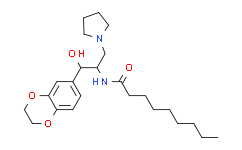



| Cas No.: | 491833-30-8 |
| Chemical Name: | Genz-123346 |
| Synonyms: | Genz-?123346;Genz-123346;N-((1R,2R)-1-(2,3-dihydrobenzo[b][1,4]dioxin-6-yl)-1-hydroxy-3-(pyrrolidin-1-yl)propan-2-yl)nonanamide;Genz-123346 (free base);N-[(1R,2R)-1-(2,3-Dihydrobenzo[b][1,4]dioxin-6-yl)-1-hydroxy-3-(pyrrolidin-1-yl)propan-2-yl]nonanamide;N-[(1R,2R)-1-(2,3-dihydro-1,4-benzodioxin-6-yl)-1-hydroxy-3-pyrrolidin-1-ylpropan-2-yl]nonanamide;C24H38N2O4;AMY19512;3693AH;s6496;Genz-123346 free base |
| SMILES: | O([H])[C@]([H])(C1C([H])=C([H])C2=C(C=1[H])OC([H])([H])C([H])([H])O2)[C@@]([H])(C([H])([H])N1C([H])([H])C([H])([H])C([H])([H])C1([H])[H])N([H])C(C([H])([H])C([H])([H])C([H])([H])C([H])([H])C([H])([H])C([H])([H])C([H])([H])C([H])([H])[H])=O |
| Formula: | C24H38N2O4 |
| M.Wt: | 418.5695 |
| Purity: | >98% |
| Sotrage: | 2 years -20°C Powder, 2 weeks 4°C in DMSO, 6 months -80°C in DMSO |
| Description: | Genz-123346 (free base) is an inhibitor of GL1 synthase that blocks the conversion of ceramide to GL1; inhibits GM1 with IC50 value of 14 nM. |
| In Vivo: | In the Zucker diabetic fatty rat, Genz-123346 loared glucose and A1C levels and improved glucose tolerance. Drug treatment also prevented the loss of pancreatic beta-cell function and preserved the ability of the animals to secrete insulin. In the diet-induced obese mouse, treatment with Genz-123346 normalized A1C levels and improved glucose tolerance. The oral bioavailability of the drug is shown to be about 10% and 30% in mice and rats, respectively, with a half-life in plasma of 30–60 min[1]. Genz-123346 treatment results in a dose-dependent reduction of renal GlcCer and GM3 levels that translates into effective inhibition of cystic disease. A direct effect of Genz-123346 on the Akt-mTOR signaling pathway is observed, with reduced phosphorylation of Akt and ribosomal protein S6[4]. |
| In Vitro: | Exposure of cells to Genz-123346 and to other GCS inhibitors at nontoxic concentrations can enhance the killing of tumor cells by cytotoxic anti-cancer agents. Genz-123346 and a few other GCS inhibitors are substrates for multi-drug resistance efflux pumps such as P-gp (ABCB1, gP-170). In cell lines selected to over-express P-gp or which endogenously express P-gp, chemosensitization by Genz-123346 is primarily due to the effects on P-gp function[2]. Genz-123346(Genz) is an enhancer of autophagy flux[3]. |
| Animal Administration: | Rats: Genz-123346 is dissolved in water. Zucker diabetic fatty rats treated with Genz-123346 (75 mg/kg) for 6 weeks are fasted overnight. The following morning, the fasted rats are anesthetized and injected with 5 units human insulin into the hepatic portal vein. Quadriceps muscle and liver are harvested 2 min after injection and immediately frozen in liquid nitrogen. Insulin receptor is immunoprecipitated. The immunoprecipitates are analyzed by immunoblotting[1]. Mice: C57BL/6 mice are fed on a high-fat (45% of kcal) diet for 8 weeks, obese mice with comparable body weight gain, glucose, and insulin levels are assigned to either the treated or control groups. The mice are then gavaged daily with Genz-123346 or water for 10 weeks[1]. |
| References: | [1]. Zhao H, et al. Inhibiting glycosphingolipid synthesis improves glycemic control and insulin sensitivity in animal models of type 2 diabetes. Diabetes. 2007 May;56(5):1210-8. [2]. Chai L, et al. The chemosensitizing activity of inhibitors of glucosylceramide synthase is mediated primarily through modulation of P-gp function. Int J Oncol. 2011 Mar;38(3):701-11. [3]. Shen W, et al. Inhibition of glucosylceramide synthase stimulates autophagy flux in neurons. J Neurochem. 2014 Jun;129(5):884-94 [4]. Natoli TA, et al. Inhibition of glucosylceramide accumulation results in effective blockade of polycystic kidney disease in mouse models. Nat Med. 2010 Jul;16(7):788-92 |