
 To enhance service speed and avoid tariff delays, we've opened a US warehouse. All US orders ship directly from our US facility.
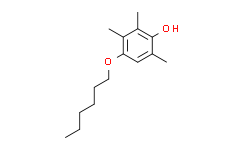



| Cas No.: | 148081-72-5 |
| Chemical Name: | 1-O-Hexyl-2,3,5-trimethylhydroquinone |
| Synonyms: | Phenol,4-(hexyloxy)-2,3,6-trimethyl-;1-O-Hexyl-2,3,5-trimethylhydroquinone;1-O-n-hexyl-2,3,5-trimethylhydroquinone;3-Hydroxy-6-hexyloxy-1.2.4-trimethyl-benzol;4-Hexyloxy-2,3,6-trimethyl-phenol;DSSTox_CID_697;HTHQ;HTHQ-2,3,5;HX-1171;4-Hexyloxy-2,3,6-triMethylphenol;4-(Hexyloxy)-2,3,6-triMethyl-phenol;4-(Hexyloxy)-2,3,6-trimethylphenol;HX 1171;Phenol, 4-(hexyloxy)-2,3,6-trimethyl-;70BK60I8RP;C15H24O2;4-hexoxy-2,3,6-trimethylphenol;DSSTox_RID_75742;DSSTox_GSID_20697;BCP19301;Tox21_301245;DB1216 |
| SMILES: | O(C1C([H])=C(C([H])([H])[H])C(=C(C([H])([H])[H])C=1C([H])([H])[H])O[H])C([H])([H])C([H])([H])C([H])([H])C([H])([H])C([H])([H])C([H])([H])[H] |
| Formula: | C15H24O2 |
| M.Wt: | 236.3499 |
| Purity: | >98% |
| Sotrage: | 4°C for 1 year, -20°C for more than 2 years |
| Description: | HTHQ, which is a hydroquinone monoalkyl ether, is a potent anti-oxidative agent, even at low dose levels.HTHQ is found to be a potent anti-lipid-peroxidative compound and its antioxidation activity to be extremely elevated in biological systems, such as that of liver microsomes via the generation of stable free radicals. In vitro: HTHQ exhibits a similar anti-oxidative activity to that of D,L-alpha-tocopherol against lipid peroxidation in linolate micelles initiated by addition of Fe2+. HTHQ exhibits approximately 4.8-fold higher anti-lipid-peroxidation activity than that of D,L-alpha-tocopherol against the peroxidation in phosphatidylcholine liposomes initiated by addition of Fe2+. [1] up to 0.125% HTHQ significantly reduced the effects of 0.02% Glu-P-1 or 0.03% MeIQx on the number and area of foci. [2]In vivo: Treatment with HTHQ potently inhibits PhIP-induced mammary carcinogenesis in female rats without prior initiation treatment. . HTHQ administration shows reduced mRNA level of PDGF (Plateletderived growth factor) , α-SMA (α-smooth muscle actin) and TGF-β (transforming growth factor-β) than DMN-induced hepetic fibrosis animals in the liver tissue. In this study, we showed that HTHQ improves against DMN-induced liver fibrosis in male SD rats.[3] |
| References: | [1]. Hino T et al. HTHQ (1-O-hexyl-2,3,5-trimethylhydroquinone), an anti-lipid-peroxidative compound: its chemical and biochemical characterizations. Biochim Biophys Acta. 1998 Sep 16;1425(1):47-60. [2]. Hirose M et al. Inhibitory effects of 1-O-hexyl-2,3,5-trimethylhydroquinone (HTHQ), green tea catechins and other antioxidants on 2-amino-6-methyldipyrido[1,2-a:3',2'-d]imidazole (Glu-P-1)-induced rat hepatocarcinogenesis and dose-dependent inhibition by HTHQ of lesion induction by Glu-P-1 or 2-amino-3,8-dimethylimidazo[4,5-f]quinoxaline (MeIQx). Carcinogenesis. 1995 Dec;16(12):3049-55. [3]. Jung YR et al. Inhibitory Effect of 1-O-Hexyl-2,3,5-Trimethylhydroquinone on Dimethylnitrosamine-induced Liver Fibrosis in Male SD Rats. Toxicol Res. 2010 Sep;26(3):193-201. |