
 To enhance service speed and avoid tariff delays, we've opened a US warehouse. All US orders ship directly from our US facility.
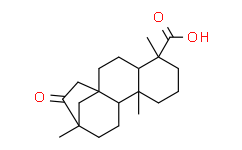



| Cas No.: | 27975-19-5 |
| Chemical Name: | Isosteviol |
| Synonyms: | isosteviol;17-NORKAURAN-18-OIC ACID, 13-METHYL-16-OXO-, (4-ALPHA,8-BETA,13-BETA)-;(4-alpha,8-beta,13-beta)-13-methyl-16-oxo-17-norkauran-18-oicacid;13-beta-kauran-18-oicacid,13-methyl-16-oxo-17-nor-8-bet;13-methyl-16-oxo-,(4-alpha,8-beta,13-beta)-17-norkauran-18-oicaci;ISOSTEVIOL STANDARD;(4aα,11aα)-4,9,11bβ-Trimethyl-8-oxo-6aα,9α-methanotetradecahydro-1H-cyclohepta[a]naphthalene-4β-carboxylic acid;(8β,13S)-13-Methyl-16-oxo-17-norkauran-18-oic acid;ISOSTEVIOL(P) PrintBack;ISOSTEVIOL(RG) PrintBack;(-)-Isosteviol;(?)-Isosteviol;16-oxobeyeran-19-oic acid;16-oxo-ent-beyeran-19-oic acid;ent-16-ketobeyeran-19-oic acid;ent-16-oxobeyeran-19-oic acid;Iso-Steviol;(−)-Isosteviol;(4α,8β,13β)-13--Methyl-16-oxo-17-norkauran-18-oic acid;Ketoisostevic acid;NSC 231875;(4α,8β,13β)-13-Methyl-16-oxo-17-norkauran-18-oic Acid;091QB7QO95;(-)-Isosteviol;iso-Steviol;s3905;STL566083;NSC731915;3749AH |
| SMILES: | O=C1C([H])([H])[C@]23C([H])([H])C([H])([H])[C@]4([H])[C@@](C(=O)O[H])(C([H])([H])[H])C([H])([H])C([H])([H])C([H])([H])[C@@]4(C([H])([H])[H])[C@]2([H])C([H])([H])C([H])([H])[C@@]1(C([H])([H])[H])C3([H])[H] |
| Formula: | C20H30O3 |
| M.Wt: | 318.4504 |
| Purity: | >98% |
| Sotrage: | 2 years -20°C Powder, 2 weeks 4°C in DMSO, 6 months -80°C in DMSO |
| Description: | Isosteviol is a derivative of stevioside, a constituent of Stevia rebaudiana, which is commonly used as a noncaloric sugar substitute in Japan and Brazil.Target:Isosteviol dose-dependently relaxed the vasopressin (10-8 M)-induced vasoconstriction in isolated aortic rings with or without endothelium. However, in the presence of potassium chloride (3×10⁻² M), the vasodilator effect of isosteviol on arterial strips disappeared. Only the inhibitors specific for the ATP-sensitive potassium (KATP) channel or small conductance calcium-activated potassium (SKCa) channel inhibited the vasodilator effect of isosteviol in isolated aortic rings contracted with 10-8 M vasopressin [1]. The attenuation by isosteviol of the vasopressin- and phenylephrine-induced increase in [Ca (2+)]i was inhibited by glibenclamide, apamin and 4-aminopyridine but not by charybdotoxin. Furthermore, the inhibitory action of isosteviol on [Ca (2+)]i was blocked when A7r5 cells co-treated with glibenclamide and apamin in conjunction with 4-aminopyridine were present [2]. Isosteviol (1-100 micromol/l) inhibits angiotensin-II-induced DNA synthesis and endothelin-1 secretion. Measurements of 2'7'-dichlorofluorescin diacetate, a redox-sensitive fluorescent dye, showed an isosteviol-mediated inhibition of intracellular reactive oxygen species generated by the effects of angiotensin II [3]. |
| References: | [1]. Wong KL, et al. Isosteviol acts on potassium channels to relax isolated aortic strips of Wistar rat. Life Sci. 2004 Mar 26;74(19):2379-87. [2]. Wong KL, et al. Isosteviol as a potassium channel opener to lower intracellular calcium concentrations in cultured aortic smooth muscle cells. Planta Med. 2004 Feb;70(2):108-12. [3]. Wong KL, et al. Antiproliferative effect of isosteviol on angiotensin-II-treated rat aortic smooth muscle cells. Pharmacology. 2006;76(4):163-9. |