
Alternate TextTo enhance service speed and avoid tariff delays, we've opened a US warehouse. All US orders ship directly from our US facility.
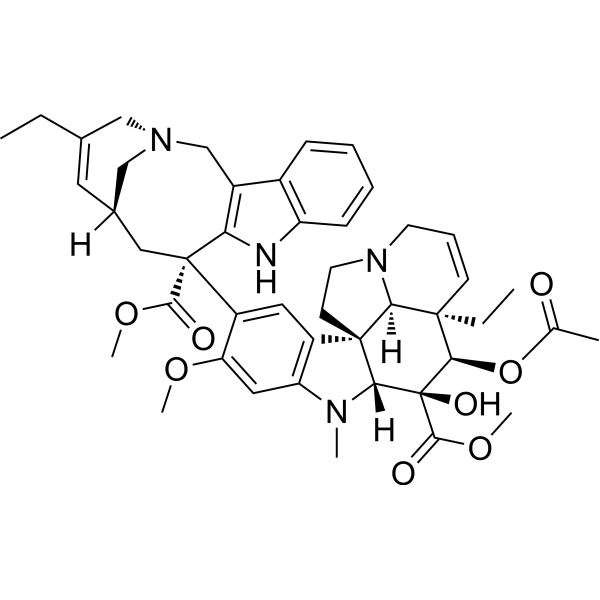

Vinorelbine

  Cat. No.:  DC23075   Featured
Chemical Structure
71486-22-1
For research use only. We do not sell to patients.
We match the best price and quality on market.
Email:order@dcchemicals.com  sales@dcchemicals.com
Tel:+86 21 58447131
We are official vendor of:
  • 20
  • 19
  • 18
  • 17
  • 16
  • 15
  • 14
  • 12
  • 11
  • 10
  • 9
  • 8
  • 13
  • 6
  • 5
  • 4
  • 3
  • 2
  • 1
More than 5000 active chemicals with high quality for research!
Field of application
Vinorelbine is a semi-synthetic Vinca alkaloid which is currently used in treatment of different cancer types mainly advanced breast cancer (ABC) and advanced/metastatic non-small cell lung cancer (NSCLC). Vinorelbine-loaded SSM can be developed as a new,
Cas No.: 71486-22-1
Chemical Name: Vinorelbine
SMILES: CCC1=C[C@@](C[N@@]2C1)([H])C[C@@](C3=C(OC)C=C(N(C)[C@]4([H])[C@@]56[C@]7([H])[C@](C=CCN7CC6)(CC)[C@@H](OC(C)=O)[C@@]4(C(OC)=O)O)C5=C3)(C(OC)=O)C8=C(C2)C9=CC=CC=C9N8
Formula: C45H54N4O8
M.Wt: 778.94
Purity: >98%
Sotrage: 4°C for 1 year, -20°C for more than 2 years
Description: Vinorelbine is an anti-mitotic agent which inhibits the proliferation of Hela cells with IC50 of 1.25 nM.
In Vivo: After vinorelbine treatment, the first neutropenicepisode occurred after the first (4 dogs), second (1), or sixth(1) vinorelbine treatment in the dogs[3]. Vinorelbine is tolerated at a weekly interval in tumor-bearing cats, with an MTD of 11.5 mg/m2[4].
In Vitro: Vinorelbine (0.5-5 nM) inhibits cell proliferation by 50% (IC50) at concentrations of 1.25 nM. At concentration of 8 nM vinorelbine, no cells are in anaphase[1]. Vinorelbine time-dependently induces the p53 and p21WAFI/CIP1 expression in androgen-dependent (AD) and- independent (AI) prostate cancer cell lines. Vinorelbine stimulates reporter genes in a concentration-dependent manner[2].
Animal Administration: As defined by the study, VRL1 is diluted in 0.9% NaCl to a concentration of 1.5 mg/mL, and given IV over 5 minutes. The intended treatment interval is 7 days for up to 4 treatments. After receiving 4 weekly doses, cats are eligible to continue VRL treatment every 2 weeks at the owner's expense.
References: [1]. Ngan VK, et al. Mechanism of mitotic block and inhibition of cell proliferation by the semisynthetic Vinca alkaloids vinorelbine and its newer derivative vinflunine. Mol Pharmacol. 2001 Jul;60(1):225-32. [2]. Liu XM, et al. Unique induction of p21(WAF1/CIP1)expression by vinorelbine in androgen-independent prostate cancer cells. Br J Cancer. 2003 Oct 20;89(8):1566-73. [3]. Poirier VJ, et al. Toxicity, dosage, and efficacy of vinorelbine (Navelbine) in dogs with spontaneous neoplasia. J Vet Intern Med. 2004 Jul-Aug;18(4):536-9. [4]. Pierro JA, et al. Phase I clinical trial of vinorelbine in tumor-bearing cats. J Vet Intern Med. 2013 Jul-Aug;27(4):943-8.
Cat. No. Product name Field of application
DC82301 IC-8 IC8 is an ionizable cationic lipid. It has been used in combination with other lipids for the formation of lipid nanoparticles (LNPs). Immunization with severe acute respiratory coronavirus 2 (SARS-CoV-2) spike glycoprotein mRNA in IC8- and manganese-containing LNPs induces IgG responses to SARS-CoV-2 Delta and Omicron variants in mice.1 Administration of mRNA encoding B7-H3 X CD3 bispecific T cell engaging (BiTE) antibodies in IC8-containing LNPs reduces tumor growth in MV4-11 and A375 mouse xenograft models.
DC75721 CL2A-SN38 (Govitecan) CL2A-SN38 is a SN38 derivative with a peptide-linker which can easily react with antibody to form an antibody-drug conjugate (ADC). CL2A-SN-38 is composed of a potent a DNA Topoisomerase I inhibitor SN-38 and a linker CL2A to make antibody drug conjugate (ADC). CL2A-SN-38 provides significant and specific antitumor effects against a range of human solid tumor types. CL2A is a noncleavable complicated PEG8- and triazole-containing PABC-peptide-mc linker. CL2A is cleavable through pH sensitivity, giving rise to bystander effect, and binds the antibody at a cysteine residue via a disulfide bond. .
DC47877 tri-GalNAc-COOH (acetylation) tri-GalNAc-COOH acetylation is the acetylated and modified form of tri-GalNAc-COOH. tri-GalNAc-COOH acetylation can be used for the synthesis of LYTAC.
DC46965 Tri-GalNAc-COOH tri-GalNAc-COOH is an asialoglycoprotein receptor (ASGPR) ligand that can be used for LYsosome TArgeting Chimera (LYTAC) research.
DC46471 RP101988 RP101988, the major active metabolite of Ozanimod, is a selective, potent S1PR1 (sphingosine-1-phosphate receptor 1) agonist, with EC50s of 0.19 nM and 32.8 nM for S1PR1 and S1PR5, respectivlely.
DC37901 PD-173212 PD-173212 is a small molecule N-type calcium channel blocker.
DC37333 N,N-Diethyl-p-toluamide N,N-Diethyl-p-toluamide is a mosquito repellent.
DC37321 AI3-15902 AI3-15902 is a biochemical.
DC37283 Methyl phenylcarbamate Methyl phenylcarbamate is a biochemical.
DC37252 Ampyrone Ampyrone is a metabolite of AMINOPYRINE with analgesic and anti-inflammatory properties. It is used as a reagent for biochemical reactions producing peroxides or phenols. Ampyrone stimulates LIVER MICROSOMES and is also used to measure extracellular water.
X