
 To enhance service speed and avoid tariff delays, we've opened a US warehouse. All US orders ship directly from our US facility.
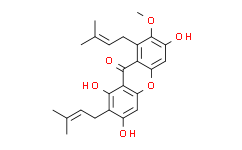



| Cas No.: | 6147-11-1 |
| Chemical Name: | alpha-Mangostin |
| Synonyms: | 1,3,6-Trihydroxy-7-methoxy-2,8-bis(3-methylbut-2-en-1-yl)-9H-xanthen-9-one;1,3,6-Trihydroxy-7-methoxy-2,8-bis(3-methyl-2-butenyl)-9H-xanthen-9-one;1,3,6-TRIHYDROXY-7-METHOXY-2,8-DI(3-METHYL-2-BUTENYL)XANTHONE;Mangosteen;MANGOSTINE;Momordica Fruit P.E.;Fructus Monordicae extract;1,3,6-Trihydroxy-7-methoxy-2,8-bis(3,3-dimethylallyl)xanthone;Mangostin, α-;alpha-Mangostin;Mangostin;MANGOSTIN, ALPHA-(P)(REQUEST QUOTE) PrintBack;Mangostin, a-Mangostin;α-Mangostin;1,3,6-trihydroxy-7-methoxy-2,8-bis(3-methylbut-2-enyl)xanthen-9-one;[ "" ];NSC30552;NSC27593;U6RIV93RU1;GNRIZKKCNOBBMO-UHFFFAOYSA-N;1,3,6-trihydroxy-7-methoxy-2,8-diprenylxanthone;TNP00140;AK105375;1,3,6-Trihy |
| SMILES: | O1C2C([H])=C(C(C([H])([H])/C(/[H])=C(\C([H])([H])[H])/C([H])([H])[H])=C(C=2C(C2=C1C([H])=C(C(=C2C([H])([H])/C(/[H])=C(\C([H])([H])[H])/C([H])([H])[H])OC([H])([H])[H])O[H])=O)O[H])O[H] |
| Formula: | C24H26O6 |
| M.Wt: | 410.4596 |
| Purity: | >98% |
| Sotrage: | 4°C for 1 year, -20°C for more than 2 years |
| Description: | Alpha-mangostin is a dietary xanthone with broad biological activities, such as antioxidant, anti-allergic, antiviral, antibacterial, anti-inflammatory and anticancer effects. It is an inhibitor of mutant IDH1 (IDH1-R132H) with a Ki of 2.85 μM. |
| Target: | IC50: 2.85 μM (IDH1-R132H)[1] |
| In Vivo: | Alpha-mangostin reduces risk of liver fibrosis through the decrease in p53 expression as compared to the TAA_DMSO treatment. The serum levels of the liver enzymes AST and ALT after treatment with α-mangostin decrease as compared to DMSO alone[4]. |
| In Vitro: | Alpha-mangostin exhibits a selective inhibitory effect on IDH1-R132H, but not on IDH1. Alpha-mangostin competitively inhibits the binding of alpha-mangostin (α-KG) to IDH1-R132H. The structure–relationship study reveals that alpha-mangostin exhibits the strongest core inhibitor structure. Alpha-mangostin selectively promotes demethylation of 5-methylcytosine (5mC) and histone H3 trimethylated lysine residues in IDH1 (+/R132H) MCF10A cells[1]. Cell proliferation significantly decreases in a dose-dependent manner in the cells treated with alpha-mangostin. Alpha-mangostin also increases the levels of Bax (pro-apoptotic), cleaved caspase-3, cleaved caspase-9 and cleaved-poly(ADP-ribose) polymerase (PARP)[2]. Alpha-mangostin significantly inhibits light-induced degeneration of photoreceptors and 200 μM H2O2-induced apoptosis of RPE cells. 200 μM H2O2-induced generation of reactive oxygen species (ROS) and light-induced generation of malondialdehyde (MDA) are suppressed by alpha-mangostin[3]. |
| Cell Assay: | IDH1+/+ and IDH1 MCF10A cells are grown in DMEM/F-12 media, supplemented with 5% horse serum, 20 ng/mL EGF, 0.5 μg/mL hydrocortisone, 10 μg/mL insulin. IDH1+/+ and IDH1 MCF10A cells are seeded in 6 well plates. After an exposure to 5 μM alpha-mangostin. cells are collected after indicated times and the viable cell number is calculated, using hemacytometer counting[1]. |
| Animal Administration: | Rats: Male Wistar rats are divided into 3 groups and treated with intraperitoneal injections of TAA (200 mg/kg). One subgroup is left untreated whereas the other two are treated either with 100 mg/kg alpha-mangostin or vehicle alone (80% DMSO, 20% water), which are administered intraperitoneally 3 times per weekfor a total of4 weeks. The incidence offibrotic nodules on the liver and the serum levels of the liver enzymes aspartate transaminase (AST) and alanine transaminase (ALT) are measured[4]. |
| References: | [1]. Kim HJ, et al. Discovery of α-mangostin as a novel competitive inhibitor against mutant isocitrate dehydrogenase-1. Bioorg Med Chem Lett. 2015 Dec 1;25(23):5625-31. [2]. Lee HN, et al. Antitumor and apoptosis-inducing effects of α-mangostin extracted from the pericarp of the mangosteen fruit (Garcinia mangostana L.) in YD-15 tongue mucoepidermoid carcinoma cells. Int J Mol Med. 2016 Apr;37(4):939-48. |