 To enhance service speed and avoid tariff delays, we've opened a US warehouse. All US orders ship directly from our US facility.
| Cat. No. | Product Name | Field of Application | Chemical Structure |
|---|---|---|---|
| DC71653 | BTR-1 |
BTR-1 induces cytotoxicity in a time- and concentration-dependent manner on leukemia cell line CEM. BTR-1 affects DNA replication by inducing a block at S phase and leads to activation of apoptosis to induce cell death.
More description
|

|
| DC71490 | CK156 |
CK156 is a highly selective death-associated protein kinase (DAPK) inhibitor with IC50s of 182 nM,34 μM, and 39 μM in the DRAK1 NanoBRET assay for DRAK1, CK2a1, and CK2a2, respectively. CK156 can be used for the research of autoimmune and inflammatory diseases.
More description
|
|
| DC71489 | Zoledronic acid disodium tetrahydrate |
Zoledronic Acid (Zoledronate) disodium tetrahydrate is a third-generation bisphosphonate (BP), with potent anti-resorptive activity. Zoledronic Acid disodium tetrahydrate inhibits the differentiation and apoptosis of osteoclasts. Zoledronic Acid disodium tetrahydrate also has anti-cancer effects.
More description
|
|
| DC71488 | BBR-BODIPY |
BBR-BODIPY is a fluorescent probe that allows screening its interaction with the targeted cells. BBR-BODIPY induces apoptosis and changes the expression of apoptosis-related proteins.
More description
|
|
| DC71296 | Desoxo-narchinol A |
Desoxo-narchinol A is an orally active and potent anti-inflammatory agent. Desoxo-narchinol A can be isolated from the roots and rhizomes of Nardostachys jatamansi. Desoxo-narchinol A can be used for septic shock and inflammatory diseases research.
More description
|
|
| DC71295 | UCB-5307 |
UCB-5307 is a TNF signaling inhibitor with a KD of 9 nM. UCB-5307 can penetrate the preformed hTNF/hTNFR1 complex.
More description
|
|
| DC71293 | NSC90616 |
NSC90616 is a mutant p53 rescue compound.
More description
|
|
| DC71292 | MMPSI |
MMPSI is a potent and selective small molecule caspase 3 and caspase 7 inhibitor with an IC50 of 1.7 μM for human caspase-3. MMPSI can significantly reduce ischemia-reperfusion-induced infarct size in the isolated rabbit heart, and reduce apoptosis in both the ischemic myocardium and isolated cardiomyocytes. MMPSI can be used for researching cardioprotection.
More description
|
|
| DC71291 | iMAC2 |
iMAC2 is a potent MAC inhibitor with an IC50 of 28 nM and an LD50 of 15000 nM. iMAC2 shows anti-apoptotic effect. iMAC2 blocks cytochrome c release.
More description
|
|
| DC71290 | CFM-4 |
CFM-4 is a potent small molecular antagonist of CARP-1/APC-2 binding. CFM-4 prevents CARP-1 binding with APC-2, causes G2M cell cycle arrest, and induces apoptosis with an IC50 range of 10-15 μM. CFM-4 also suppresses growth of drug-resistant human breast cancer cells.
More description
|
|
| DC71289 | Vin-C01 |
Vin-C01 is a potent pancreatic β-cells protective agent with an EC50 of 0.22 µM. Vin-C01 effectively promotes β-cell survival and protects β-cells from STZ-induced apoptosis. Vin-C01 can be used for type 2 diabetes mellitus research.
More description
|
|
| DC71288 | Vin-F03 |
Vin-F03 is a potent pancreatic β-cells protective agent with an EC50 of 0.27 µM. Vin-F03 effectively promotes β-cell survival and protects β-cells from STZ-induced apoptosis. Vin-F03 can be used for type 2 diabetes mellitus research.
More description
|
|
| DC71287 | (S)-Erypoegin K |
(S)-Erypoegin K is a potent anticancer agent. (S)-Erypoegin K shows potent anti-proliferative activity against HL-60 cells. (S)-Erypoegin K induces apoptosis.
More description
|
|
| DC71286 | Tripchlorolide |
Tripchlorolide is a neuroprotective agent that can be found in Tripterygium wilfordii. Tripchlorolide prevents tumor growth by inducing apoptosis and autophagy. Tripchlorolide improves cognitive deficits in Alzheimer's disease.
More description
|
|
| DC71285 | C6 Ceramide |
C6-ceramide, a ceramide pathway activator, shows activity against a variety of cancer cell lines. C6-ceramide can be used as an adjuvant for chemotherapeutic agents, to enhance anti-tumor effects.
More description
|
|
| DC71252 | Chol-CTPP |
Chol-CTPP is a ligand with dual targeting effect on blood-brain barrier (BBB) and glioma cells. Lip-CTPP can be gained by Chol-CTPP and another mitochondria targeting ligand (Chol-TPP). Lip-CTPP is a promising potential carrier to exert the anti-glioma effect of doxorubicin (DOX) and lonidamine (LND) collaboratively. Lip-CTPP elevates the inhibition rate of tumor cell proliferation, migration and invasion, promote apoptosis and necrosis, and interfere with mitochondrial function.
More description
|
|
| DC71225 | Lumichrome |
Lumichrome, a photodegradation product of Riboflavin, is an endogenous compound in humans. Lumichrome inhibits human lung cancer cell growth and induces apoptosis via a p53-dependent mechanism.
More description
|
|
| DC71167 | DMUP |
DMUP is a potent CD47-SIRPα axis inhibitor. DMUP induces apoptosis and increases the macrophage phagocytosis in A549 cells. DMUP decreases the expression of CD47 and SIRPα protein. DMUP shows antitumor activity.
More description
|
|
| DC71166 | YM281 |
YM281 is a potent EZH2 inhibitor. YM281 induces cell apoptosis and cell cycle arrest at the G0/G1 phase. YM281 shows antitumor effects in vivo. YM281 has the potential for the research of lymphoma.
More description
|
|
| DC71137 | AG6033 |
AG6033 is a potential novel CRBN modulator. AG6033 suppresses various tumor cells by modulating the interactions between CRBN and various antitumor target proteins. AG6033 can cause GSPT1 and IKZF1 degradation. AG6033 induces CRBN-dependent cytotoxic effect.
More description
|
|
| DC71076 | M24 |
M24 is a Mcl-1 selective inhibitor. M24 exhibits good binding affinity against Mcl-1 with Ki value of 0.33 μM. M24 exhibits good anti-proliferative activity and induce apoptosis in HepG2 cells.
More description
|
|
| DC71015 | Cardanol monoene |
Cardanol monoene (Cardanol C15:1) is a phenolic compound which can be found in cashew nut shell liquid. Cardanol monoene can induce mitochondria-associated apoptosis in human melanoma cells.
More description
|
|
| DC70951 | JMX0293 |
JMX0293 is an O-alkylamino-tethered salicylamide derivative compound. JMX0293 maintains good potency against MDA-MB-231 cell line (IC50 = 3.38 μM) while exhibiting very low toxicity against human non-tumorigenic breast epithelial cell line MCF-10A (IC50> 60 μM). JMX0293 inhibits STAT3 phosphorylation and contribute to apoptosis in TNBC MDA-MB-231 cells. JMX0293 significantly suppresses MDA-MB-231 xenograft tumor growth in vivo without significant toxicity.
More description
|
|
| DC9902 | PRIMA-1 Featured |
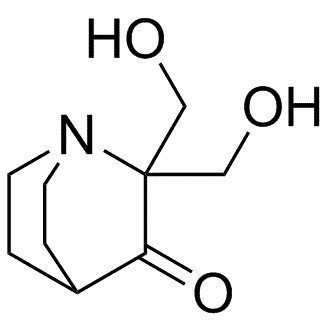
PRIMA-1 is a mutant p53 reactivator, restores the sensitivity of TP53 mutant-type thyroid cancer cells to the histone methylation inhibitor 3-Deazaneplanocin A.
More description
|
|
| DC8128 | Pyridoclax(MR29072) Featured |
Pyridoclax(MR-29072) is a potent Mcl-1 inhibitor with Kd value of 25 nM.
More description
|
.gif)
|
| DC9283 | Q-VD-Oph Featured |
Q-VD-Oph is a potent pan-caspase inhibitor with IC50 ranged from 25 to 400 nM for caspases 1,3,8, and 9.
More description
|

|
| DC8865 | RG-7112 Featured |
RG7112 (RO5045337) is an orally bioavailable and selective p53-MDM2 inhibitor.
More description
|

|
| DC8467 | RO8994 Featured |
RO8994 is a potent and selective spiroindolinone MDM2 inhibitor for cancer therapy.
More description
|

|
| DC10851 | PK11000 Featured |
PK11000 is an alkylating agent, and stabilizes the DNA-binding domain of both WT and mutant p53 by covalent cysteine modification, without compromising DNA binding.
More description
|

|
| DC70938 | ZJU-37 |
ZJU-37 is a novel small molecule, BBB penetrant RIPK1 kinase inhibitor (IC50=366.4 nM) with higher potency than Nec-1s, prevents TNFα-induced necroptosis of Jurkat FADD−/− cells with IC50 of 185.2 nM.ZJU-37 promotes oligodendrocyte progenitor cells (OPCs) proliferation in vitro with higher efficacy than Nec-1s, enhances remyelination in vivo.ZJU-37 promotes transcription of PDGFRα and proliferation of OPCs via NF-κB.
More description
|
|
