To enhance service speed and avoid tariff delays, we've opened a US warehouse. All US orders ship directly from our US facility.
| Cat. No. | Product Name | Field of Application | Chemical Structure |
|---|---|---|---|
| DC40211 | H-Ile-Pro-Pro-OH hydrochloride Featured |
H-Ile-Pro-Pro-OH hydrochloride, a milk-derived peptide, inhibits angiotensin-converting enzyme (ACE) with an IC50 of 5 μM. Antihypertensive tripeptides.
More description
|

|
| DC42455 | Acetylene-linker-Val-Cit-PABC-MMAE Featured |
Acetylene-linker-Val-Cit-PABC-MMAE (LCB14-0602) consists the ADCs linker (Acetylene-linker-Val-Cit-PABC) and potent tubulin (MMAE). Acetylene-linker-Val-Cit-PABC-MMAE (LCB14-0602) is a drug-linker conjugate for ADC.
More description
|

|
| DC71950 | Ac-Lys-Val-Cit-PABC-MMAE Featured |
Ac-Lys-Val-Cit-PABC-MMAE is a drug-linker conjugate for ADC. Ac-Lys-Val-Cit-PABC-MMAE contains the ADC linker (peptide Ac-Lys-Val-Cit-PABC) and a potent tubulin polymerization inhibitor MMAE.
More description
|

|
| DC49346 | Bi-Mc-VC-PAB-MMAE Featured |
Bi-Mc-VC-PAB-MMAE consists ADCs linker (Fmoc-Val-Cit-PAB) and potent tubulin inhibitor (MMAE). Bi-Mc-VC-PAB-MMAE is a drug-linker conjugate for ADC.
More description
|

|
| DC47680 | PSMA-Val-Cit-PAB-MMAE Featured |
PSMA-Val-Cit-PAB-MMAE is a novel small-molecule PSMA-targeted conjugate based on the monomethyl auristatin E for the chemotherapy of prostate cancer.
More description
|

|
| DC74540 | MTX-3937 Featured |
MTX-3937 is a small-molecule inhibitor targeting Siglec-9 (Sialic acid-binding immunoglobulin-type lectin-9), a member of the Siglec family of immunomodulatory receptors. Siglec-9 is primarily expressed on immune cells, such as myeloid cells and natural killer (NK) cells, and plays a role in regulating immune responses by transmitting inhibitory signals through its intracellular immunoreceptor tyrosine-based inhibitory motifs (ITIMs).
More description
|

|
| DC60780 | TH7126 Featured |
TH7126 is an inactive control of TH6342. TH7126 does not disrupt SAMHD1 dimerization.
More description
|

|
| DC73210 | TH7528 Featured |
TH7528 is a SAMHD1 inhibitor with IC50 of 4.5 μM/2.8 μM/2.6 μM against dGTP/Cl-F-ara-ATP/ara-CTP, respectively.
More description
|

|
| DC12262 | H-Val-Pro-Pro-OH TFA Featured |
H-Val-Pro-Pro-OH (TFA) is a trifluoroacetate (TFA) salt form of the tripeptide H-Val-Pro-Pro-OH, which is derived from milk proteins. This peptide is known for its ability to inhibit Angiotensin I Converting Enzyme (ACE), a key enzyme in the renin-angiotensin system (RAS) that regulates blood pressure. The TFA salt form is commonly used in research and pharmaceutical applications to improve the solubility and stability of the peptide.
More description
|

|
| DC20081 | H-Val-Pro-Pro-OH Featured |
H-Val-Pro-Pro-OH is a tripeptide derived from milk proteins, specifically a proline-rich peptide, and is known for its inhibitory activity against Angiotensin I Converting Enzyme (ACE). ACE is a key enzyme in the renin-angiotensin system (RAS), which regulates blood pressure by converting angiotensin I to angiotensin II, a potent vasoconstrictor. Inhibition of ACE leads to reduced angiotensin II levels, resulting in vasodilation and lowered blood pressure.
More description
|

|
| DC60279 | ART812 Featured |
ART-812 is a potent inhibitor of DNA polymerase Polθ (also known as Pol theta or POLQ), with an IC50 value of 7.6 nM. This indicates that ART-812 effectively inhibits the enzymatic activity of Polθ at low nanomolar concentrations. Polθ is a key enzyme involved in the microhomology-mediated end joining (MMEJ) pathway, which is an error-prone DNA repair mechanism.
More description
|

|
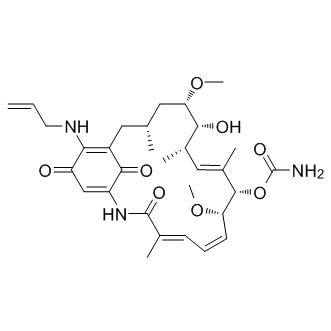
| DC9482 | 17-AAG Featured |
17-AAG (17-N-Allylamino-17-demethoxygeldanamycin), also known by its NSC number 330507 and CP number 127374, is a well-studied inhibitor of Heat Shock Protein 90 (HSP90). HSP90 is a molecular chaperone that plays a critical role in the stabilization and activation of a wide range of client proteins, many of which are involved in oncogenic processes. By inhibiting HSP90, 17-AAG disrupts the function of these client proteins, leading to the degradation of oncogenic proteins and ultimately inhibiting cancer cell growth and survival.
More description
|
|
| DC72877 | PF-114 Featured |
Vamotinib (PF-114) is a potent, selective and orally available inhibitor of native (IC50=0.49 nM) and mutated BCR/ABL (IC50=0.7-4 nM, ABL (T315I) IC50=0.78 nM). PF-114 potently inhibits ABL2, DDR1, DDR2, FMS, FRK, LCK, LYN and PDGFR kinases, but did not inhibit c-SRC, CSK, or c-KIT.
More description
|

|
| DC74017 | HTL0041178 Featured |
HTL0041178 is a potent GPR52 agonist with EC50 of 27.5 nM (human or rat GPR52).
More description
|

|
| DC22392 | BRD-4592 Featured |
BRD4592 is a small-molecule allosteric inhibitor that targets the tryptophan synthase (TrpAB) of Mycobacterium tuberculosis. TrpAB is a bifunctional enzyme composed of α and β subunits, which catalyzes the final steps of tryptophan biosynthesis. BRD4592 binds at the interface of the α and β subunits, disrupting the enzyme's function.
More description
|

|
| DC47030 | Ilunocitinib Featured |
Ilunocitinib (compound 27) is a JAK inhibitor (extracted from patent WO2009114512A1).
More description
|

|
| DC23181 | (R)-GNE-140 Featured |
(R)-GNE-140 (GNE-140) is a novel potent, selective lactate dehydrogenase (LDH) inhibitor with IC50 of 3, 5, and 5 nM for LDHA, LDHB, and LDHC, respectively.
More description
|

|
| DC8746 | NSC319726 Featured |
NSC319726 is a mutant p53R175 reactivator; inhibits growth of fibroblasts expressing the p53R175 mutation (IC50 = 8 nM); shows no inhibition for p53 wild-type cells.
More description
|

|
| DCC1260 | CBL0137 hydrochloride Featured |
CBL0137 (CBL-0137) activates p53 and inhibits NF-kB with EC50s of 0.37 μM and 0.47 μM in the cell-based p53 and NF-kB reporter assays, respectively. It also inhibits histone chaperone FACT (facilitates chromatin transcription complex).
More description
|

|
| DC70728 | RA608 Featured |
RA608 (RA-608) is a potent, selective, ATP-competitive, orally available CaMKII inhibitor, inhibits human CaMKIIδ, CaMKIIγ, CaMKIIα, and CaMKIIβ with IC50 of 22, 51, 121, and 1135 nM, respectively.RA608 displays a good selectivity profile against a broad panel of 304 human recombinant kinases.RA608 significantly reduces SR Ca leak in human atrial cardiomyocytes, reduces diastolic tension of human atrial trabeculae, does not affect action potential characteristics; attenuates heart failure in the murine HF model induced by TAC.
More description
|

|
| A420 | Nofazinlimab Biosimilar(Anti-PDCD1 / PD-1 / CD279 Reference Antibody) Featured |
Nofazinlimab (CS1003) is a humanised IgG4 anti-PD-1 monoclonal antibody. Nofazinlimab can be used for unresectable hepatocellular carcinoma (uHCC) research.
More description
|

|
| A419 | Prolgolimab Biosimilar(Anti-PDCD1 / PD-1 / CD279 Reference Antibody) Featured |
Prolgolimab (BCD-100) is a human IgG1 anti-PD-1 monoclonal antibody containing the Fc-silencing 'LALA' mutation. Prolgolimab can be used for the research of advanced melanoma.
More description
|

|
| A418 | Zimberelimab Biosimilar(Anti-PDCD1 / PD-1 / CD279 Reference Antibody) Featured |
Zimberelimab (GLS-010) is a fully human IgG4 anti-PD-1 monoclonal antibody with an EC50 of 210 pM for human PD-1. Zimberelimab effectively blocks the binding of PD-L1 and PD-L2 to cell-surface PD-1 in CHO-S cells, with IC50 values of 580 pM and 670 pM, respectively. Zimberelimab shows antitumor activities, and can be used for various cancers research, including cervical cancer, non-small cell lung cancer and classical Hodgkin’s lymphoma.
More description
|

|
| A417 | Toripalimab Biosimilar(Anti-PDCD1 / PD-1 / CD279 Reference Antibody) Featured |
Toripalimab is the first domestic anti-tumor PD-1 antibody in China. Toripalimab is a selective, recombinant, humanized monoclonal antibody against PD-1. Toripalimab is able to bind to PD-1 and block the interaction with its ligands. Toripalimab has exhibited primary anti-tumor effects in tumors such as melanoma, lung cancer, digestive tract tumors, hepatobiliary and pancreatic tumors, neuroendocrine neoplasms, nasopharyngeal carcinoma and urothelial carcinoma.
More description
|

|
| A416 | Pimivalimab Biosimilar(Anti-PDCD1 / PD-1 / CD279 Reference Antibody) Featured |
Pimivalimab (JTX-4014) is a PD-1 inhibitor. Pimivalimab can be used for the research of solid tumor.
More description
|

|
| A016 | Pembrolizumab Biosimilar(Anti-PDCD1 / PD-1 / CD279 Reference Antibody) Featured |
Pembrolizumab (anti-PD-1) is a potent, highly selective, fully humanized immunoglobulin (Ig) G4-kappa monoclonal antibody against PD-1 with potential immune checkpoint inhibitory and antineoplastic activities.
More description
|

|
| A415 | Spartalizumab Biosimilar(Anti-PDCD1 / PD-1 / CD279 Reference Antibody) Featured |
Spartalizumab (PDR001) is a humanized immunoglobulin 4 monoclonal antibody that binds PD-1 with subnanomolar activity and blocks interaction with PD-L1 and PD-L2. Spartalizumab can be used for the research of anaplastic thyroid carcinoma (ATC).
More description
|

|
| A414 | Sasanlimab Biosimilar(Anti-PDCD1 / PD-1 / CD279 Reference Antibody) Featured |
Sasanlimab (PF-06801591) is a humanized IgG4-κ antibody targeting PD-1. Mainly expressed by CHO (Chinese Hamster Ovary) cells.
More description
|

|
| A413 | Pidilizumab Biosimilar(Anti-PDCD1 / PD-1 / CD279 Reference Antibody) Featured |
Pidilizumab (CT-011) is a humanized IgG1k anti-PD-1 monoclonal antibody. Pidilizumab acts as a DLL1 antagonist. Pidilizumab has the potential for hematologic malignancies research.
More description
|

|
| A412 | Iparomlimab Biosimilar(Anti-PDCD1 / PD-1 / CD279 Reference Antibody) Featured |
Iparomlimab is an anti-human PD-1/CD279/PDCD1 IgG4κ antibody. Iparomlimab also targets to human monoclonal PSB103 γ4-chain, disulfided with human monoclonal PSB103 κ-chain to form a dimer. Iparomlimab can be used for Oncology research.
More description
|

|