To enhance service speed and avoid tariff delays, we've opened a US warehouse. All US orders ship directly from our US facility.
| Cat. No. | Product Name | Field of Application | Chemical Structure |
|---|---|---|---|
| DC65710 | PS13 Featured |
PS13 is a highly potent and selective COX-1 inhibitor, and its radiolabeled form, [¹¹C]PS13, is a promising PET radiotracer for imaging COX-1 expression in vivo. Its ability to selectively bind COX-1 in major organs, including the spleen, gastrointestinal tract, kidneys, and brain, makes it a valuable tool for studying COX-1-mediated processes in health and disease. This radiotracer has significant potential for advancing research and therapeutic development in COX-1-related conditions.
More description
|

|
| DC65839 | MC1 Precursor Featured |
Precursor of MC1, is a vital component in the synthesis of MC1, a selective and potent COX-2 inhibitor. Radiolabeled MC1, [¹¹C]MC1, serves as a promising PET radioligand for imaging COX-2 expression in vivo. Its high selectivity, combined with its ability to non-invasively visualize COX-2 in disease states, makes it a valuable tool for research and clinical applications, particularly in neuroinflammation, cancer, and drug development.
More description
|

|
| DC65841 | MC1 Featured |
MC1 is a selective and potent COX-2 inhibitor, and its radiolabeled form, [¹¹C]MC1, is a promising PET radiotracer for detecting COX-2 expression in vivo. Its ability to visualize COX-2 in neuroinflammation and other disease states makes it a valuable tool for research and therapeutic development, particularly in understanding and targeting COX-2-mediated processes in the brain.
More description
|

|
| DC60607 | SL-25.1188 Featured |
SL-25.1188 is a reversible MAO-B inhibitor with high brain uptake and slow plasma metabolism, making it a promising candidate for treating Alzheimer's dementia and aiding in smoking cessation. Its ability to modulate neurotransmitter levels in the brain positions it as a valuable therapeutic tool for addressing these challenging conditions.
More description
|

|
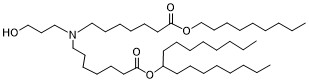
| DC65387 | BP Lipid 132(LP01 analog) Featured |
BP Lipid 132 is a well-designed ionizable lipid that combines effective mRNA encapsulation with enhanced biodegradability and tissue clearance, making it a valuable component in LNP-based mRNA delivery systems.
More description
|
|
| DC74224 | XST-20 Featured |
XST-20 is a small molecule that selectively targets the DNA-binding domain (DBD) of FOXM1, atranscription factor involved in cell cycle progression, proliferation, and cancer development. Witha surface plasmon resonance (SPR)-derived binding affinity (Kd) of 20 uM, XST-20 effectivelysuppresses FOXM1's transcriptional activities, making it a promising candidate for targetingFOXM1-driven cancers, such as ovarian cancer.
More description
|

|
| DC21170 | JNJ525 Featured |
JNJ525 is a small molecule inhibitor that targets tumor necrosis factor alpha (TNFα), a cytokine involved in inflammation and immune regulation. TNFα exerts its biological effects by binding to its receptors, TNFR1 (TNF receptor 1) and TNFR2 (TNF receptor 2). JNJ525 works by preventing the formation of TNFα complexes with these receptors, thereby inhibiting TNFα-mediated signaling pathways.
More description
|

|
| DC74454 | aNDR1 Featured |
aNDR1 (NDR1 agonist) is a specific small-molecule agonist of Nuclear Dbf2-related kinase 1 (NDR1, STK38), specifically inhibits CRPC cells and promotes kinase activity of NDR1.
More description
|

|
| DCC1166 | BU99008 Featured |
BU99008 is non-radiolabled compound. 11C-BU99008 is a PET Ligand for the imidazoline2 Binding Sites in Rhesus Brain.
More description
|

|
| DC60788 | PT-129 Featured |
PT-129 is a potent G3BP1/2 PROTAC degrader and dissolves preformed stress granules (SG). PT-129 disrupts the protective SG environment, making cancer cells more susceptible to stress-induced cell death.
More description
|

|
| DC60787 | UNC10142 Featured |
UNC10142 is a first-in-class antagonist of the tandem chromodomains of CHD1 with IC50 of 1.7 μM. UNC10142 treatment results in synthetic lethality in PTEN-deficient prostate cancer cells while sparing PTEN-intact prostate cancer cells.
More description
|

|
| DC60786 | SR-C-107(R) Featured |
SR-C-107(R) is a potent, orally available inhibitor of eleven-nineteen-leukemia YEATS with IC50 of 40 nM.SR-C-107(R) also exhibits superior inhibitory activity against ENL-dependent leukemia in xenografted mice.
More description
|
.jpg)
|
| DC60785 | GS-2278 Featured |
GS-2278 is a potent and selective LPAR1 antagonist with EC50 of 12 nM. GS-2278 dose-dependently blocks LPA-induced histamine release and demonstrates efficacy in an interventional model of bleomycin-induced lung fibrosis.
More description
|

|
| DC60784 | IRX5010 (IRX4647F) Featured |
IRX5010 (IRX4647F) is a highly selective RARγ nuclear receptor agonist with EC50 less than 0.1 nM. IRX5010 demonstrates substantial treatment effects on inhibition of growth of murine triple negative breast cancer in vivo.
More description
|

|
| DC60783 | LD4172 Featured |
LD4172 is a highly potent and specific RIPK1 degrader with Ki of 4.8 nM. LD4172 enhances tumor-infiltrating lymphocyte responses, and sensitizes tumors to anti-PD1 therapy in female C57BL/6J mice.
More description
|

|
| DC67175 | ATX968 Featured |
ATX968 is a potent and selective inhibitor of DHX9 with IC50 of 8 nM and Kd of 1.3 nM, respectively. ATX968 induces robust and durable responses in an MSI-H/dMMR xenograft model but not in a microsatellite stable (MSS)/proficient mismatch repair (pMMR) model.
More description
|

|
| DC31276 | PRLX93936 Featured |
PRLX 93936 is a structural analogue of erastin with potential antineoplastic activity. Erastin analogue PRLX 93936 appears to inhibit mitochondrial outer membrane protein VDACs (voltage-dependent anion channels) 2 and 3, resulting in an oxidative, non-apoptotic cell death. Erastin analogue PRLX 93936 exhibits greater lethality in cell lines harboring mutations in the GTPase protein oncogenes HRAS and KRAS or the serine-threonine protein kinase oncogene BRAF than in non-tumorigenic cell lines. VDACs 2 and 3 are up-regulated in a wide variety of tumor cell lines.
More description
|

|
| DC21436 | OAT-177 Featured |
OAT-177 is a potent, selective, orally active acidic mammalian chitinase (AMCase) inhibitor with IC50 of 14 and 19 nM against human and mouse AMCas, respectively, >150-fold selectivity over mCHIT1.
More description
|

|
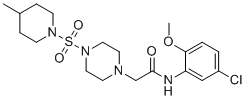
| DC70890 | VU0606170 Featured |
VU 0606170 (also referred to as VU0606170) is a selective inhibitor of the sodium-activated potassium channel KNa1.1, also known as Slack or Slo2.2. This compound has shown specificity for Slack channels over other related potassium channels, making it a valuable tool for studying the physiological and pathological roles of KNa1.1.
More description
|
|
| DC73825 | MG-002 Featured |
MG-002 is a second-generation, orally bioavailable inhibitor of eIF4A, a key RNA helicase involved in the initiation of cap-dependent mRNA translation. By targeting eIF4A, MG-002 effectively disrupts the translation of certain mRNAs, particularly those with complex 5' untranslated regions (UTRs) that are highly dependent on eIF4A activity. This mechanism of action makes MG-002 a promising candidate for targeting cancers and other diseases driven by dysregulated translation.
More description
|

|
| DC65028 | 4-(((1r,4r)-4-aminocyclohexyl)oxy)-2-chlorobenzonitrile hydrochloride Featured |

|
|
| DCC5399 | Ver-246608 Featured |
Novel pan-isoform ATP competitive inhibitor of pyruvate dehydrogenase kinase, disrupting Warburg metabolism and inducing context-dependent cytostasis in cancer cells
More description
|

|
| DC9764 | Afoxolaner Featured |
Afoxolaner is an isoxazoline that inhibits insect and acarine ligand-gated chloride channels, in particular those gated by the neurotransmitter gamma-aminobutyric acid (GABA), blocking pre and post synaptic transfer of chloride ions across cell membranes.
More description
|

|
| DC67028 | Pegaptanib Featured |

|
|
| DC47290 | Remlarsen Featured |
Remlarsen (MRG-201), a miR-29b mimic, acts a miR-29b agonist. Remlarsen has the potential for preventiong formation of a fibrotic scar or cutaneous fibrosis.
More description
|
|
| DC9703 | CHIR-99021 HCl Featured |
CHIR-99021 HCl is a potent and selective inhibitor of glycogen synthase kinase 3 beta (GSK-3β), a key enzyme involved in regulating various cellular processes, including metabolism, cell proliferation, and differentiation. By inhibiting GSK-3β, CHIR-99021 HCl modulates downstream signaling pathways, particularly the Wnt/β-catenin pathway, leading to significant biological effects both in vitro and in vivo.
More description
|

|
| DC23985 | Laduviglusib trihydrochloride Featured |
Laduviglusib (CHIR-99021) trihydrochloride is a well-characterized small molecule inhibitor that specifically targets glycogen synthase kinase-3 alpha and beta (GSK-3α/β). It exhibits potent inhibitory activity with IC50 values of 10 nM for GSK-3α and 6.7 nM for GSK-3β. Importantly, it demonstrates high selectivity, being over 500-fold more selective for GSK-3 compared to other kinases such as CDC2 and ERK2, as well as a broad range of other protein kinases.
More description
|

|
| DC67275 | VU0364739 Featured |
VU0364739 is a selective inhibitor of phospholipase D2 (PLD2) with an IC50 value of 22 nM. Phospholipase D (PLD) enzymes, including PLD1 and PLD2, are involved in various cellular processes, such as signal transduction, membrane trafficking, and cytoskeletal reorganization. PLD2, in particular, has been implicated in cancer cell proliferation, survival, and metastasis, making it a potential target for anticancer therapies.
More description
|
.gif)
|
| DC65715 | VU 0364739 hydrochloride Featured |
VU0364739 is a selective PLD2 inhibitor (IC50: 22 nM). VU0364739 decreases cancer cell proliferation.
More description
|

|
| DC20083 | H-Ile-Pro-Pro-OH Featured |
H-Ile-Pro-Pro-OH, a milk-derived peptide, inhibits angiotensin-converting enzyme (ACE) with an IC50 of 5 μM. Antihypertensive tripeptides.
More description
|

|