To enhance service speed and avoid tariff delays, we've opened a US warehouse. All US orders ship directly from our US facility.
| Cat. No. | Product Name | Field of Application | Chemical Structure |
|---|---|---|---|
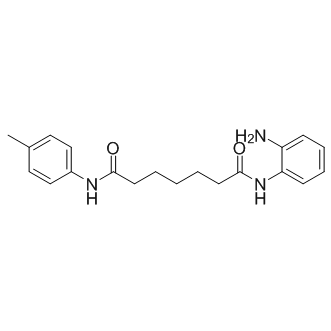
| DC8661 | Pimelic Diphenylamide 106(TC-H 106) Featured |
Pimelic diphenylamide 106 is a slow, tight-binding inhibitor of class I HDAC (HDAC 1, 2, and 3, with IC50 values of 150 nM , 760nM, and 370 nM, respectively), demonstrating no activity against class II HDACs.
More description
|
|
| DC71179 | GEM144 |
GEM144 is a potent and orally active DNA polymerase α (POLA1) and HDAC 11 dual inhibitor. GEM144 induces acetylation of p53, activation of p21, G1/S cell cycle arrest, and apoptosis. GEM144 has significant antitumor activity in human orthotopic malignant pleural mesothelioma xenografts.
More description
|

|
| DC71069 | JPS036 |
JPS036 is a benzamide-based Von Hippel-Lindau (VHL) E3-ligase proteolysis targeting chimeras (PROTAC). JPS036 degrades class I histone deacetylase (HDAC). JPS036 is potent HDAC1/2 degrader correlated with greater total differentially expressed genes and enhanced apoptosis in HCT116 cells.
More description
|
|
| DC71068 | JPS035 |
JPS035 is a benzamide-based Von Hippel-Lindau (VHL) E3-ligase proteolysis targeting chimeras (PROTAC). JPS035 degrades class I histone deacetylase (HDAC). JPS035 is potent HDAC1/2 degrader correlated with greater total differentially expressed genes and enhanced apoptosis in HCT116 cells.
More description
|
|
| DC71067 | JPS016 |
JPS016 is a benzamide-based Von Hippel-Lindau (VHL) E3-ligase proteolysis targeting chimeras (PROTAC). JPS016 degrades class I histone deacetylase (HDAC). JPS016 is potent HDAC1/2 degrader correlated with greater total differentially expressed genes and enhanced apoptosis in HCT116 cells.
More description
|
|
| DC71066 | JPS014 |
JPS014 is a benzamide-based Von Hippel-Lindau (VHL) E3-ligase proteolysis targeting chimeras (PROTAC). JPS014 degrades class I histone deacetylase (HDAC). JPS014 is potent HDAC1/2 degrader correlated with greater total differentially expressed genes and enhanced apoptosis in HCT116 cells.
More description
|
|
| DC70995 | 2-Hexyl-4-pentynoic acid |
2-Hexyl-4-pentynoic acid ((±)-2-Hexyl-4-pentynoic acid), valproic acid (VPA) derivative, exhibits potential roles of HDAC inhibition (IC50=13 µM) and HSP70 induction. Potent neuroprotective effects. 2-Hexyl-4-pentynoic acid causes histone hyperacetylation and protect against glutamate-induced excitotoxicity in cultured neurons.
More description
|
|
| DC70945 | [18F]-NT160 |
[18F]-NT160, a Florbetapir (18F)-radiolabeled NT160, is a diagnostic tool for positron emission tomography (PET). NT160 is a brain-penetrant and selective class-IIa HDAC inhibitor with an IC50 of 46 nM. NT160 exhibits a remarkably high inhibition against HDAC4, HDAC5, HDAC7, and HDAC9 with IC50s of 0.08 nM, 1.2 nM, 1.0 nM, and 0.9 nM, respectively.
More description
|
|
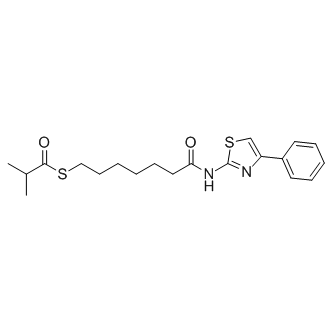
| DC8654 | PTACH (NCH-51) Featured |
PTACH (NCH-51) is a SAHA-based novel inhibitor of human HDAC. PTACH exerts potent growth inhibition against various human cancer cells, with EC50 values ranging from 1 to 10 μM.
More description
|
|
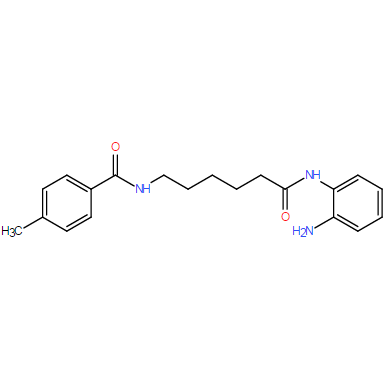
| DC7795 | RG2833 (RGFP109) Featured |
RG2833 is a brain-penetrant inhibitor of HDAC with IC50 values of 60 nM and 50 nM for HDAC1 and HDAC3, respectively.
More description
|
|
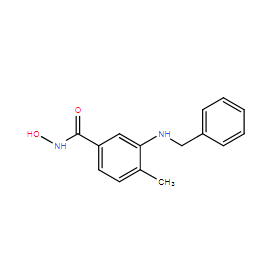
| DC12487 | TH-34 Featured |
TH34 is a potent HDAC6/8/10 inhibitor, induceing DNA damage-mediated cell death in human high-grade neuroblastoma cell lines.
More description
|
|
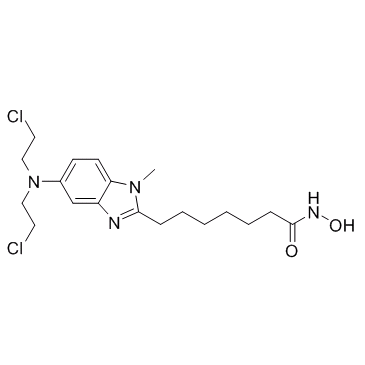
| DC10478 | Tinostamustine(EDO-S101) Featured |
Tinostamustine is the first representative of the A-DAC principle, a new approach in chemotherapy that uses fusion technology to combine an alkylating agent with a pan-histone deacetylase inhibitor (HDAC) to simultaneously damage DNA and block damage repa
More description
|
|
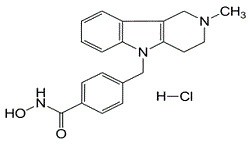
| DC6303 | Tubastatin A HCl Featured |
Tubastatin A is a potent and selective HDAC6 inhibitor with IC50 of 15 nM. It is selective against all the other isozymes (1000-fold) except HDAC8 (57-fold).
More description
|
|
| DC70860 | UBD253 |
UBD253 (SGC-UBD253) is a potent, selective ubiquitin chemical probe for ubiquitin binding domain of HDAC6 with Kd of 84 nM (SPR), inhibits the HDAC6-ISG15 interaction (EC50=1.9 uM, nanoBRET).UBD253 (SGC-UBD253) displays little to no affinity for other USPs (>100-fold selectivity). SGC-UBD253 potently (<100 nM) binds HDAC6-UBD (ubiquitin binding domain), decreases the interaction between full-length HDAC6 with ISG15.
More description
|
|
| DC70815 | SW-101 |
SW-101 (SW101) is a potent, selective HDAC6 inhibitor with IC50 of 0.7 nM, >200-fold selectivity over HDAC1/2/3.SW-101 possesses excellent HDAC6 potency and selectivity, together with markedly improved metabolic stability and druglike properties compared to SW-100.SW-101 treatment elevates the impaired level of acetylated α-tubulin in the distal sciatic nerve, counteracts progressive motor dysfunction, and ameliorates neuropathic symptoms in a CMT2A mouse model bearing mutant MFN2.
More description
|
|
| DC70719 | PTG-0861 |
PTG-0861 (JG-265) is a novel potent, selective HDAC6 inhibitor with IC50 of 5.92 nM, >36-fold selectivity over other HDACs.PTG-0861 (JG-265) displays HDAC6 cellular target engagement with EC50 of 0.59 uM (ELISA), has in vitro and cellular selectivity superior to HDAC6-selective inhibitor citarinostat (ACY-241).PTG-0861 (JG-265) demonstrates potency against several blood cancer cell lines (e.g. MV4-11, MM1S), whilst showing limited cytotoxicity against non-malignant cells and CD-1 mice.PTG-0861 (JG-265) exihibits promising in vitro pharmacokinetics achieved with good safety profile in cells and in vivo.
More description
|
|
| DC70663 | NR-160 |
NR-160 (NR160) is a novel potent, selective inhibitor of histone deacetylase 6 (HDAC6) with IC50 of 30 nM, shows SI (75-1847 )over all HDAC class I isoforms.NR-160 induced α-tubulin acetylation (ac-α-tubulin) in treated acute myeloid leukemic (AML) cell line HL60, but not histone H3 (ac-H3) (a marker for the inhibition of class I HDACs).NR-160 enhances the cytotoxicity induction of bortezomib, epirubicin and daunorubicin on a panel of seven leukemia cell lines
More description
|
|
| DC70656 | NN-390 |
NN-390 (NN390) is a potent, selective HDAC6 inhibitor with IC50 of 9.8 nM, >200-550-fold selectivity over other HDAC isoforms.NN-390 inhibits primary cells of treatment-refractory Group 3 MB cells (SU_MB002) with IC50 of 2.33 uM.NN-390 is the first HDAC6-selective inhibitor to show therapeutic potential in metastatic Group 3 medulloblastoma (MB), an aggressive pediatric brain tumor often associated with leptomeningeal metastases and therapy resistance.NN-390 selectively targets cell population with a 44.3-fold therapeutic margin between patient-derived Group 3 MB cells in comparison to healthy neural stem cells.NN-390 demonstrated a 45-fold increased potency over HDAC6-selective clinical candidate citarinostat.
More description
|
|
| DC70600 | MJM-1 |
MJM-1 is a small-molecule brain-penetrant HDAC inhibitor that increases the overall level of histone 3 (H3) acetylation in prostate cancer cell line.MJM-1 injected intraperitoneally (i.p.) crossed the BBB in mice and could be detected in the hippocampus, a brain region that mediates memory.MJM-1 (post-training i.p. administration) enhanced hippocampus-dependent spatial memory consolidation in male mice.
More description
|
|
| DC70572 | LSH-A54 |
LSH-A54 is a potent, class I selective HDAC inhibitor with IC50 of 26.2 nM (HDAC1) and 59.3 nM (HDAC2);
LSH-A54 displays no significant inhibition against HADC3/6 (IC50>10 uM).
LSH-A54 exhibits antiproliferative properties against breast cancer cell lines T-47D (IC50=1.58 uM), MCF-7 (IC50=1.32 uM) and BT-474 (IC50=2.55 uM).
LSH-A54 attenuates cell migration significantly in wound healing assay and comparably to the pan-HDACi vorinostat, whereas the HDAC1-3 selective HDACi entinostat has no significant effect on cell migration.
LSH-A54 reduced the number of colonies significantly in clonogenic survival assay compared to entinostat and showed comparable activity to pan-HDACi vorinostat.
More description
|
|
| DC70516 | IRBM6 |
IRBM6 (Class I HDAC-IN-6) is a potent, class I selective HDAC inhibitor with EC50 of 50 nM (HeLa cellular), HDAC1/2/3 IC50 of 1.7/2.8/1.1 nM.IRBM6 weakly inhibits HDAC6 (IC50=177 nM) and is inactive at 5 uM against HDACs 4-7.IRBM6 showed a potent inhibitory effect on the growth TC-797s and two additional NUT carcinoma (NC) cell lines, PER-403, and 10-15.IRBM6 induces a transcriptional program of differentiation in NC cells, demonstrated large-scale changes in gene expression that were significantly enriched with differentiation gene sets and depleted of pro-growth gene sets, including those of MYC and E2F targets.IRBM6 repressed growth and induced differentiation of NUT carcinoma (NC) cells in proportion to inhibition of NUT transcriptional activity.
More description
|
|
| DC70419 | FT108 |
FT108 (FT-108) is a potent, selective HDAC6 inhibitor (IC50=26 nM) relative to other HDAC family members (HDAC3 IC50=6.68 uM and HDAC8 IC50=4.07 uM).
More description
|
|
| DC49590 | MC4343 |
MC4343 is a potent and dual inhibitor of EZH2 and histone deacetylase. MC4343 has the potential for the research of cancer disease.
More description
|
|
| DC49589 | KD 5170 |
KD 5170 is a pan inhibitor of histone deacetylases (HDACs) and exhibits broad spectrum antitumor activity in vitro and in vivo.
More description
|
|
| DC49588 | HDAC-IN-30 |
HDAC-IN-30 is a novel multi-target HDAC inhibitor, including HDAC1 (IC50=13.4 nM),HDAC2 (IC50=28.0 nM), HDAC3 (IC50=9.18 nM), HDAC6 (IC50=42.7 nM), HDAC8 (IC50=131 nM). HDAC-IN-30 exhibits potent antitumor efficacy.
More description
|
|
| DC49586 | PHD2/HDACs-IN-1 |
PHD2/HDACs-IN-1 is a potent PHD2/HDACs hybrid inhibitor (IC50s of 1.15 μM, 19.75 μM, 26.60 μM and 15.98 μM for PHD2, HDAC1, HDAC2 and HDAC6, respectively). PHD2/HDACs-IN-1 is a low-toxicity renoprotective agent for research of cisplatin-induced acute kidney injury (AKI).
More description
|
|
| DC49585 | MIR002 |
MIR002 is a potent and orally active DNA polymerase α (POLA1) and HDAC 11 dual inhibitor. MIR002 induces acetylation of p53, activation of p21, G1/S cell cycle arrest, and apoptosis. MIR002 shows significant antitumor activity in vivo.
More description
|
|
| DC49584 | MPT0B390 |
MPT0B390 is an arylsulfonamide-based derivative with potent HDAC inhibitory ability. MPT0B390, TIMP3 inducer, inhibits tumor growth, metastasis and angiogenesis. MPT0B390 shows antiproliferative activity against human colon cancer cell line HCT116 with the GI50 of 0.03 μM.
More description
|
|
| DC49582 | OKI-006 |
OKI-006 is a potent and orally active inhibitor of histone deacetylase (HDAC). OKI-006 is a unique congener of the natural product HDAC inhibitor largazole. Histone deacetylases (HDACs) play critical roles in epigenomic regulation, and histone acetylation is dysregulated in many human cancers. OKI-006 has the potential for the research of cancer disease.
More description
|
|
| DC7673 | Splitomicin Featured |
Splitomicin is a derivative of β-naphthol is an inhibitor of Silent Information Regulator 2 (SIR2).
More description
|

|