Alternate TextTo enhance service speed and avoid tariff delays, we've opened a US warehouse. All US orders ship directly from our US facility.
Home > RNA Delivery > Ionizable Lipid library

Ionizable Lipid library

You can also try the following methods, and our professionals will serve you Customized Consultation
Cat. No. Product Name Field of Application Chemical Structure
DC49952 246C10 Featured
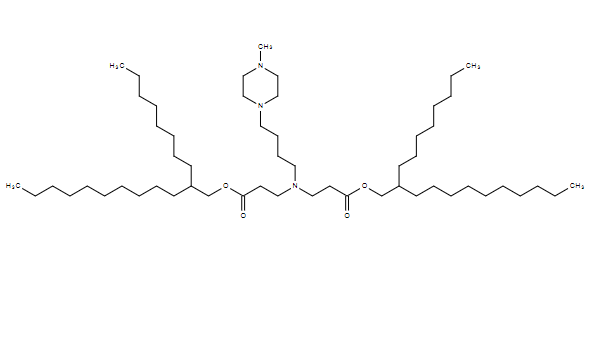
246C10 is a synthesized ionizable lipid. 246C10 can be formulated into lipid nanoparticles (LNPs) with dioleoylphosphatidylethanolamine (DOPE), cholesterol, and C16-PEG2000 ceramide (PEG-lipid) as well as mRNA. The lipid nanoparticle formulations can be used for mRNA delivery. To obtain iLNPs that could specifically target liver sinusoidal endothelial cells (LSECs), six different ionizable lipids (241C10 to 246C10) were synthesized by an epoxide ring-opening reaction with piperazine- or piperidine-containing amines. Biodistribution and gene regulation of various iLNPs were assessed in vivo, and the results showed that the 246C10 iLNPs (containing piperazine amine) had the highest luciferase expression in the liver. When further analyzing the 246C10 iLNPs transfection efficiency in different types of liver cells, it was found that tdTomato fluorescence was mainly concentrated in hepatocytes, not in LSECs. Figure 6f shows that 80% of hepatocytes are fluorescent, 40% of LSECs are fluorescent, and 20% of Kupffer cells are fluorescent. Due to the mannose receptor on LSECs, mannose-PEG lipid was introduced into 246C10 iLNPs to alter the distribution of iLNPs in different liver cells. As shown in Figure 6g, tdTomato fluorescence distribution was 15% of hepatocytes, 70% of LSECs, and 15% of Kupffer cells, significantly improved the ability of iLNPs to actively target LSECs. In contrast, this work indirectly shows that the iLNPs with piperazine head lipid are more able to deliver mRNA to the liver and translate the target protein than the iLNPs with piperidine head lipid. It is worth mentioning that the preparation buffer of 246C10 iLNPs could influence the encapsulation efficiency of mRNA. With the addition of sodium chloride in the citrate buffer, the encapsulation efficiency of CRISPR-Cas9 mRNA and sgRNA was increased. These iLNPs were able to treat hemophilia safely, without causing hepatotoxicity, the immune response induced by Cas9 and off-target editing.
More description
DC70010 98N12-5 Featured
98N12-5 is an ionizable cationic lipid. It has been used in combination with other lipids in the generation of lipid nanoparticles (LNPs). LNPs containing 98N12-5 and encapsulating proprotein convertase subtilisin kexin type 9 (PCSK9) siRNA selectively accumulate in the liver and reduce total serum cholesterol levels in mice and rats and serum LDL levels in cynomolgus monkeys.
More description
DC82125 lipid 14 Featured
LIPID 14 is a novel ionizable lipid used for mRNA delivery.In 2021, Elia et al. used lipid 2 LNPs and lipid 14 LNPs to deliver mRNA encoding SARSCoV-2 human Fc-conjugated receptor binding domain (RBDhFc mRNA). While both lipid 274 LNP RBD-hFc mRNA and lipid 14 LNP RBD-hFc mRNA induced equal cellular and humoral responses in mice at an mRNA dose of 5 μg, only lipid 14 LNP RBD-hFc mRNA exhibited strong immunogenicity following intradermal administration. Both intradermal administration and intramuscular administration of lipid 14 LNPs could activate antigen presenting cells (APCs), thus inducing cellular responses.
More description
DC60848 Lipid 854 Featured
Lipid 854 is an ionizable cationic lipid that has been used in the generation of lipid nanoparticles (LNPs) for the delivery of mRNA in vivo. Lipid 854 has been optimized based on Lipid 88.
More description
DC60489 LIPID 331 Featured
Lipid 331 is a biodegradable cyclic ionizable lipid. LNPs containing Lipid 331 result in robust transfection in the nasal and lung tissues of mice and efficient transfection of lung epithelial cells and lung-resident APCs. Lipid 331 is a promising candidate for mRNA vaccine delivery, offering the potential for further enhancing the potency of mRNA vaccines.
More description
DC60352 DDAB
DC33635 DODAP Featured
DODAP, also known as 1,2-Dioleoyl-3-dimethylammonium-propane, is a cationic lipid. It has been used as a component in liposomes that can be used to encapsulate siRNA, immunostimulatory oligodeoxynucleotides, antisense oligonucleotides, or chemotherapeutic agents for in vitro and in vivo delivery.
More description
DC33636 DOTAP Featured
DOTAP, also known as 1,2-Dioleoyl-3-trimethylammoniumpropane, is a cationic liposome-forming compound used for transfection of DNA, RNA, and other negatively charged molecules into eukaryotic cells. It has been used in gene delivery vectors for gene ther
More description
DC65362 BP Lipid 114 Featured
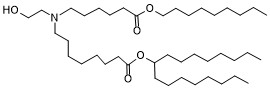
BP Lipid 114 is a well-designed ionizable lipid optimized for mRNA encapsulation and delivery. Its ethanolamine headgroup, ester bonds at the C6 and C8 positions, and 9-carbon tail contribute to efficient mRNA complexation, stability during delivery, and improved biodegradability. These properties make it a valuable component in LNPs for gene therapy and other mRNA-based therapeutic applications.
More description
DC65390 BP Lipid 135 Featured
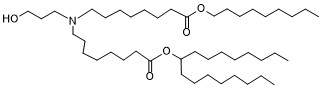
BP Lipid 135 is a well-designed ionizable lipid optimized for mRNA encapsulation and delivery. Its propanolamine headgroup, ester bonds at the C8 position, and 9-carbon tail contribute to efficient mRNA complexation, stability during delivery, and improved biodegradability. These properties make it a valuable component in LNPs for gene therapy and other mRNA-based therapeutic applications.
More description
DC57100 Acuitas A9 Featured
Lipid A9 is an ionizable cationic lipid (pKa = 6.27) that has been used in the generation of lipid nanoparticles (LNPs) for the delivery of mRNA and siRNA in vivo. LNPs containing lipid A9 and encapsulating non-stimulatory siRNA increase plasma levels of chemokine (C-C motif) ligand 2 (CCL2), indicating activation of the innate immune response, and decrease body weight in mice.
More description
DC42537 ALC-0315 Featured
ALC-0315 is an ionisable aminolipid that used for mRNA compaction and aids mRNA cellular delivery. ALC-0315 can be used to form lipid nanoparticle (LNP) delivery vehicles.
More description
DC60509 4A3-SCC-PH Featured
4A3-SCC-PH is a groundbreaking linker-degradable ionizable lipid (LDIL) that features a glutathione (GSH)-responsive cone-shaped molecular structure. This unique architecture enables superior endosomal escape and rapid mRNA release, making it highly effective for mRNA delivery. In vivo studies have highlighted its exceptional performance, showing a 176-fold increase in mRNA delivery efficiency to the liver compared to DLin-MC3-DMA, a widely used benchmark lipid. Both 4A3-SCC-PH and its structural analog, 4A3-SCC-10, also demonstrated significantly enhanced mRNA delivery efficacy compared to their non-disulfide-containing parent compounds and disulfide-containing controls with modified lipid tails.
More description
DC49257 DLin-K-C3-DMA Featured
DLin-KC3-DMA, a nucleic acid, shows in vivo silencing activity. DLin-K-C3-DMA can be used in the synthesis of nucleic acid-lipid particle to delivery of nucleic acid.
More description
DC57002 LIPID C24 Featured
C24 is a novel multiprotic ionizable lipid. C24 lipid nanoparticle (LNP) has a multistage protonation behavior resulting in greater endosomal protonation and greater translation compared to the standard reference MC3 LNP. C24 LNP also lower injection site inflammation and higher stability compared to MC3 LNP.
More description
DC60575 U-101 Featured
U-101 is an ionizable lipid for mRNA delivery. U101-LNP/IL-2F mRNA formulation demonstrats effective antitumor activity and safety.LNPs containing lipid U 101 and encapsulating mRNA encoding a fusion protein composed of IL-2, a linker, and CD25 inhibit tumor growth in an MC-38 mouse xenograft model.
More description
DC85555 2-Octyldecyl 6-[[4-(decyloxy)-4-oxobutyl](2- hydroxyethyl)amino]hexanoate Featured
YK-009 is a novel ionizable lipid for mRNA delivery. Comparisons of YK009-LNP-mRNA and commercial MC3-LNP-mRNA showed that YK009-LNP-mRNA vaccines had good biodistribution patterns, favorable tissue clearance, and high delivery efficiency. Furthermore, our study proved that YK009-LNP-Omicron mRNA could trigger a robust immune response and immune protection against the SARS-CoV-2 Omicron variant.
More description

Customized Consultation X

Your information is safe with us. * Required Fields.

Your name
Company
Email
Procuct Name
Cat. No.
Remark
Verification code
Please fill out the characters in the picture
X