| DC60979 |
Ionizable lipid-3 (SM-102 analogue)
|
Ionizable lipid-3( SM-102 analogu) is a cationic lipid for nucleic acid delivery, with the ability to form lipid nanoparticle mRNA vaccines that exhibit in vitro stability and immunostimulatory activity.This SM-102 analogue retains the ionizable tertiary amine and asymmetric hydrophobic architecture while replacing the ester linkages with carbonate groups and repositioning the hydroxyl functionality. These modifications are designed to tune biodegradability, membrane interactions, and LNP delivery performance. |
| DC60978 |
C12-2aN
|
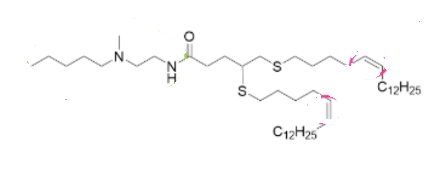
C12-2aN is a crosslinked ionizable lipid developed for mRNA vaccine delivery and dendritic-cell metabolic reprogramming. Its structure combines two piperazine-based ionizable amine cores, a bis-amidine crosslinker, and four hydroxylated C12 hydrophobic tails. When formulated with DOPE, cholesterol, and C14-PEG2000, C12-2aN LNPs enhanced mRNA endosomal escape and activated AMPK–mTORC2-dependent glycolysis, supporting dendritic-cell maturation and antigen presentation. In preclinical mouse studies, C12-2aN LNPs generated robust humoral and cellular immune responses in SARS-CoV-2 RBD and OVA cancer-vaccine models. The formulation also demonstrated reduced liver-associated off-target expression and lower acute inflammatory markers than the tested control formulations. C12-2aN is a preclinical research lipid intended for evaluating metabolically active mRNA vaccine delivery systems. |
| DC60965 |
Ionizable lipid-2 (ALC-0315 analogue)
|
Ionizable lipid-2 is a cationic lipid for nucleic acid delivery, with the ability to form lipid nanoparticle mRNA vaccines that exhibit in vitro stability and immunostimulatory activity.This ALC-0315 analogue retains its ionizable tertiary amine, hydroxybutyl headgroup, and dual branched hydrophobic tails, while replacing the two ester linkages with carbonate groups. This modification may alter hydrolytic stability, biodegradability, membrane interactions, and overall LNP delivery performance. |
| DC60950 |
FL0445
|
FL0445 is a biodegradable, multi-branched ionizable lipid featuring an ionizable amine-containing headgroup together with ester and carbonate linkages. When formulated with DOPE, cholesterol, and a PEG lipid, FL0445-LNP enabled efficient delivery of both linear mRNA and structurally constrained capped circular RNA (Cap-cirRNA). In the reported study, the optimized formulation produced substantially higher in vitro protein expression than benchmark LNPs based on MC3, SM-102, or ALC-0315 and demonstrated functional nucleic-acid delivery following intravenous, intramuscular, and subcutaneous administration in mice. The platform was also evaluated for mRNA vaccination, ASO-mediated gene silencing, pDNA delivery, and GLP-1-encoding Cap-cirRNA. FL0445-LNP induced comparatively low inflammatory cytokine responses and showed favorable single-dose tolerability in the tested mouse models, supporting its further evaluation as a versatile preclinical delivery lipid for mRNA, circular RNA, and other nucleic-acid modalities. |
| DC67785 |
KC3-OA
|
KC3-OA, chemically known as 3-((S)-2,2-di((Z)-octadec-9-en-1-yl)-1,3-dioxolan-4-yl)-N,N-dimethylpropan-1-amine, is an ionizable cationic lipid (ICL) optimized for lipid nanoparticle (LNP) formulations in nucleic acid delivery, particularly for mRNA vaccines. It features a unique structure with mono-unsaturated alkyl chains (C18:1), which enhances oxidative stability compared to polyunsaturated analogs like KC3, while maintaining efficient membrane fusion and endosomal escape capabilities. In LNP compositions, KC3-OA is typically incorporated at 46–54 mol% of total lipids, with an N/P ratio of 4–6 relative to mRNA, ensuring high encapsulation efficiency and transfection potency.
Experimental data demonstrate that KC3-OA-based LNPs achieve superior mRNA expression in human dendritic cells, outperforming alternatives like KC3-PA or KC3-01 in both in vitro and in vivo models. For instance, in FIG. 2, KC3-OA LNPs showed ~2-fold higher mCherry expression at low mRNA doses (0.1 μg/mL) due to improved cellular uptake and reduced degradation. Its synergy with anionic phospholipids like DPPS (5 mol%) further enhances dendritic cell targeting via receptor-mediated internalization, leading to robust CD4+ and CD8+ T-cell responses against Mycobacterium tuberculosis antigens. This balance of stability, efficiency, and immunogenicity makes KC3-OA a leading candidate for next-generation vaccines. |
| DC67615 |
STING Agonist Lipid SAL-12
|
SAL12 is a novel ionizable lipid derivative that integrates a non-nucleotide STING agonist (agonist 6) with an amino lipid tail through an ester bond, forming the core component of specialized lipid nanoparticles (SAL12-LNPs). These nanoparticles are designed for dual functionality: they efficiently encapsulate and deliver mRNA into dendritic cells while concurrently activating the STING pathway to stimulate innate immunity. |
| DC67558 |
AMG1541
|
AMG-1541 is a degradable cyclic amino alcohol ionizable lipid optimized for mRNA vaccine delivery using lipid nanoparticles (LNPs). Formulated typically with DOPE, cholesterol, and PEG-lipids, AMG 1541 LNPs have a diameter of ~85 nm, PDI of 0.107, and encapsulation efficiency of 67%, ensuring stability and efficient mRNA delivery. In vitro, it outperforms benchmarks like SM-102, showing enhanced transfection in cells such as C2C12 and PBMCs. In vivo, intramuscular administration in mice results in robust protein expression within 6 hours and induces potent immune responses, including high antibody titers and Th1-biased T-cell activation, with minimal inflammation. Mechanistically, its β-hydroxyl groups form hydrogen bonds with mRNA phosphate backbones, facilitating endosomal escape. AMG1541 degrades rapidly under enzymatic conditions, reducing long-term toxicity, and is effective for vaccines targeting pathogens like influenza and SARS-CoV-2, making it a promising candidate for clinical applications. |
| DC67480 |
Sanofi Lipid VII
|
Lipid VII is a novel ionizable cationic lipid developed by Sanofi.Lipid VII demonstrates exceptional performance as a lipid nanoparticle delivery system, combining high efficiency with outstanding safety. Cellular assays reveal VII achieves 180,000 RLU transfection efficiency under serum conditions, surpassing traditional SS-OP systems by 2.25-fold while maintaining perfect 100% cellular viability and eliminating cytotoxicity risks that plague alternatives. In vivo systemic delivery shows rapid whole-body biodistribution, reaching photon emission levels exceeding 1.00E+10 photons/sec within 48 hours. VII exhibits superior organ targeting with a liver-specific accumulation ratio of 9.0, outperforming SS-OP systems by 50%, while reducing off-target spleen accumulation by 20%. Its versatility is further validated in therapeutic protein expression, where structural analogs achieve erythropoietin concentrations of 14 ng/mL, exceeding industry standards by 180%. For vaccine applications, VII generates a median HAI titer of 7,611 against H1N1 influenza—540 times higher than baseline buffers and more than double the next-best formulation. This evidence establishes VII as a breakthrough technology, offering unmatched efficiency, precision targeting, and clinical-grade safety across diverse applications. |
| DC67463 |
CP-LC-1428
|
Derived from the natural amino acid homocysteine, CP-LC-1428 is an ionizable cationic lipid that enables highly efficient in vivo delivery of multiple RNA formats (including mRNA, cRNA and saRNA) with robust protein expression. When formulated into standard LNPs (50:38.5:10:1.5 molar ratio of ionizable lipid:cholesterol:DOPE:PEG-lipid), it demonstrates superior spleen-selective targeting compared to conventional delivery systems following intravenous administration, while maintaining an excellent safety profile. |
| DC67314 |
Lipid AA2
|
AA2 lipid is an innovative amino alcohol-derived ionizable lipid designed for optimized mRNA delivery. Its unique structure includes a hydroxyl-containing headgroup that enhances mRNA binding through hydrogen bonds and a branched ester tail (R2) that promotes a cone-shaped architecture, facilitating efficient endosomal escape. Formulated into lipid nanoparticles (LNPs) with a size of 108.6 ± 3.7 nm and a polydispersity index (PDI) below 0.3, AA2 achieves high mRNA encapsulation efficiency (89.0 ± 1.4%) and an ideal pKa of approximately 6.2, ensuring effective endosomal release.In vivo studies demonstrate that AA2 LNP-encapsulated spike mRNA elicits 4.7-fold higher IgG titers and robust CD8+ T-cell responses (characterized by IFN-γ+, TNF-α+, and granzyme B+ markers) compared to SM-102/ALC-0315 LNPs. Notably, AA2 exhibits minimal off-target accumulation, with low biodistribution in the liver and spleen. Its slightly positive surface charge (+3–5 mV) enhances cellular uptake, while the biodegradable ester structure ensures metabolic clearance, reducing potential toxicity. |

 To enhance service speed and avoid tariff delays, we've opened a US warehouse. All US orders ship directly from our US facility.