| DC59010 |
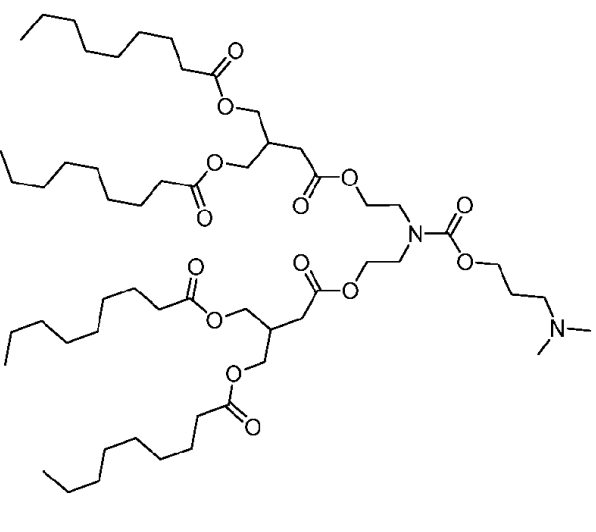
C14-4
|
C14-4 (C14-494,Lipid B-4,Lipid B4) is a novel ionizable lipid with the highest T-cell transfection efficiency and low cytotoxicity.The C14-4 ionizable lipid has been explored for CAR-T therapy.To screen the excellent formulations for mRNA delivery, a
lipid library of 24 ionizable lipids was constructed to make
iLNPs, which were used to deliver luciferase mRNA into
Jurkat cells.[115] The optimal iLNPs formulation was C14-4
iLNPs (C14-4 ionizable lipid, DOPE, chol, and PEG at a molar
ratio of 35%, 16%, 46.5%, and 2.5%) (Figure 6c). The optimal
dose of luciferase mRNA for C14-4 iLNPs was 30 ng.
Compared with electroporated CAR T cells, the CAR T cells engineered
via C14-4 iLNPs showed potent cancer-killing activity
when they were cocultured with Nalm-6 acute lymphoblastic leukemia
cells. To obtain a safer and more effective CAR mRNA
delivery vehicle, the orthogonal design provided 256 potential
formulations, and 16 representative iLNPs formulations were
evaluated.Through evaluating the safety, delivery efficiency,
and transfection efficiency of 16 iLNPs, the formulation B10
(C14-4 ionizable lipid, DOPE, chol, PEG at a molar ratio of
40%, 30%, 25%, and 2.5%) was screened out as the optimal performing formulation. The luciferase expression based on B10
formulation was increased threefold than the initial formulation.
Reducing the accumulation and clearance of iLNPs in the liver
can increase the expression of CAR mRNA in T cells, further
improving the therapeutic effect of CAR-T. Studies have shown
that cholesterol analogs can alter the mechanisms of intracellular
circulation and enhance the delivery of mRNA, which may be
related to the reduced recognition of iLNPs by the Niemann
Pick C1 (NPC1) enzyme.The addition of a hydroxyl
group to various locations in the cholesterol molecule can alter
the binding kinetics between the modified cholesterol and NPC1,
and reduced NPC1 recognition of cholesterol. The results
showed that replacement of 25% and 50% 7 α-hydroxycholesterol
for cholesterol in iLNPs improved mRNA delivery to
primary human T cells in vitro by 1.8-fold and twofold,
respectively.C14-4 is one of the ionizable lipids to efficiently deliver mRNA
to Jurkat cells or primary human T cells. It will effectively promote
the development of mRNA delivery by iLNPs for CAR-T
therapy. |
| DC53130 |
93-O17S
|
93-O17S is an imidazole-based synthetic lipidoid for in vivo mRNA delivery. Lipid nanoparticles (LNPs) with 93-O17S promotes both the cross-presentation of tumor antigens and the intracellular delivery of cGAMP (STING agonist). |
| DCL0005 |
Lipid 6
|
Lipid 6 is the lead ionizable lipid among eight candidates screened by Gao et al. for mRNA delivery to primary human immune cells. Lipid 6 LNPs were used to generate MUC1-CAR T cells ex vivo and to assess their cytotoxicity against MUC1-positive cancer cell lines in vitro. Mouse reporter-mRNA expression was studied separately; in vivo antitumor efficacy of the CAR T cells was not established. |
| DCL0003 |
Lipid 43
|
Lipid 43 is an ionizable lipid disclosed as Compound 43 in WO 2024/109794. In the patent's TMF30 formulation, mRNA-LNPs showed predominantly splenic reporter expression after administration in mice. Its structure, molecular formula, molecular weight and SMILES were assigned from the compound-specific synthesis scheme and checked against the reported proton count. |
| DC68213 |
Lipid A1B7C2
|
A1B7C2 is an imidazole‑based ionizable lipid from the IMIL library. It features dimethylamino‑propyl imidazole head group, paired with B7 hydrophobic tails and C2 degradable ester linkers. LNPs assembled from A1B7C2 can effectively accumulate within the spleen after systemic administration. It mediates mRNA expression in splenic tissue, and is applied as a key control compound to investigate structure‑activity relationships for spleen‑targeted nucleic acid delivery. |
| DC68212 |
Lipid A3B7C2
|
A3B7C2 is an imidazole‑based ionizable lipid, featuring dimethylamino‑imidazole head group connected via ester‑type degradable C2‑linker to two C14 unsaturated aliphatic tails. It forms LNPs achieving 98 % splenic transfection proportion, potent for splenic dendritic cell‑targeted mRNA delivery, superior to MC3, SM102. |
| DC68208 |
Sail lipid 7669
|
Lipid 7669 is a premium, spleen-tropic ionizable lipid highly validated in US2025/0049948A1 for targeted mRNA delivery. Engineered for extrahepatic targeting, it achieves exceptional splenic protein expression while minimizing hepatic accumulation, significantly outperforming conventional liver-targeting lipids like MC3 and C12-200. In vivo bioluminescence data confirms its superior whole-body transfection efficiency and highly selective spleen tropism. This high-performance lipid is ideal for pioneering research in mRNA vaccines, splenic immune editing, and autoimmune disease therapies requiring precise extrahepatic delivery. Lipid 7669 is for research purpose. |
| DC68205 |
CA-20
|
CA-20 is a bile acid-derived sterol designed to replace cholesterol in mRNA LNPs. It achieves high mRNA encapsulation efficiency up to 87.4% and forms uniform, spherical nanoparticles with ordered membrane structures confirmed by cryo-TEM and MD simulations. In vivo, CA-20 drastically cuts hepatic mRNA expression while shifting nearly all gene expression to the spleen, driven by reduced ApoE protein binding on LNP surfaces. Using HA mRNA vaccines, CA-20 LNPs trigger stronger antigen-specific IgG, neutralizing antibodies, memory B cells and IFN-γ-secreting T cells than cholesterol LNPs. Acute safety tests prove CA-20 causes minimal liver damage, with normal serum liver enzymes and intact organ histology, delivering balanced superior immunogenicity and low liver toxicity for spleen-targeted mRNA vaccine delivery. |
| DC68179 |
A5-CE-C7-6
|
A5-CE-C7-6 is an ionizable lipid engineered for spleen-targeted mRNA delivery, integrating a hydroxylated dual-amine core (A5) for enhanced mRNA binding and endosomal escape, a biodegradable carbonate ester linker (CE) enabling rapid hydrolysis (61% degradation in 24 h), and branched heptyl hydrophobic tails (C7-6) that optimize nanoparticle stability and spleen tropism. When formulated into cholesterol-free lipid nanoparticles (B-8 formulation), its unique architecture—combining hydroxyl groups for cellular uptake, carbonate-mediated biodegradability, and branched-chain fluidity—achieves unprecedented efficiency: low pKa (~6.0) minimizes liver accumulation while enabling 21% transfection of splenic NK cells, outperforming benchmark systems like MC3 SORT LNPs by >10-fold in spleen-specific delivery and establishing a new standard for in vivo immune cell engineering. |
| DC68177 |
L52715
|
L52715 is a novel ionizable lipid developed by Shanghai Vitalgen, used to deliver mRNA. |

 To enhance service speed and avoid tariff delays, we've opened a US warehouse. All US orders ship directly from our US facility.