To enhance service speed and avoid tariff delays, we've opened a US warehouse. All US orders ship directly from our US facility.
| Cat. No. | Product Name | Field of Application | Chemical Structure |
|---|---|---|---|
| DC76126 | Hypoxia inducer-1 |
Hypoxia inducer-1 (Compound N6) is an orally active hypoxia activated nitric oxide (NO) donor compound. Hypoxia inducer-1 exhibits highly selective NO release under hypoxic conditions and inhibits hypoxia-induced apoptosis, necrosis, and the increase in ROS levels. Hypoxia inducer-1 regulates vascular dilation and has a protective effect in a mouse model of myocardial hypoxia injury. Hypoxia inducer-1 can be used in the research of coronary heart disease.
More description
|

|
| DC76125 | HPCR |
HPCR exhibits anti-proliferative activity against multi cancer cells. HPCR is involved in cell apoptosis.
More description
|
|
| DC76124 | GL392 |
GL392 is a senolytic agent that selectively delivers the potent senolytic compound Dasatinib with antimicrobial and antiplatelet activities against MRSA.
More description
|
|
| DC76123 | FA4-Cu |
FA4-Cu is a complex of the potent pancreatic cancer inhibitor FA4 and Cu(II) that induces apoptosis via ER and mitochondrial stress.
More description
|
|
| DC76122 | Digallic acid |
Digallic acid is an antioxidant, antimutagenic, antigenotoxic, and anti-hyperuricemic compound. Digallic acid is a reverse transcriptase and XOD, URAT1 (IC50: 5.34 μM) inhibitor. Digallic acid scavenges DPPH· and O2·− radicals. Digallic acid induces apoptosis. Digallic acid can be isolated from the fruits of Pistascia lentiscus.
More description
|
|
| DC76121 | DefNEtTrp |
DefNEtTrp is a Fe dual chelator ligand, consisting of the Def and Trp moieties. DefNEtTrp exhibits potent and broad-spectrum antiproliferative and cell death behavior in cancer cell lines. DefNEtTrp induces both apoptosis and ferroptosis and has cytotoxicity with an IC50 value of 0.77 μM.
More description
|
|
| DC76120 | DD0-2363 |
DD0-2363 (Compound 32d) is a dual-target inhibitor of WDR5-MLL1/HDAC. DD0-2363 inhibits cells proliferation and induces apoptosis in acute myeloid leukemia cells. DD0-2363 has antitumor activity and can be used in the research of acute myeloid leukemia.
More description
|
|
| DC76119 | C8 D-threo Ceramide (d18:1/8:0) |
C8 D-threo Ceramide (d18:1/8:0) is a sphingolipid analog that can effectively induce apoptosis in U937 cells and cause fragmentation of nucleosomal DNA.
More description
|
|
| DC76118 | C6-Phytoceramide |
C6-Phytoceramide is a cell-permeable analog of Phytoceramide. C6-Phytoceramide induces higher levels of apoptosis than C6-Ceramide-induced systemic allergic reaction model.
More description
|
|
| DC76117 | BG11 |
BG11 induces the accumulation of Fe2+ and intracellular lipid peroxides, induces ferroptosis. BG11 regulates the expression of Bax and Bcl-2 proteins, and induces apoptosis in MDA-MB-231 cell. BG11 arrests the cell cycle at G0/G1 and S phase, inhibits the proliferation of TNBC cancer cell (IC50 for MDA-MB-231 and BT549 is 0.49 μM and 0.52 μM), and inhibits the cell migration and invasion. BG11 exhibits antitumor efficacy in mouse models.
More description
|
|
| DC76116 | BEPP hydrochloride |
BEPP hydrochloride is a double-stranded RNA-dependent protein kinase (PKR) inducer and antiviral agent. BEPP hydrochloride effectively inhibits the growth of human lung cancer cell lines overexpressing PKR and induces apoptosis and activates caspase-3 in sensitive cells. In addition, BEPP hydrochloride can also significantly inhibit vaccinia virus replication.
More description
|
|
| DC76115 | Autophagy inducer 7 |
Autophagy inducer 7 (Compound SSA) is an Autophagy and Apoptosis inducer. Autophagy inducer 7 activates autophagy by inhibiting Akt/mTOR signaling and the expression of downstream proteins. Autophagy inducer 7 suppresses DNA synthesis and causes a G0-G1 cell-cycle arrest. Autophagy inducer 7 inhibits tumor cell growth.
More description
|
|
| DC76114 | Apoptosis inducer 38 |
Apoptosis inducer 38 (compound CA7) is a potent Apoptosis inducer. Apoptosis inducer 38 inhibits MDA-MB-231 activity with an IC50 of 0.45 μM.
More description
|
|
| DC76113 | Apoptosis inducer 37 |
Apoptosis inducer 37 (Derivative 10) is an apoptosis inducer. Apoptosis inducer 37 exerts anticancer effects by inducing S-G2/M cell cycle arrest and promoting cell apoptosis. Apoptosis inducer 37 has significant inhibitory activity against HCT116, SKOV3 and HepG2 cancer cells (IC50 values are 24.98 μM, 26.15 μM and 23.09 μM, respectively). Apoptosis inducer 37 has antitumor effects and can be used in ovarian cancer research.
More description
|
|
| DC76112 | Apoptosis inducer 36 |
Apoptosis inducer 36 (Compound 42) exhibits anti-leukemic activity through reduction of leukemia stem cells (LSCs) and induction of differentiation. Apoptosis inducer 36 inhibits the proliferation of AML cells, arrests cell cycle at G1 phase, and induces PANoptosis including apoptosis, pyroptosis and necrosis. Prodrug of apoptosis inducer 36 exhibits orally active antitumor efficacy in mouse model.
More description
|
|
| DC76111 | Apoptosis inducer 32 |
Apoptosis inducer 32 (Compound 7g) is an apoptosis inducer with a KD of 42 μM, showing anti-tumor activity. Apoptosis inducer 32 caused significant cellular morphological changes in MDA-MB-231 cells, including membrane bubbling, nuclear fragmentation, and apoptotic body formation. The IC50 of Apoptosis inducer 32 in MCF-7, MDA-MB-231, and HEK cells is 4.77, 6.56 and 337.8 μM respectively.
More description
|
|
| DC76110 | Apoptosis inducer 31 |
Apoptosis inducer 31 (compound 19) induces caspase-dependent apoptosis. Apoptosis inducer 31 plays an important role in cancer research.
More description
|
|
| DC76109 | 5α-Dihydro levonorgestrel |
5α-Dihydro levonorgestrel is a metabolite of the synthetic progestin Levonorgestrel.
More description
|
|
| DC76108 | 4-TM.P |
4-TM.P binds to the minor groove of DNA, inhibits proliferation of cancer cell K562 with an IC50 of 25 µM, arrests the cell cycle at G0/G1 phase, and induces apoptosis in cell K562. 4-TM.P can be used in anti-leukemia research.
More description
|
|
| DC76107 | [Ru(phen)2(HMPIP)](PF6)2 |
[Ru(phen)2(HMPIP)](PF6)2 (Compound 6A) is an anti-tumor agent. [Ru(phen)2(HMPIP)](PF6)2 can inhibit the proliferation and migration of HepG2 liver cancer cells, and induce apoptosis, autophagy, cell cycle arrest and ferroptosis of HepG2 liver cancer cells. [Ru(phen)2(HMPIP)](PF6)2 exerts its anti-tumor activity by stimulating immune response to increase CD8+ T cells.
More description
|
|
| DC76106 | (5R)-Dimethylbenzene-camptothecin |
(5R)-Dimethylbenzene-camptothecin (Compound 6a) is a camptothecin derivative. (5R)-Dimethylbenzene-camptothecin is cytotoxic to tumor cells and can induce apoptosis and cell cycle arrest. (5R)-Dimethylbenzene-camptothecin has anti-tumor activity.
More description
|
|
| DC71004 | Apaziquone Featured |
Apaziquone (EO-9), an analog of Mitomycin C, is a prodrug that is activated to DNA damaging species by oxidoreductases (particularly NQO1). Apaziquone has the ability to kill aerobic and/or hypoxic cancer cells. Apaziquone, a bioreductive alkylating agent, inhibits cell proliferation and induces apoptosis in oral squamous cell carcinoma (OSCC) cells. Apaziquone significantly reduces oral tumor xenograft volume in immunocompromised NOD/SCID/Crl mice.
More description
|
.gif)
|
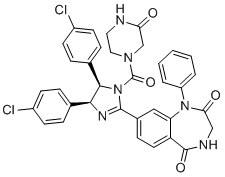
| DC70475 | H203 Featured |
H203 is a potent dual Mdm2/MdmX inhibitor with Ki of 2/11 nM, respectively;
H203 significantly reduced cell viability in the cells overexpressing both Mdm2 and MdmX, and a significant and dose-dependent decrease in cell number in H203-treated cells lacking Mdm2 or MdmX.
H203-mediated decrease in cell viability is strictly p53-dependent and H203 affects MdmX more specifically than nutlin-3a.
H203 induced the expression of the p21 gene but not the p53 gene in treated cancer cells.
More description
|
|
| DC10657 | COTI-2 Featured |
COTI-2 is a small molecule candidate anti-cancer drug which can convert mutant p53 to wild-type conformation.
More description
|

|
| DC8746 | NSC319726 Featured |
NSC319726 is a mutant p53R175 reactivator; inhibits growth of fibroblasts expressing the p53R175 mutation (IC50 = 8 nM); shows no inhibition for p53 wild-type cells.
More description
|

|
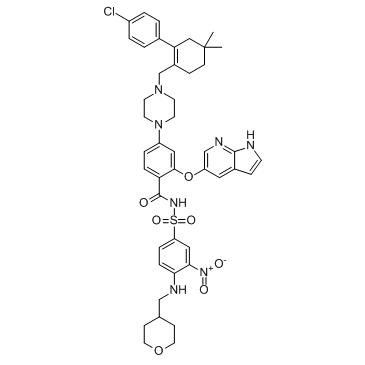
| DC2002 | Venetoclax(ABT-199) Featured |
Venetoclax (ABT-199; GDC-0199) is a highly selective, orally bioavailable small-molecule inhibitor of Bcl-2, exhibiting sub-nanomolar binding affinity with a Ki of less than 0.01 nM. This compound has been demonstrated to induce autophagy, highlighting its role in modulating programmed cell death pathways. In vitro studies reveal that Venetoclax exhibits potent cytotoxic activity against FL5.12-BCL-2 cells, with an EC50 of 4 nM, while showing markedly reduced efficacy against FL5.12-BCL-XL cells (EC50 = 261 nM), underscoring its selectivity for Bcl-2 over Bcl-XL.
The selectivity of Venetoclax is further corroborated in cellular mammalian two-hybrid assays, where it effectively disrupts BCL-2-BIM protein-protein interactions with an EC50 of 3 nM. In contrast, it demonstrates significantly weaker activity against BCL-XL-BCL-XS and MCL-1-NOXA complexes, with EC50 values of 2.2 μM, reinforcing its specificity for Bcl-2-dependent apoptotic regulation.
In vivo efficacy studies utilizing xenograft models derived from RS4;11 cells, a representative model of acute lymphoblastic leukemia (ALL), demonstrate that a single oral dose of Venetoclax (12.5 mg/kg) achieves a maximal tumor growth inhibition (TGImax) of 47% (P < 0.001) and a tumor growth delay (TGD) of 26% (P < 0.05). These results indicate robust anti-tumor activity in a Bcl-2-dependent malignancy.
More description
|
|
| DC8113 | Carubicin Featured |
Carubicin is an anthracycline antineoplastic antibiotic isolated from the bacterium Actinomadura carminata.
More description
|

|
| DC11726 | Milademetan Featured |
Milademetan (DS-3032) is a specific and orally active MDM2 inhibitor for the research of acute myeloid leukemia (AML) or solid tumors. Milademetan (DS-3032) induces G1 cell cycle arrest, senescence and apoptosis.
More description
|

|
| DC73134 | GNE-684 Featured |
GNE-684 is a potent, cross-species, specific RIP1 kinase (RIPK1) inhibitor with IC50 of 21, 189 and 691 nM for human, mouse and rat RIP1, respectively.
More description
|

|
| DC71725 | Misetionamide Featured |
Misetionamide is an orally oxathiazin-like compound. Misetionamide is a glyceraldehyde-3-phosphate dehydrogenase (GAPDH) inhibitor with antineoplastic activity. Misetionamide can be used for the research of cancer.
More description
|

|