To enhance service speed and avoid tariff delays, we've opened a US warehouse. All US orders ship directly from our US facility.
| Cat. No. | Product Name | Field of Application | Chemical Structure |
|---|---|---|---|
| DC74225 | YB-537 Featured |
YB-537 (YB537) is a potent, highly specific quinone reductase 2 (QR2) inhibitor with IC50 of 3 nM, shows no activity against QR1 (IC50>10 uM).
More description
|

|
| DC10157 | PAβN dihydrochloride Featured |
PAβN dihydrochloride (MC-207110 dihydrochloride) is an efflux pump inhibitor.
More description
|

|
| DC60637 | BI-9508 Featured |
BI-9508 is a potent and selective, brain-penetrant GPR88 agonist with EC50 of 47 nM.
More description
|

|
| DC73146 | MK-1468 Featured |
MK-1468 is a potent, selective, brain-penetrant LRRK2 inhibitor with IC50 of 0.4 nM (G2019S LRRK2), potently inhibits the phosphorylation of LRRK2 serine 935 (pSer935) in hPBMCs with IC50 of 2.8 nM.
More description
|

|
| DC66613 | BMS-986308 Featured |
BMS-986308 is a selective and orally active renal outer medullary potassium (ROMK) channel inhibitor. BMS-986308 is selective for ROMK over hERG. BMS-986308 can be used for heart failure research.
More description
|

|
| DC74571 | VT107 Featured |
VT-107, as an analogous to VT104, is an orally active and potent pan-TEAD auto-palmitoylation inhibitor. VT-107 can be used for the research of cancer.
More description
|

|
| DC66602 | Gepotidacin mesylate Featured |
Gepotidacin, also known as GSK-2140944, is a potent Type II DNA topoisomerase inhibitor. Gepotidacin is a novel antibacterial drug candidate. Gepotidacin Demonstrates Absence of Fluoroquinolone-Like Arthropathy in Juvenile Rats. Gepotidacin is efficacious in a nonhuman primate model of pneumonic plague. When tested against Gram-negative (n = 333) and Gram-positive (n = 225) anaerobes by agar dilution, gepotidacin inhibited 90% of isolates at concentrations of 4 and 2 μg/mL, respectively.
More description
|

|
| DC66601 | Zoniporide Featured |

|
|
| DC74158 | S9-A13 Featured |
S9-A13 is a highly potent and specific inhibitor of SLC26A9, potently inhibits SLC26A9-mediated Cl−/I− and Cl−/SCN− exchange activities with IC50 of 90.9 and 171.5 nM, respectively.S9-A13 does not inhibit other members of the SLC26 family and has no effects on Cl− channels such as CFTR, TMEM16A, or VRAC.S9-A13 (0-1 uM ) inhibits SLC26A9 currents in a dose-dependent manner in HEK293 cells, but shows little effects on CFTR currents in HEK293 cells at the highest concentration (5 uM).S9-A13 has a minor effect on ion transport in human airway epithelial cells and mouse trachea, despite clear expression of SLC26A9 in the apical membrane of ciliated cells.
More description
|

|
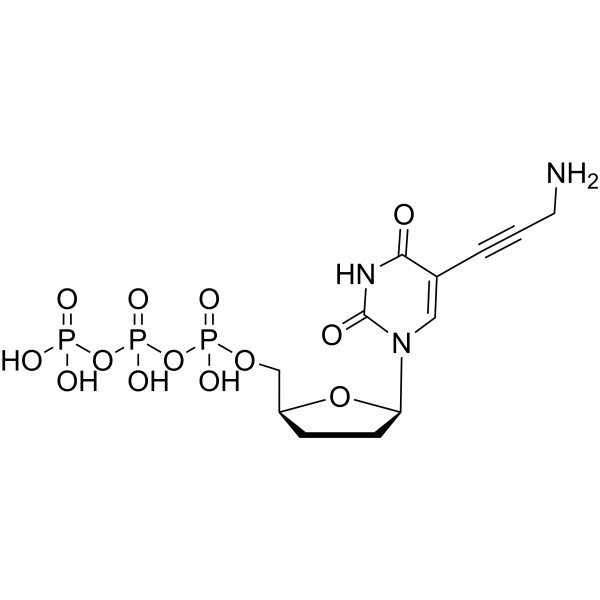
| DC44137 | 5-Propargylamino-ddUTP Featured |
5-Propargylamino-ddUTP, a nucleoside molecule that can be used to synthesis of cyanine dye-nucleotide conjugate which is used in nucleic acid labeling or sequence analysis.
More description
|
|
| DC66600 | BLU-222 Featured |
BLU-222 is an investigational, oral, potent, and selective CDK2 inhibitor. BLU-222 has shown robust anti-tumor activity in preclinical models of CCNE-aberrant ovarian, breast and gastric cancer.
More description
|

|
| DC66598 | Octadecyl β-D-glucopyranosiduronic acid Featured |

|
|
| DC66597 | 1-O-palmityl-D-glucuronic acid Featured |

|
|
| DC71559 | IZTZ-1 Featured |
IZTZ-1, an imidazole-benzothiazole conjugate, is a c-MYC G4 ligand. IZTZ-1 is able to downregulate the c-MYC expression by stabilizing c-MYC G4. IZTZ-1 induces cell cycle arrest, apoptosis, thereby inhibiting cell proliferation in B16 cells. IZTZ-1 shows antitumor activity, and can be used for melanoma research.
More description
|

|
| DC70730 | Ras binder 2C07 Featured |
Ras binder 2C07 is a switch-II binding ligand which binds Ras GDP and GTP states.
More description
|

|
| DC20170 | Dapagliflozin propanediol monohydrate Featured |
Dapagliflozin propanediol belongs to the class of orally administered antidiabetic agents designated as sodiumglucose cotransporter 2 (SGLT2) inhibitors.
More description
|

|
| DC40325 | ζ-Stat trisodium Featured |
ζ-Stat trisodium (NSC37044 trisodium) is a specific and atypical PKC-ζ inhibitor, with an IC50 of 5 μM. ζ-Stat trisodium can reduce melanoma cell lines proliferation and induce apoptosis, and has antitumor activity in vitro.
More description
|

|
| DC74161 | SAR439883 Featured |
SAR439883 (SAR 439883) is a novel potent, selective, orally active PKR inhibitor with IC50 of 0.68/0.69 uM against hPKR/mPKR, respectively.
More description
|

|
| DC22197 | PZ09(PKC-9) Featured |
PZ09 (PKC-zeta inhibitor 9, PKC-ζ inhibitor PZ9) is a potent, isoform selective PKC-zeta (PKC-ζ) inhibitor with IC50 of 5.18 nM, displays excellent selectivity (>200-fold) over other PKC isoforms with exception of PKC-i (10-fold). PZ09 also shows high selectivity for CDK-2 (>200-fold), as well as a broader range of other kinases (<50% inhibition at 10 uM). PZ09 is a small-molecule inhibitor, the first tool to successfully interrogate aPKC signaling in cells.
More description
|

|
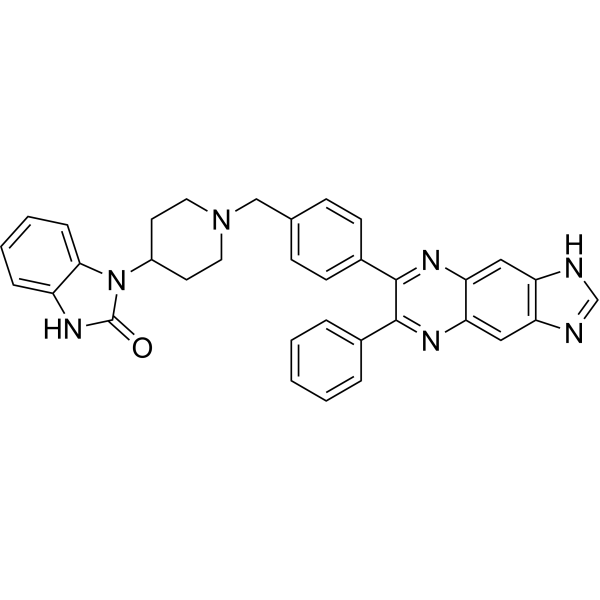
| DC8458 | Akt Inhibitor VIII Featured |
Akt Inhibitor VIII is a cell-permeable quinoxaline compound that has been shown to potently, selectively, allosterically, and reversibly inhibit Akt1, Akt2, and Akt3 activity (IC50 = 58 nM, 210 nM, and 2.12 μM; respectively).
More description
|
|
| DC66596 | Bartsiosid Featured |
Bartsioside is an anti-inflammatory agent which can be extracted from C. deserticola. Bartsioside exerts no significant cytotoxicity under 40 μM to BV-2 cells.
More description
|

|
| DC66595 | (+)-UH 232 Featured |
(+)-UH 232 is a partially selective agonist of the D3 receptor with an intrinsic activity of 0.2-0.4. (+)-UH 232 antagonized quinpirole-induced mitogenesis with a Ki value of 9.4 nM.
More description
|

|
| DC66594 | AJ-76 Featured |
AJ-76 ((+)-AJ 76; (1S,2R)-AJ 76) is a dopamine autoreceptor antagonist. AJ-76 can increase the synthesis and turnover of dopamine in the rat brain, while having little effect on the synthesis and turnover of serotonin (5-HT) and norepinephrine. AJ-76 can also antagonize the sedative effects of low-dose apomorphine and has a weak antagonistic effect on postsynaptic dopamine receptor.
More description
|

|
| DC66592 | GW274150 dihydrochloride Featured |
GW274150 (dihydrochloride) is a potent, selective, orally active and NADPH-dependent inhibitor of human inducible nitric oxide synthase (iNOS) (IC50=2.19 μM; Kd=40 nM) and rat iNOS (ED50=1.15 μM). GW274150 (dihydrochloride) displays less potency for both humans or rats endothelial NOS (eNOS) and neuronal NOS (nNOS). GW274150 (dihydrochloride) exerts a protective role in an acute model of lung injury inflammation.
More description
|

|
| DC66591 | 5-bromo-1H-pyrrolo[2,3-b]pyridine-2,3-dione Featured |

|
|
| DC10202 | AZD8797 Featured |
AZD8797 is an allosteric non-competitive modulator of the human CX3CR1 receptor; antagonizes CX3CL1 with IC50 values of 6 and 300 nM in B-lymphocyte cell line and human whole blood, respectively.
More description
|
|
| DC66589 | 1,4,7,10-Tetraoxa-13,16-diazacyclooctadecane Featured |

|
|
| DC71725 | Misetionamide Featured |
Misetionamide is an orally oxathiazin-like compound. Misetionamide is a glyceraldehyde-3-phosphate dehydrogenase (GAPDH) inhibitor with antineoplastic activity. Misetionamide can be used for the research of cancer.
More description
|

|
| DC36995 | Adrenochrome Featured |
Adrenochrome is a chemical compound produced by the oxidation of adrenaline (epinephrine). The derivative carbazochrome is a hemostatic medication.
More description
|

|
| DC66588 | GlyRS-IN-1 Featured |
GlyRS-IN-1 is a glycyl-tRNA synthase (GlyRS) inhibitor extracted from patent WO 2017066459 A1. GlyRS-IN-1 can also inhibit the growth of bacteria.
More description
|

|