To enhance service speed and avoid tariff delays, we've opened a US warehouse. All US orders ship directly from our US facility.
| Cat. No. | Product Name | Field of Application | Chemical Structure |
|---|---|---|---|
| DC72588 | SG2057 |
SG2057 (DRG16) is a PBD dimer containing a pentyldioxy linkage which binds sequence selectively in the minor groove of DNA forming DNA interstrand and intrastrand cross-linked adducts. SG2057 is a highly active antitumor agent.
More description
|

|
| DC72587 | Talotrexin |
Talotrexin (PT523), an analog of Aminopterin, is a nonpolyglutamatable classic antifolate. Talotrexin is a RFC (reduced folate carrier) specific inhibitor and selectively inhibits RFC transport. Talotrexin shows antitumor activity by targeting DHFR to inhibit tumor growth.
More description
|
|
| DC9246 | PJ34(free base) Featured |
PJ34 is a potent specific inhibitor of PARPl/2 with IC50 of 110 nM and 86 nM, respectively.
More description
|

|
| DC1028 | Y-27632 2HCL Featured |
Y-27632 2HCl is a selective ROCK1 (p160ROCK) inhibitor with Ki of 140 nM.
More description
|

|
| DC7533 | wiki4 Featured |
WIKI4 is a novel Tankyrase inhibitor with IC50 of 15 nM for TNKS2, and leads to inhibition of Wnt/beta-catenin signaling.
More description
|

|
| DC8068 | WHI-P180(Janex 3) Featured |
WHI-P180(Janex 3) is a potent inhibitor of IgE-mediated mast cell responses to allergens in vitro and in vivo. Also inhibits cyclin-dependent kinase 2 (CDK2; IC50 = 1µM) by blocking the ATP site
More description
|

|
| DC7530 | Voreloxin Featured |
Voreloxin(SNS-595; AG 7352) is a small molecule and a naphthyridine analogue with antineoplastic activity; inhibitor of Topo II.
More description
|

|
| DC7187 | Volasertib(BI6727) Featured |
Volasertib(BI6727) is a highly potent PLK1 inhibitor with an IC50 of 0.87 nM; shows 6- and 65-fold greater selectivity against Plk2 and Plk3.
More description
|

|
| DC5150 | Veliparib (ABT-888 hydrochloride) Featured |
Veliparib is a potent inhibitor of both PARP-1 and PARP-2 by [3H]NAD+ with Kis of 5.2 and 2.9 nmol/L, respectively.
More description
|

|
| DC3132 | VE-821 Featured |
VE-821 is a potent and selective ATP competitive inhibitor of ATR with Ki and IC50 of 13 nM and 26 nM, respectively.
More description
|

|
| DC7334 | UPF 1069 Featured |
UPF 1069 is a selective PARP2 inhibitor with IC50 of 0.3 μM; ~27-fold selective against PARP1.
More description
|

|
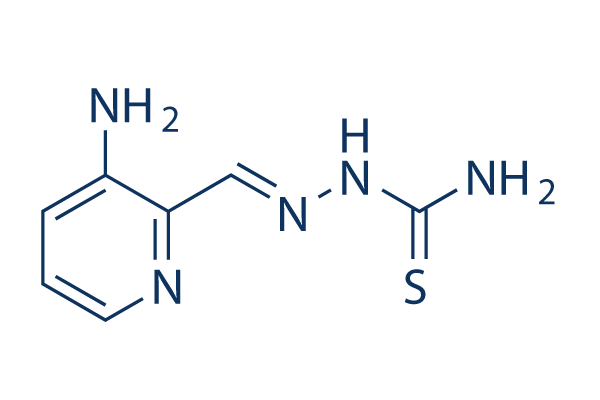
| DC7522 | Triapine Featured |
Triapine is a potent ribonucleotide reductase inhibitor with broad spectrum antitumor activity by inhibiting DNA synthesis. Phase 2.
More description
|
|
| DC10827 | THZ531 Featured |
THZ531 is a covalent CDK12 and CDK13 covalent inhibitor.
More description
|

|
| DC7653 | THZ1 free base Featured |
THZ1 is a novel selective and potent covalent CDK7 inhibitor with IC50(binding affinity) of 3.2 nM; inhibits Jurkat cell's proliferation with IC50 of 50 nM.
More description
|

|
| DC6902 | Thiazovivin Featured |
Thiazovivin is a rock inhibitor and enhances fibroblast reprogramming efficiency to generate stem cells
More description
|

|
| DC7689 | Evofosfamide(TH-302) Featured |
TH-302 is selective hypoxia-activated prodrug targeting hypoxic regions of solid tumors with IC50 of 19 nM, demonstrates 270-fold enhanced cytotoxicity under hypoxia versus their potency under aerobic conditions, stable to cytochrome P450 metabolism.
More description
|

|
| DC10067 | T-5601640(T56-LIMKi) Featured |
T56-LIMKi is a LIMK2 inhibitor that reduces phosphorylated cofilin, and induces disassembly of actin stress fibers in NF1-/- MEFs cells.
More description
|

|
| DC8852 | SW-044248 Featured |
SW-044248 is a Novel Inhibitor of Topoisomerase I Is Selectively Toxic for a Subset of Non-Small Cell Lung Cancer Cell Lines.
More description
|

|
| DC7493 | SB1317(TG-02) Featured |
SB1317(TG-02) is a novel small molecule potent CDK2/JAK2/FLT3 inhibitor with IC50s of 13/73/56 nM respectively.
More description
|

|
| DC7246 | SR3677 Featured |
SR-3677 is a new potent and selective ROCK-II inhibitor with an IC50 of ~3 nM in enzyme and cell based assays; IC50 for ROCK-I is 56 ± 12 nM.
More description
|

|
| DC7297 | SNS-032(BMS-387032) Featured |
SNS-032(BMS-387032) is a potent inhibitor of cyclin-dependent kinases (cdks) 9, 2 and 7 (IC50 values are 4, 38 and 62 nM respectively).
More description
|

|
| DC8329 | SLx-2119(KD-025,Belumosudil ) Featured |
SLx-2119(KD-025) is a small molecule and selective inhibitor of ROCK2 with IC50 of 105 nM; > 200 fold selecivity over ROCK1(IC50 =24 uM)
More description
|

|
| DC8737 | SCH900776 S-isomer Featured |
SCH900776 (S-isomer) is the S-isomer form of SCH900776, which is a potent, selective and orally bioavailable inhibitor of checkpoint kinase Chk1 (IC50 = 3 nM), highly selective against Chk2 (IC50 = 1500 nM) and cyclin-dependent kinase CDK2 (IC50
More description
|

|
| DC5024 | MK-8776 (SCH 900776) Featured |
SCH 900776 is a selective Chk1 inhibitor with IC50 of 3 nM. It shows 50-fold selectivity against Chk2. Phase 2.
More description
|

|
| DC9854 | SAR407899 Featured |
SAR407899 is a potent, ATP-competitive ROCK inhibitor woth Ki value of 36 nM/41 nM for human ROCK/Rat ROCK respectively.
More description
|

|
| DC3116 | RO-3306 Featured |
Ro-3306 is a potent and selective inhibitor of CDK1 with Ki value of 35 nM for CDK1/cyclin B1, 10-fold selectivity relative to CDK2/cyclin E and >50-fold relative to CDK4/cyclin D.
More description
|

|
| DC7269 | RKI-1447 Featured |
RKI-1447 is a potent small molecule inhibitor of ROCK1 and ROCK2.
More description
|

|
| DC8831 | RKI-1313 Featured |
RKI-1313 is the negative control for RKI-1447 which is a potent inhibitor of the Rho-associated ROCK kinases with anti-invasive and antitumor activities in breast cancer
More description
|

|
| DC7265 | Rigosertib Featured |
Rigosertib (ON-01910) is a non-ATP-competitive inhibitor of PLK1 with IC50 of 9 nM; shows 30-fold greater selectivity against PLK2 and no activity to PLK3.
More description
|

|
| DC8226 | RI-2 Featured |
RI-2 is an optimized RAD51 inhibitor with an IC50 of 44.17 μM in the standard DNA binding assay; specifically inhibits HR(Homologous recombination) repair in human cells.
More description
|

|