To enhance service speed and avoid tariff delays, we've opened a US warehouse. All US orders ship directly from our US facility.
| Cat. No. | Product Name | Field of Application | Chemical Structure |
|---|---|---|---|
| A600 | Epitomics patent anti-TNFα Biosimilar(Anti-TNFSF2 / TNFa Reference Antibody) Featured |

|
|
| A599 | CMAB008 Biosimilar(Anti-TNFSF2 / TNFa Reference Antibody) Featured |
|
|
| A598 | CDP-571 Biosimilar(Anti-TNFSF2 / TNFa Reference Antibody) Featured |
|
|
| A597 | CertolizumAb Biosimilar(Anti-TNFSF2 / TNFa Reference Antibody) Featured |
Certolizumab pegol (Certolizumab) is a recombinant, polyethylene glycolylated, antigen-binding fragment of a humanized monoclonal antibody that selectively targets and neutralizes tumour necrosis factor-α (TNF-α).
More description
|

|
| A596 | Quisovalimab Biosimilar(Anti-TNFSF14 / LIGHT / CD258 Reference Antibody) Featured |
Quisovalimab (AVTX-002; AEVI 002; SAR 252067) is a human monoclonal antibody against LIGHT, a tumor necrosis factor (TNF)-related cytokine (TNFSF14) that plays an important role in acute respiratory distress syndrome (ARDS) and cytokine release syndrome (CRS) COVID-19. Quisovalimab can be used in COVID-19 acute respiratory distress syndrome and other studies.
More description
|

|
| A595 | Belimumab Biosimilar(Anti-TNFSF13B / BAFF / CD257 Reference Antibody) Featured |
Belimumab (LymphoStat B) is a humanized IgG1λ monoclonal antibody against B-lymphocyte stimulator (BLyS) protein. Belimumab antagonizes BLyS activity in autoimmune diseases and B-lymphocyte malignancies. Belimumab can be used for systemic lupus erythematosus (SLE) research.
More description
|

|
| A594 | Tabalumab Biosimilar(Anti-TNFSF13B / BAFF / CD257 Reference Antibody) Featured |
Tabalumab (LY2127399) is a human anti-BAFF (B-cell activating factor) monoclonal antibody (IgG4 type) with neutralising activity against membrane bound and soluble BAFF. Tabalumab can be used in studies of autoimmune diseases such as rheumatoid arthritis, renal failure and systemic lupus erythematosus.
More description
|

|
| A593 | Zigakibart Biosimilar(Anti-TNFSF13 / APRIL / CD256 Reference Antibody) Featured |
Zigakibart (BION-1301) is an IgG4-kappa, anti-TNFSF13 (tumor necrosis factor (TNF) superfamily member 13, APRIL, CD256) humanized monoclonal antibody. Zigakibart shows anti-inflammatory activity.
More description
|

|
| A592 | Sibeprenlimab Biosimilar(Anti-TNFSF13 / APRIL / CD256 Reference Antibody) Featured |
Sibeprenlimab (VIS649) is a humanized IgG2 monoclonal antibody which inhibits a proliferation-inducing ligand (APRIL). Sibeprenlimab suppresses pathogenic immunoglobulins (IgA and IgM), while preserving antibody responses to mRNA-based vaccines against SARS-COV-2. Sibeprenlimab reduces urinary protein-to-creatinine ratio (UPCR) and glomerular filtration rate (GFR). Sibeprenlimab is promising for the research of IgA nephropathy (IgAN).
More description
|

|
| A591 | RO5458640 Biosimilar(Anti-TNFSF12 / TWEAK Reference Antibody) Featured |
|
|
| A590 | Urelumab Biosimilar(Anti-TNFRSF9 / 4-1BB / CD137 Reference Antibody) Featured |
Urelumab, a fully human, non-ligand binding, CD137 agonist IgG4 monoclonal antibody, enhances T-cell and natural killer-cell antitumor activity, and may enhance cytotoxic activity of Rituximab (HY-P9913). Urelumab can be used for the research of diffuse large B-cell lymphoma (DLBCL), follicular lymphoma (FL), and other types of non-Hodgkin lymphoma (NHL).
More description
|

|
| A589 | Utomilumab Biosimilar(Anti-TNFRSF9 / 4-1BB / CD137 Reference Antibody) Featured |
Utomilumab (PF 05082566) is a fully human IgG2 mAb agonist of the T-cell costimulatory receptor 4-1BB/CD137. Utomilumab can be used for the research of relapsed/refractory follicular lymphoma (FL) and other CD20+ non-Hodgkin lymphomas (NHL).
More description
|

|
| A588 | Brentuximab Biosimilar(Anti-TNFRSF8 / CD30 Reference Antibody) Featured |
Brentuximab is a monoclonal antibody targeting CD30. Brentuximab is conjugated with monomethyl auristatin E (MMAE) (HY-15162) to form the antibody-drug conjugate Brentuximab vedotin (HY-P99107), which can induce apoptosis in primary effusion lymphoma cells. Brentuximab vedotin exhibits antitumor activity with an IC50 of 10 nM against human CD30+ cancer cells.
More description
|

|
| A587 | Organon patent anti-CD27 Biosimilar(Anti-TNFRSF7 / CD27 Reference Antibody) Featured |
|
|
| A586 | Varlilumab Biosimilar(Anti-TNFRSF7 / CD27 Reference Antibody) Featured |
Varlilumab (CDX-1127) is a first-in-class human IgG1 anti-CD27 monoclonal antibody. Varlilumab has an anti-tumor activity.
More description
|

|
| A585 | Emory U. anti-CD40 Biosimilar(Anti-TNFRSF5 / CD40 Reference Antibody) Featured |
|
|
| A584 | Mitazalimab Biosimilar(Anti-TNFRSF5 / CD40 Reference Antibody) Featured |
Mitazalimab (ADC-1013; JNJ-64457107) is FcγR-dependent CD40 agonist with tumor-directed activity. Mitazalimab activates antigen-presenting cells, e.g. dendritic cells (DC), to initiate tumor-reactive T cells. Therefore, Mitazalimab induces tumor-specific T cells to infiltrate and kill tumors. Mitazalimab remodels the tumor-infiltrating myeloid microenvironment.
More description
|

|
| A583 | Bleselumab Biosimilar(Anti-TNFRSF5 / CD40 Reference Antibody) Featured |
Bleselumab (ASKP 1240) is a human anti-CD40 monoclonal antibody (mAb). Bleselumab binds to human CD40 with high affinity (Kd: ?0.24?nM). Bleselumab inhibits immune responses by blocking the interaction of CD40 with its ligand CD40L. Bleselumab prevents organ transplant rejection.
More description
|

|
| A582 | Iscalimab Biosimilar(Anti-TNFRSF5 / CD40 Reference Antibody) Featured |
Iscalimab (CFZ-533) is a non-depleting IGg1 monoclonal antibody targeting CD40 (KD: 0.3 nM). Iscalimab can be used for research of Graves' hyperthyroidism and autoimmune diseases.
More description
|

|
| DC40273 | AV-105 Featured |
AV-105 is a tosylate precursor compound derived from Florbetapir (18F), a radiolabeled styrylpyridine derivative referenced in patent WO2010078370A1 (Example 1.5). This precursor plays a crucial role in the synthesis of 18F-radiolabeled imaging agents, particularly for positron emission tomography (PET) applications.
More description
|

|
| DC8052 | AZ5104 Featured |
AZ-5104 is a pharmacologically active metabolite derived from the demethylation of AZD9291 (osimertinib). It functions as a potent EGFR inhibitor, demonstrating strong inhibitory activity against various EGFR mutants and ErbB4.
More description
|

|
| DC22799 | ML-162 Featured |
ML162 is a covalent inhibitor that specifically targets glutathione peroxidase 4 (GPX4), a key regulator of ferroptosis. This compound exhibits selective cytotoxicity against cancer cell lines harboring mutant RAS oncogenes, making it a promising candidate for precision oncology.
More description
|

|
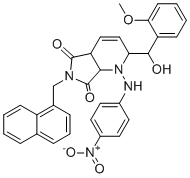
| DC70162 | A83B4C63 Featured |
A83B4C63 is a highly potent small-molecule inhibitor targeting the DNA repair enzyme polynucleotide kinase 3'-phosphatase (PNKP), exhibiting strong binding affinity with a Kd of 80 nM. Due to its limited aqueous solubility, A83B4C63 was formulated into nano-encapsulated carriers, enhancing its therapeutic potential—particularly in PTEN-deficient colorectal cancer (CRC).
More description
|
|
| DC11235 | Furamidine dihydrochloride Featured |
Furamidine dihydrochloride (NSC 305831) tyrosyl-DNA phosphodiesterase (Tdp1), also is a selective protein arginine methyltransferase 1 (PRMT1) inhibitor with IC50 of 9.4 uM.
More description
|

|
| DC67413 | MRT-23227 Featured |

|
|
| DC67411 | MRT-7612 Featured |

|
|
| DC67410 | MRT-10350 Featured |

|
|
| DC32456 | Pyrinuron Featured |
Pyrinuron is an inhibitor of NAMPT and NMNAT2.Pyrinuron is used as a model compound in studies of urea derivatives and their reactivity.Research has explored the effects of this compound on insulin-producing beta cells, providing insights into diabetes mechanisms.Although not used therapeutically, this compound’s ability to selectively destroy beta cells has implications for understanding and potentially treating type 1 diabetes.
More description
|

|
| DC67407 | IKZF1-degrader-1 Featured |
IKZF1-degrader-1 (Compound 9-B) is a highly potent molecular glue that achieves sub-nanomolar degradation of IKZF1 (DC50 = 0.134 nM), demonstrating significant therapeutic potential for targeting IKZF1-dependent malignancies.
More description
|

|
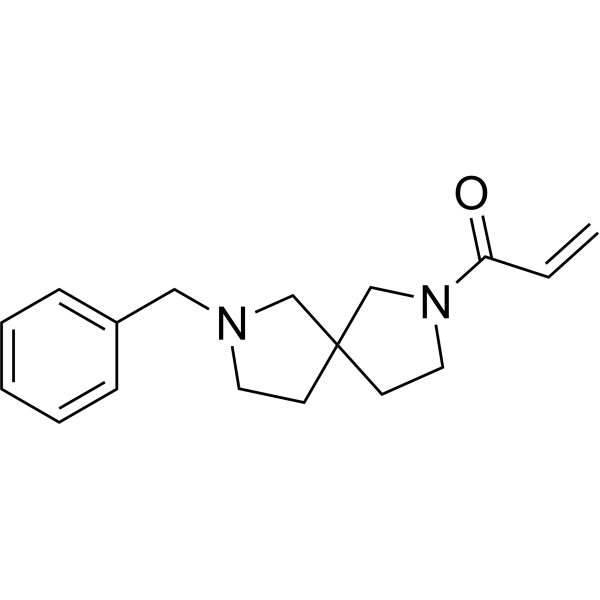
| DC73867 | EN171 Featured |
EN171 covalently targets both C38 and C96 on 14−3−3 to enhance 14−3−3 interactions with ERα, YAP, and TAZ, leading to impaired estrogen receptor and Hippo pathway transcriptional activity.
More description
|
|