 To enhance service speed and avoid tariff delays, we've opened a US warehouse. All US orders ship directly from our US facility.
| Cat. No. | Product Name | Field of Application | Chemical Structure |
|---|---|---|---|
| A585 | Emory U. anti-CD40 Biosimilar(Anti-TNFRSF5 / CD40 Reference Antibody) Featured |

|
|
| A584 | Mitazalimab Biosimilar(Anti-TNFRSF5 / CD40 Reference Antibody) Featured |
Mitazalimab (ADC-1013; JNJ-64457107) is FcγR-dependent CD40 agonist with tumor-directed activity. Mitazalimab activates antigen-presenting cells, e.g. dendritic cells (DC), to initiate tumor-reactive T cells. Therefore, Mitazalimab induces tumor-specific T cells to infiltrate and kill tumors. Mitazalimab remodels the tumor-infiltrating myeloid microenvironment.
More description
|

|
| A583 | Bleselumab Biosimilar(Anti-TNFRSF5 / CD40 Reference Antibody) Featured |
Bleselumab (ASKP 1240) is a human anti-CD40 monoclonal antibody (mAb). Bleselumab binds to human CD40 with high affinity (Kd: ?0.24?nM). Bleselumab inhibits immune responses by blocking the interaction of CD40 with its ligand CD40L. Bleselumab prevents organ transplant rejection.
More description
|

|
| A582 | Iscalimab Biosimilar(Anti-TNFRSF5 / CD40 Reference Antibody) Featured |
Iscalimab (CFZ-533) is a non-depleting IGg1 monoclonal antibody targeting CD40 (KD: 0.3 nM). Iscalimab can be used for research of Graves' hyperthyroidism and autoimmune diseases.
More description
|

|
| DC40273 | AV-105 Featured |
AV-105 is a tosylate precursor compound derived from Florbetapir (18F), a radiolabeled styrylpyridine derivative referenced in patent WO2010078370A1 (Example 1.5). This precursor plays a crucial role in the synthesis of 18F-radiolabeled imaging agents, particularly for positron emission tomography (PET) applications.
More description
|

|
| DC8052 | AZ5104 Featured |
AZ-5104 is a pharmacologically active metabolite derived from the demethylation of AZD9291 (osimertinib). It functions as a potent EGFR inhibitor, demonstrating strong inhibitory activity against various EGFR mutants and ErbB4.
More description
|

|
| DC22799 | ML-162 Featured |
ML162 is a covalent inhibitor that specifically targets glutathione peroxidase 4 (GPX4), a key regulator of ferroptosis. This compound exhibits selective cytotoxicity against cancer cell lines harboring mutant RAS oncogenes, making it a promising candidate for precision oncology.
More description
|

|
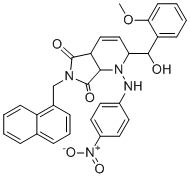
| DC70162 | A83B4C63 Featured |
A83B4C63 is a highly potent small-molecule inhibitor targeting the DNA repair enzyme polynucleotide kinase 3'-phosphatase (PNKP), exhibiting strong binding affinity with a Kd of 80 nM. Due to its limited aqueous solubility, A83B4C63 was formulated into nano-encapsulated carriers, enhancing its therapeutic potential—particularly in PTEN-deficient colorectal cancer (CRC).
More description
|
|
| DC11235 | Furamidine dihydrochloride Featured |
Furamidine dihydrochloride (NSC 305831) tyrosyl-DNA phosphodiesterase (Tdp1), also is a selective protein arginine methyltransferase 1 (PRMT1) inhibitor with IC50 of 9.4 uM.
More description
|

|
| DC67413 | MRT-23227 Featured |

|
|
| DC67411 | MRT-7612 Featured |

|
|
| DC67410 | MRT-10350 Featured |

|
|
| DC32456 | Pyrinuron Featured |
Pyrinuron is an inhibitor of NAMPT and NMNAT2.Pyrinuron is used as a model compound in studies of urea derivatives and their reactivity.Research has explored the effects of this compound on insulin-producing beta cells, providing insights into diabetes mechanisms.Although not used therapeutically, this compound’s ability to selectively destroy beta cells has implications for understanding and potentially treating type 1 diabetes.
More description
|

|
| DC67407 | IKZF1-degrader-1 Featured |
IKZF1-degrader-1 (Compound 9-B) is a highly potent molecular glue that achieves sub-nanomolar degradation of IKZF1 (DC50 = 0.134 nM), demonstrating significant therapeutic potential for targeting IKZF1-dependent malignancies.
More description
|

|
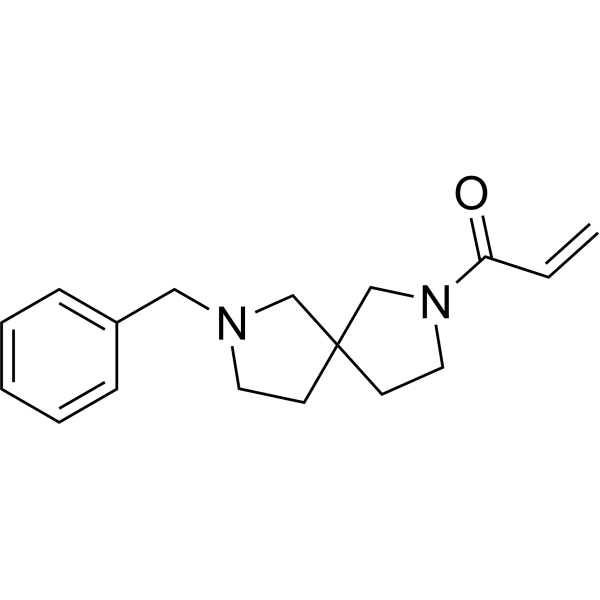
| DC73867 | EN171 Featured |
EN171 covalently targets both C38 and C96 on 14−3−3 to enhance 14−3−3 interactions with ERα, YAP, and TAZ, leading to impaired estrogen receptor and Hippo pathway transcriptional activity.
More description
|
|
| DC67406 | EM12-FS Featured |
EM12-FS is a bifunctional CRBN modulator that engages cereblon at His353 while functioning as a molecular glue to induce NTAQ1 degradation. Demonstrating favorable pharmacokinetics, it exhibits a human plasma half-life of 196 minutes, supporting its therapeutic potential.
More description
|

|
| DC67405 | Acetyl-cyclosporin A aldehyde Featured |
Acetyl-cyclosporin A aldehyde is a chemically modified derivative of cyclosporin A (HY-B0579), featuring an acetyl group and a reactive aldehyde moiety. The parent compound, cyclosporin A, is a dual-function molecule that both inhibits calmodulin signaling and binds cyclophilin, thereby blocking NF-AT nuclear translocation and inducing mitochondrial dysfunction.
More description
|

|
| DC67404 | QS-57 Featured |
QS-57 is a bifunctional degrader that combines BRD4-targeting PROTAC activity with 14-3-3 molecular glue properties.
More description
|

|
| DC67403 | KRAS ligand 4 Featured |
KRAS ligand 4 (compound 2) is a SOS1-targeting bifunctional molecular glue that suppresses oncogenic signaling by degrading key KRAS pathway components, evidenced by reduced pERK and pS6 levels. It demonstrates broad-spectrum activity against diverse KRAS mutations, disrupting proliferation across resistant cancer models.
More description
|

|
| DC67402 | Pomalidomide-15N,13C5 Featured |
Pomalidomide-15N,13C5 is a stable isotope-labeled variant of pomalidomide (HY-10984), a third-generation immunomodulatory drug that functions as a cereblon-directed molecular glue. This compound mediates targeted ubiquitination and degradation of Ikaros family transcription factors (IKZF1/3) through recruitment of the CRL4CRBN E3 ligase complex, underpinning its therapeutic mechanism.
More description
|

|
| DC67401 | GSPT1 degrader-5 Featured |
GSPT1 degrader-5 (compound 4) is a molecular glue compound that induces targeted degradation of GSPT1 with a DC50 of 144 nM, demonstrating moderate but selective activity.
More description
|

|
| DC67400 | ER degrader 9 Featured |
ER degrader 9 (compound 1) is a bifunctional molecular glue that achieves sub-10 nM degradation potency (DC50 ≤10 nM) against estrogen receptor (ER) in MCF-7 breast cancer cells, demonstrating significant potential for therapeutic development in ER-dependent malignancies.
More description
|

|
| DC67399 | VAV1 degrader-2 Featured |
VAV1 degrader-2 (Example 176) is a high-potency molecular glue that selectively targets VAV1 for degradation (DC50 = 4.41 nM), demonstrating therapeutic potential for modulating inflammatory and autoimmune pathways.
More description
|

|
| DC67398 | SJ46411-Br Featured |
SJ46411-Br is a selective CRL2^KLHDC2 E3 ligase ligand that facilitates cooperative, target-specific ternary complex formation. Its modular design enables conjugation to BET inhibitors like JQ1 (HY-13030) via PROTAC linkers, serving as a versatile scaffold for developing KLHDC2-directed degraders.
More description
|

|
| DC67397 | JWJ-01-306 Featured |
JWJ-01-306 is a first-in-class molecular glue that selectively targets and degrades the C2H2 zinc finger transcription factor ZBTB11, disrupting mitochondrial metabolism by suppressing oxidative phosphorylation (OXPHOS) and the tricarboxylic acid (TCA) cycle. This dual metabolic reprogramming activity overcomes proliferation in KAS-mutant pancreatic ductal adenocarcinoma (PDAC) cells while demonstrating favorable pharmacokinetic properties in vivo.
More description
|

|
| DC67396 | CDK-IN-9 Featured |
CDK-IN-9 (compound 24) is a bifunctional agent that combines potent CDK2/E inhibition (IC50 = 4 nM) with molecular glue activity, selectively bridging CDK12 and DDB1 to trigger polyubiquitination and proteasomal degradation of cyclin K.
More description
|

|
| DC67395 | Cyclosporin A-d3 Featured |
Cyclosporin A-d3 is a deuterium-enriched isotopologue of Cyclosporin A (HY-B0579), designed for metabolic stability studies and quantitative mass spectrometry applications.
More description
|

|
| DC67394 | HGC652 Featured |
HGC652 is a first-in-class molecular glue that selectively recruits the E3 ubiquitin ligase TRIM21 to form a ternary complex with NUP98, triggering targeted degradation of NUP155 and nuclear pore complex (NPC) proteins. This unique mechanism induces potent cytotoxicity across multiple cancer types, with activity correlating with cellular TRIM21 expression levels.
More description
|

|
| DC67392 | PROTAC GSPT1 degrader-2 Featured |
PROTAC GSPT1 degrader-2 (compound A) is a highly efficient molecular glue that achieves near-complete GSPT1 degradation (>95%). This compound demonstrates potent anti-proliferative activity in HL-60 leukemia cells, with an IC50 value of 10 nM, highlighting its therapeutic potential.
More description
|

|
| DC67391 | WIZ degrader 8 Featured |
WIZ degrader 8 (compound 10) is a potent and selective molecular glue that induces targeted degradation of the transcription factor WIZ, resulting in robust upregulation of fetal hemoglobin (HbF) expression. This dual activity—WIZ depletion coupled with HbF induction—positions it as a promising therapeutic candidate for sickle cell disease.
More description
|

|
