To enhance service speed and avoid tariff delays, we've opened a US warehouse. All US orders ship directly from our US facility.
| Cat. No. | Product Name | Field of Application | Chemical Structure |
|---|---|---|---|
| DC79845 | SK2188 Featured |
SK2188 is a highly efficient and selective PROTAC degrader targeting AURKA (DC50 = 3.9 nM). SK2188 induces DNA damage and cell apoptosis. SK2188 indirectly degrades MYCN, inhibits tumor cell proliferation, and provides insights into the study of MYCN-amplified neuroblastoma.
More description
|

|
| DC67279 | Rhobo6 Featured |
Rhobo6 is a cell-impermeable small-molecule fluorophore designed for labeling the extracellular matrix (ECM) in live tissues. It contains a phenylboronic acid group that binds to diols commonly found in ECM glycans, resulting in a significant increase in fluorescence and a red shift in emission spectra. This property allows Rhobo6 to effectively visualize ECM architecture without perturbing native structures, making it suitable for long-term imaging studies. Additionally, Rhobo6's low affinity for monosaccharides enables reversible binding, which prevents photobleaching and allows for dynamic imaging of ECM components. While Rhobo6 does not specifically target individual ECM components, it provides a holistic view of ECM distribution and is particularly useful for studying ECM-related biological phenomena in samples that are not amenable to genetic manipulation or ex vivo culture.Rhobo6 is available under license from the Howard Hughes Medical Institute.
More description
|

|
| DC46956 | Thalidomide-5-COOH Featured |
Thalidomide-5-COOH is the Thalidomide-based cereblon ligand used in the recruitment of CRBN protein. Thalidomide-5-COOH can be connected to the ligand for protein by a linker to form PROTACs.
More description
|

|
| DC67705 | (±)-JQ1 Featured |
(±)-JQ1 is the racemate of (+)-JQ-1 (HY-13030).
More description
|
-JQ1.gif)
|
| DC47889 | Thalidomide-5-NH2-CH2-COOH Featured |
Thalidomide-5-NH2-CH2-COOH (compound 114) is a potent and selective inhibitor of tropomyosin receptor kinase (trk). Thalidomide-5-NH2-CH2-COOH is a ligand of E3 ligase. Thalidomide-5-NH2-CH2-COOH has the potential for the treatment of one or more diseases (extracted from patent WO2021170109A1) .
More description
|

|
| DC67706 | (R,S,S)-AHPC hydrochloride Featured |
-AHPC hydrochloride.gif)
|
|
| DC67709 | UNC10225387B Featured |
UNC10225387B is a multi-kinase inhibitor, cocktail of UNC10225387B, UNC10225263A and UNC10225761A, promotes stem-cell-like chimeric antigen receptor T cells (CAR T cells).
More description
|

|
| DC67710 | UNC10225263A Featured |
UNC10225263A is a multi-kinase inhibitor, cocktail of UNC10225387B, UNC10225263A and UNC10225761A, promotes stem-cell-like chimeric antigen receptor T cells (CAR T cells).
More description
|

|
| DC67711 | UNC10225761A Featured |
UNC10225761A is a multi-kinase inhibitor, cocktail of UNC10225387B, UNC10225263A and UNC10225761A, promotes stem-cell-like chimeric antigen receptor T cells (CAR T cells).
More description
|

|
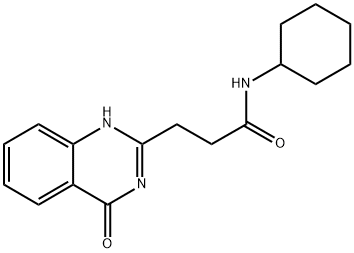
| DC67714 | WAY-620124 Featured |
|
|
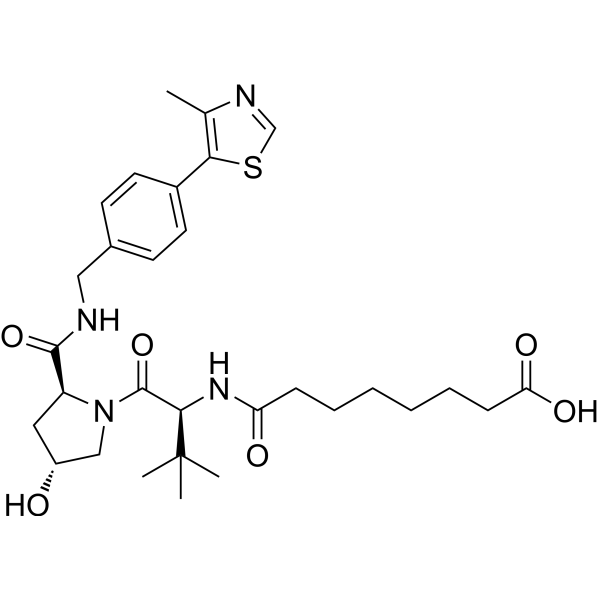
| DC67713 | VH 032 amide-alkylC6-acid Featured |
VH 032 amide-alkylC6-acid ((S,R,S)-AHPC-CO-C6-COOH) is a VH032 analog that acts as a ligand for VHL, recruiting von Hippel-Lindau (VHL) protein. VH 032 amide-alkylC6-acid can be used in the synthesis of PROTACs.
More description
|
|
| DC67716 | (S,R,S)-AHPC-PEG2-C4-Cl Featured |
(S,R,S)-AHPC-PEG2-C4-Cl (VH032-PEG2-C4-Cl) is a conjugate of ligands for E3 and 13-atom-length linker. The connector of linker is Halogen group. (S,R,S)-AHPC-PEG2-C4-Cl incorporates the (S,R,S)-AHPC based VHL ligand and an alkyl/ether-based linker. (S,R,S)-AHPC-PEG2-C4-Cl is capable of inducing the degradation of GFP-HaloTag7 in cell-based assays.
More description
|
-AHPC-PEG2-C4-Cl.gif)
|
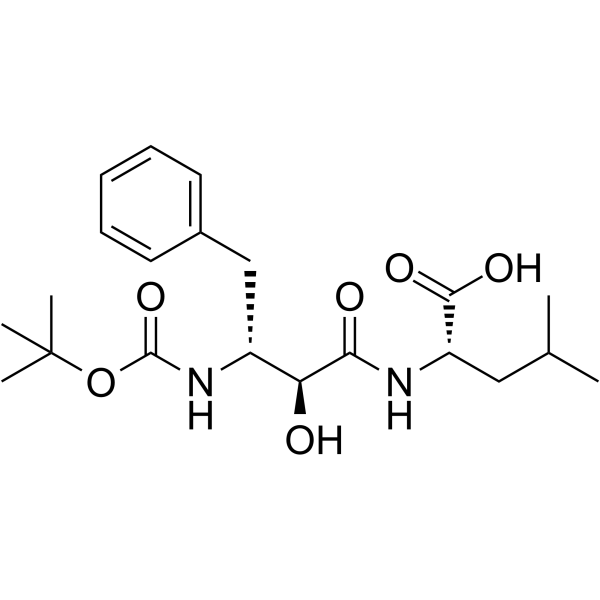
| DC67715 | E3 ligase Ligand 9 Featured |
E3 ligase Ligand 9 is a ligand for E3 ubiquitin ligase. E3 ligase Ligand 9 can be connected to the ligand for protein by a linker to form PROTACs or SNIPERs. PROTACs are inducers of ubiquitination-mediated degradation of cancer-promoting proteins.
More description
|
|
| DC67717 | 1H-Indazole-4-carboxamide, 6-bromo-N-[(1,2-dihydro-4,6-dimethyl-2-oxo-3-pyridinyl)methyl]-1-(1-methylethyl)- Featured |
methyl]-1-(1-methylethyl)-.gif)
|
|
| DC67719 | (S,R,S)-CO-C2-acid Featured |
(S,R,S)-CO-C2-acid (VH 032 amide-alkylC2-acid) is a functionalized von-Hippel-Lindau (VHL) protein ligand that can be used in PROTAC research and development. (S,R,S)-CO-C2-acid contains an E3 ligand alkyl ligand for conjugation of target protein ligands.
More description
|
-CO-C2-acid.gif)
|
| DC67723 | Petrelintide acetate Featured |
Perelintide (ZP8396) acetate is an amylin analog that shows potential for reducing body weight. Petrelintide can be used in diabetes research.
More description
|

|
| DC60798 | 6-[1-(Hexyloxy)ethoxy]hexanal Featured |
6-[1-(Hexyloxy)ethoxy]hexanal is the tail fragement for MK16.MK16 is a novel blood-brain barrier (BBB)-crossing lipid nanoparticle (BLNP) platform developed for efficient mRNA delivery to the central nervous system (CNS).
More description
|

|
| DC67545 | 4-nonanoyloxy-3-(nonanoyloxymethyl)butanoic acid Featured |
Tail of CICL-1 lipid
More description
|

|
| DC60899 | N-[2-(Dodecyldisulfanyl)ethyl]acrylamide Featured |

|
|
| DC60900 | ALC-0159 (di-C18) Featured |
ALC-0159 (di-C18) is an analog of ALC-0159, in which the original C14 chain is replaced with C18 chain. C18-ALC-0159 demonstrates high stability in vivo, effectively prevents binding with proteins such as ApoE, and achieves a prolonged blood circulation time. It also reduces liver targeting and accumulation.
More description
|

|
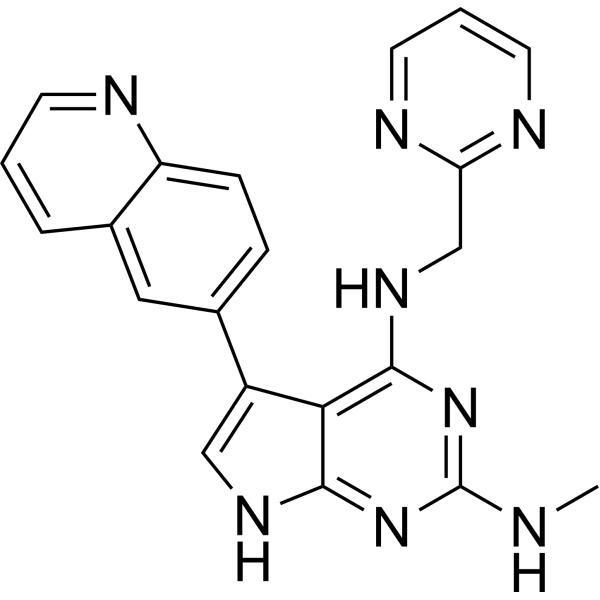
| DC77088 | T025 Featured |
T025 is as an orally available and potent inhibitor of Cdc2‐like kinases (CLKs) with an IC50s of 0.93 nM, 1 nM, 14 nM, 1.5 nM for CLK1, CLK2, CLK3, DYRK1B respectively. It exhibits anti‐tumor efficacy and can be used in MYC‐driven cancer research.
More description
|
|
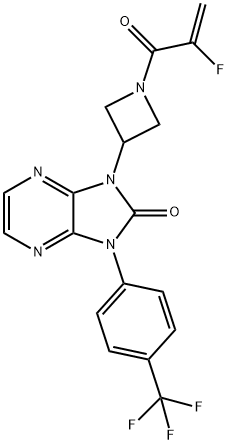
| DC60903 | BPI-460372 Featured |
|
|
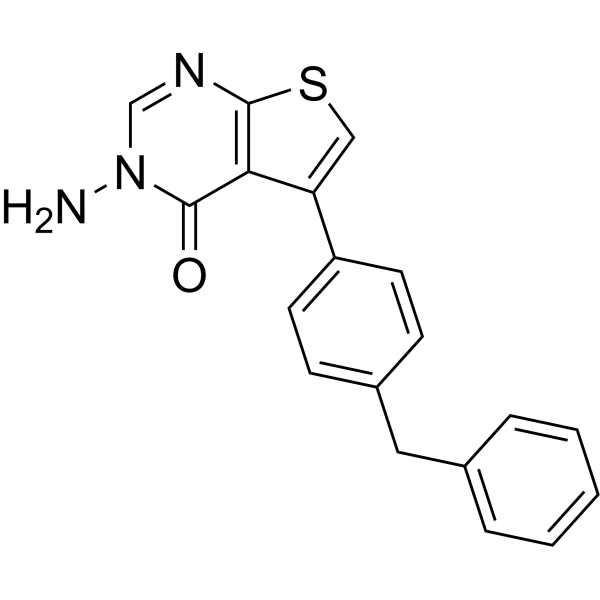
| DC20317 | Barbadin Featured |
Barbadin is a small molecule that selectively inhibits the β-arrestin/β2-adaptin interaction (IC50=19.1/15.6 uM for β-arrestin1/2) without effect on the formation of receptor/β-arrestin complexes.
More description
|
|
| DC60678 | ALG-055009 Featured |
ALG-055009 is a potent and selective thyroid hormone receptor beta (THR-β) agonist with EC50 of 0.063 μM. ALG-055009 is highly metabolically stable, with good permeability and a relatively low efflux ratio.
More description
|

|
| DC60906 | Lp(a)-IN-5 Featured |
Lp(a)-IN-5 (Compound A) is an orally active lipoprotein (a) (Lp(a)) inhibitor. Lp(a)-IN-5 inhibits the assembly of Apo(a) and ApoB proteins with an IC50 value of 0.41 nM. Lp(a)-IN-5 is promising for research of diseases related to elevated plasma Lp(a) levels, such as cardiovascular diseases.
More description
|
-IN-5.gif)
|
| DC60643 | BRD-810 Featured |
BRD-810 is a potent and selective MCL1 inhibitor with Kd of 0.3 nM (SPR) and IC50 of 0.4 nM (MCL1-Noxa HTRF), respectively. BRD-810 is a rapidly cleared inhibitor of MCL1 that has robust antitumor efficacy in hematological and solid tumor cancer models.
More description
|

|
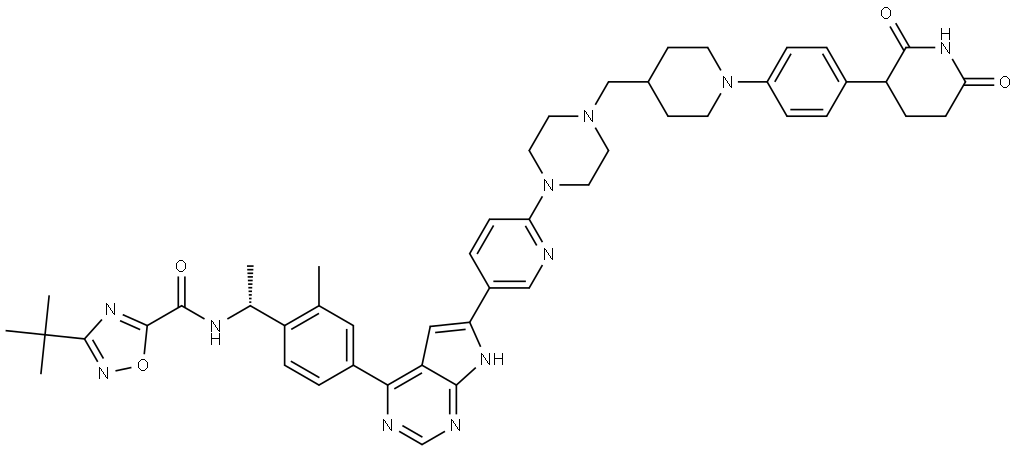
| DC60901 | PROTAC BTK Degrader-11 Featured |
PROTAC BTK Degrader-11 is a PROTAC degrader that can break down BTK, with a DC50 of 1.7 nM.
More description
|
|
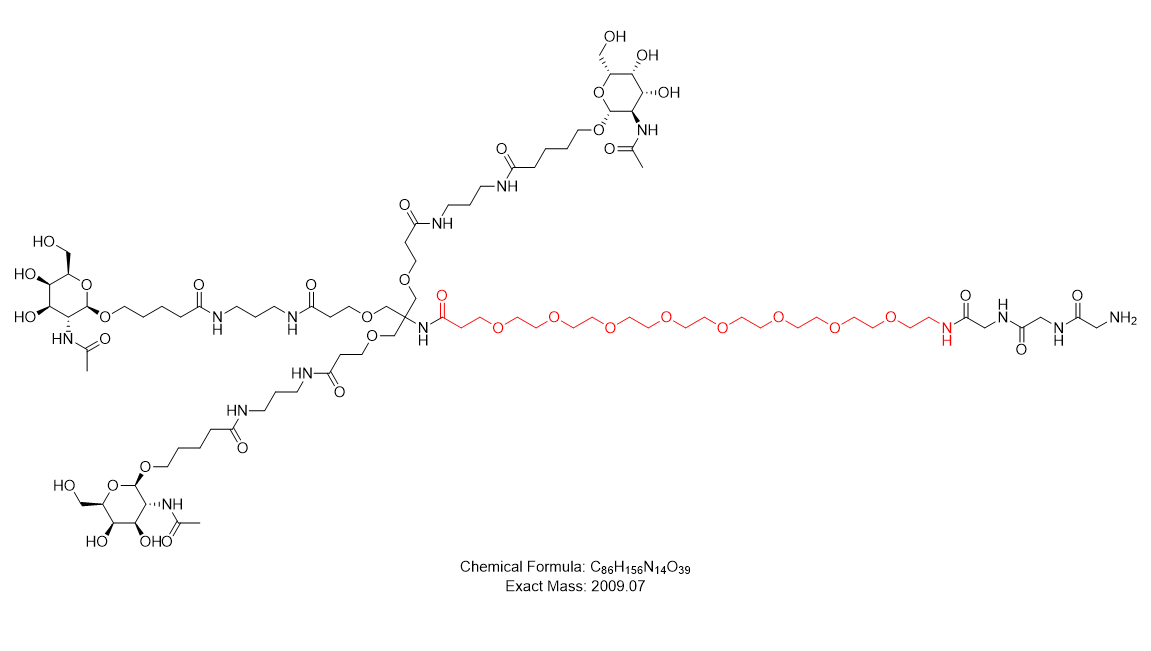
| DC60914 | Tri-GalNAc-PEG8-Gly-Gly-Gly(Tri-GalNAc-G3) Featured |
Tri-GaNAc-PEG8-Gly-Gly-Gly is a compound that targets the asialoglycoprotein receptor (ASGPR) and is utilized to conjutate with antibody.
More description
|
|
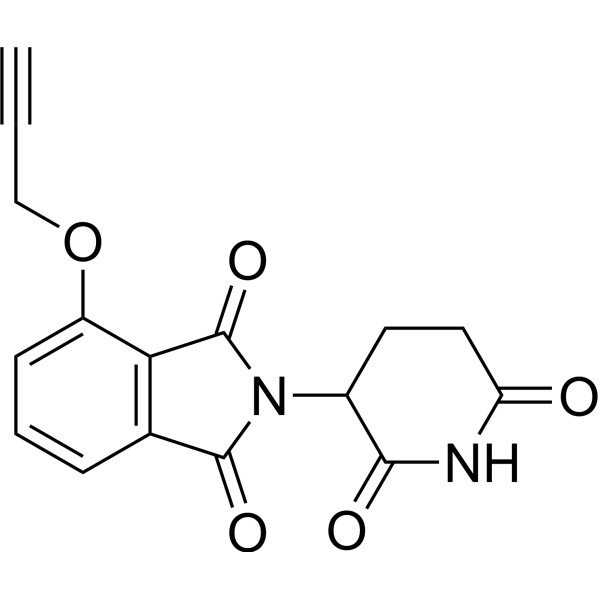
| DC67724 | Thalidomide-propargyl Featured |
Thalidomide-propargyl is the Thalidomide-based Cereblon ligand used in the recruitment of CRBN protein. Thalidomide-propargyl can be connected to the ligand for protein by a linker to form the IMiD containing PROTACs[1]. Thalidomide-propargyl is a click chemistry reagent, it contains an Alkyne group and can undergo copper-catalyzed azide-alkyne cycloaddition (CuAAc) with molecules containing Azide groups.
More description
|
|
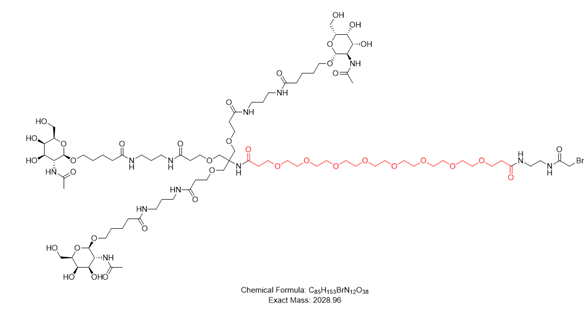
| DC60915 | Tri-GalNAc-PEG8-NH2-CH2CH2-NH2-bromoacetyl (Tri-GalNAc-Haloacetyls) Featured |
Tri-GaNAc-PEG8-NH2-CH2CH2-NH2-bromoacetyl is a compound that targets the asialoglycoprotein receptor (ASGPR) and is utilized to conjutate with antibody.
More description
|
|