 To enhance service speed and avoid tariff delays, we've opened a US warehouse. All US orders ship directly from our US facility.
| Cat. No. | Product Name | Field of Application | Chemical Structure |
|---|---|---|---|
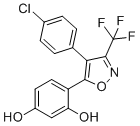
| DC70327 | CTIBD Featured |
CTIBD is a novel potent activator of the BKCa channel with EC50 of 3.9 uM.CTIBD showed significantly higher potency compared with three other known BKCa activators: NS 1619, NS 11021, and rottlerin.CTIBD induced a reversible potentiation of macroscopic outward currents of the BKCa channel, CTIBD activates both rSlo/rβ1 and rSlo/rβ4 coexpressed channels mainly by decreasing the closing rate of the channel.CTIBD concentration-dependently reduced ACh-induced contractions in isolated rat urinary bladder strips. CTIBD effectively restored frequent voiding contraction and lowered voiding volume without affecting other bladder function parameters in acetic acid-induced overactive bladder (OAB) model (i.p. 20 mg/kg).
More description
|
|
| DC81805 | α-Glucosidase-IN-113 |
α-Glucosidase-IN-113 is an α-glucosidase inhibitor with an IC50 of 17.52 μM. α-Glucosidase-IN-113 shows antiglycating activity and inhibits advanced glycation end-product formation. α-Glucosidase-IN-113 can be used for the research of type 2 diabetes.
More description
|

|
| DC81547 | SM-11044 |
SM-11044 is a β-adrenoceptor agonist with Ki values of 18.1 μM (β1), 4.1 μM (β2) and 1.3 μM (β3), showing higher binding selectivity for the β3-adrenoceptor. SM-11044 stimulates cAMP accumulation in cells expressing this receptor. SM-11044 mediates ileal relaxation, tracheal relaxation, pulmonary parenchymal relaxation, increased right atrial heart rate and adipocyte lipolysis.
More description
|
|
| DC81508 | SCH-720881 |
SCH-720881 is the active metabolite of Rolapitant. Rolapitant (SCH619734) is a potent, selective, long-acting and orally active neurokinin 1 (NK1) receptor antagonist with a Ki of 0.66 nM. Rolapitant does not interact with CYP3A4. Rolapitant shows potent anti-emetic activity in a ferret emesis model.
More description
|
|
| DC81342 | PROTAC CDK2/4/6 Degrader-2 |
PROTAC CDK2/4/6 Degrader-2 is a CDK2/4/6 PROTAC degrader. PROTAC CDK2/4/6 Degrader-2. PROTAC CDK2/4/6 Degrader-2 can be converted into the prodrug PROTAC CDK2/4/6 Degrader-1 through a one-step reaction with chloromethyl pivalate. PROTAC CDK2/4/6 Degrader-2 degrades CDK2/4/6 and their complex in malignant melanomas cells. PROTAC CDK2/4/6 Degrader-2 induces cell cycle arrest and cell apoptosis in various cancer cells, in particular for melanomas. PROTAC CDK2/4/6 Degrader-2 can be used for malignant melanomas research.
(Pink: CDK2 and CDK4 and CDK6 ligand ; Blue: Cereblon ligand ; Black: linker).
More description
|
|
| DC81190 | OCA 983 |
OCA 983 is an orally active tetrahydrofuranyl 1β-methylcarbapenem antibiotic. OCA 983 exhibits potent inhibitory activity against class A and class C β-lactamases. OCA 983 possesses a broad antibacterial spectrum, and can be used in the research of infectious diseases.
More description
|
|
| DC81087 | MS6178 |
MS6178 is a MS5105-based CFTR deubiquitinase-targeted chimera (DUBTAC) that recruits OTUB1 to stabilize ΔF508-CFTR mutant protein in a concentration- and time-dependent manner, with an OTUB1-dependent effect and no impact on CFTR mRNA level. MS6178 can be used for the research of cancer.
More description
|
|
| DC80939 | Largazole thiol |
Largazole thiol, the active form of Largazole, is a potent, selective and brain-penetrant class I HDAC inhibitor. Largazole thiol. Largazole thiol exerts antitumor and neuroprotective effects. Largazole thiol can be used for research of Glioblastoma.
More description
|
|
| DC80749 | GSPT2 degrader-1 |
GSPT2 degrader-1 (compound 619) is a selective molecular glue GSPT2 degrader targeting GSPT2. GSPT2 degrader-1 contains Thalidomide and the linker of MDEG-541. GSPT2 degrader-1 induces the degradation, but not GSPT1 or myelocytomatosis oncogene (MYC). GSPT2 degrader-1 can be used for research of gastrointestinal cancer.
More description
|
|
| DC80652 | Feruloyl-CoA |
Feruloyl-CoA (Feruloyl-coenzyme A) is a cinnamoyl-CoA ester substrate involved in the biosynthesis of lignin and coumarin in plants. Feruloyl-CoA acts as a substrate for cinnamoyl-CoA reductase 1-dependent reduction reaction with NADPH to produce cinnamaldehyde. Feruloyl-CoA is a precursor that generates Scopoletin via spontaneous trans/cis isomerization and lactonization of its side chain.
More description
|
|
| DC80562 | Dotarizine |
Dotarizine is a novel Piperazine derivative and antimigraine agent. Dotarizine exhibits Ca2+ channel blocking properties. Dotarizine decreases the release of lactate dehydrogenase. Dotarizine shows 5-HT receptor blocking effect.
More description
|
|
| DC80552 | DM245 |
DM245 is an EPAC1 activator and STAT3 phosphorylation inhibitor with a target pIC50 of 4.801. DM245 activates EPAC1 to increase Rap1-GTP levels, with no activation of EPAC2 or PKA. DM245 reduces IL-6/IL-6Rα-evoked STAT3 phosphorylation in endothelial cells. DM245 suppresses TGF-β1-induced fibroblast-to-myofibroblast transition, reducing αSMA and Collagen I levels. DM245 exhibits minimal cytotoxicity in normal human lung fibroblasts, with negligible loss of intact nuclei after 72 h exposure.
More description
|
|
| DC80419 | CGP-45688 |
CGP-45688 is an orally active non-steroidal aromatase inhibitor with an ED50 of 30-100 μg/kg. CGP-45688 can reduce the level of estrogen in the body, thereby inhibiting the growth of estrogen-dependent tumors. CGP-45688 inhibits the growth of estrogen-dependent breast tumors in rat models. CGP-45688 disrupts the ovarian cycle and inhibits the weight of the uterus. CGP-45688 can be used for the study of breast cancer.
More description
|
|
| DC80388 | CC-M-1 |
CC-M-1 is a potent and selective PI3K/mTOR inhibitor. CC-M-1 inhibits PI3Kα/β/γ/δ and mTOR with IC50 values of 0.68, 1.02, 1.03, 8.03, and 15 nM, respectively. CC-M-1 inhibits the proliferation of colorectal cancer cell lines, including HCT-116 (IC50 = 0.38 μM) and HT-29 (IC50 = 1.70 μM). CC-M-1 can be used for colorectal cancer (CRC) research.
More description
|
|
| DC80218 | Antileishmanial agent-36 |
Antileishmanial agent-36 (compound 4f) is an indole-dihydropyrimidinone derivative with anti-leishmanial activity. Antileishmanial agent-36 induces reactive oxygen species (ROS)-mediated mitochondrial dysfunction and apoptosis. Antileishmanial agent-36 exhibits potent activity against L. donovani (IC50 =4.54 μM) with low cytotoxicity against J774.1 macrophage. Antileishmanial agent-36 clears the parasite burden in a visceral leishmaniasis (VL) model. Antileishmanial agent-36 can be used for VL research.
More description
|
|
| DC80117 | 6-Iodonordihydrocapsaicin |
6-Iodonordihydrocapsaicin is a TRPV1 antagonist. 6-Iodonordihydrocapsaicin functionally blocks TRPV1-mediated responses, including capsaicin-induced ion currents in dorsal root ganglion neurons and distension-induced firing of jejunal spinal afferent fibers in mice. 6-Iodonordihydrocapsaicin can be used in the research of visceral pain and anxiety disorders.
More description
|
|
| DC79932 | (S,R,S)-AHPC-Me-NHBoc |
(S,R,S)-AHPC-Me-NHBoc is an E3 ubiquitin ligase VHL ligand used to recruit the VHL protein. (S,R,S)-AHPC-Me-NHBoc can be linked to a target protein ligand via a linker to form a PROTAC.
More description
|
|
| DC79866 | IDOR-1104-0086 |
IDOR-1104-0086 is an orally active Kv7 potassium channel opener with an EC50 of 210 nM that can cross blood-brain barrier. IDOR-1104-0086 displays strong selectivity against the hERG channel with an IC20 of 25 μM. IDOR-1104-0086 exhibits efficacy in two rodent models of epilepsy and a favorable tolerability profile. IDOR-1104-0086 can used for the study of epilepsy.
More description
|
|
| DC79579 | BRL 55834 |
BRL 55834 is an orally and potent potassium channel activator. BRL 55834 exhibits great bronchodilator potency but reduces tendency to lower arterial blood pressure. BRL 55834 has the potential to use as a bronchodilator.
More description
|
|
| DC79578 | RWJ 29009 |
RWJ 29009 is a highly selective ATP-sensitive potassium channel agonist. RWJ 29009 activates potassium channel in vascular smooth muscle cells, promoting potassium efflux and membrane hyperpolarization to induce coronary and peripheral vasodilation. RWJ 29009 is promising for research of cardiovascular diseases such as acute myocardial ischemia and hypertension.
More description
|
|
| DC79544 | L-702958 hydrochloride |
L-702958 (hydrochloride) is a potent hERG blocker (IC50 = 14.3 nM). L-702958 (hydrochloride) can be used for research on arrhythmia.
More description
|
|
| DC79515 | CAT335 |
CAT335 is a TREK activator. CAT335 can be used in the research of pain sensation, sleep, and intraocular pressure.
More description
|
|
| DC79091 | VU6032735 |
VU6032735 is a potent and subtype-selective sperm-specific potassium channel 3 (SLO3) inhibitor with IC50 values of 165 nM (hSLO3) and 730 nM (mSLO3). VU6032735 also inhibits sodium channel and L-type calcium channel VU6032735 can sustain high tissue exposure in the fertilized oviduct. VU6032735 can be used for the research of contraception.
More description
|
|
| DC78859 | NIP-121 |
NIP-121 is a new type of potassium channel opener. NIP-121 significantly reduces mean pulmonary artery pressure and total pulmonary resistance through vasodilation. NIP-121 can be used for research on pulmonary arterial hypertension.
More description
|
|
| DC78794 | AL 0671 |
AL 0671 is a potassium channel opener. AL 0671 can inhibit nonenzymatic glycation of protein and LDL oxidation. AL 0671 can be used for the researches of cardiovascular and metabolic disease, such as hypertensive diabetes.
More description
|
|
| DC78725 | BMS-182264 |
BMS-182264 is a highly selective ATP-sensitive potassium channel agonist. BMS-182264 promotes potassium efflux and membrane hyperpolarization to induce smooth muscle relaxation and vasodilation. BMS-182264 is promising for research of cardiovascular diseases such as hypertension and myocardial ischemia.
More description
|
|
| DC78724 | KI 1769 |
KI 1769 is a potassium channel opener. KI 1769 can exhibit vasodilating effect. KI 1769 prolongs the micturition interval and reduces the resistance to fluid infusion through the urethral lumen. KI 1769 can be used for the research of cardiovascular disease.
More description
|
|
| DC78588 | UK-78282 |
UK-78282 is a selective Kv1.3 voltage-gated potassium channel inhibitor with an IC50 of 200 nM. UK-78282 also inhibit Kv1.4 potassium channel. UK-78282 can inhibit human T cell activation.
More description
|
|
| DC78580 | VU6080824 hydrochloride |
VU6080824 (hydrochloride), a derivative of ML-133), is an inward-rectifier potassium channel (Kir2.1) inhibitor with an IC50 of 0.35 μM. VU6080824 (hydrochloride) has superior thallium flux and manual patch clamp (MPC) functional potency.
More description
|
|
| DC78579 | VU6080824 |
VU6080824 (Compound 5s), a derivative of ML-133), is an inward-rectifier potassium channel (Kir2.1) inhibitor with an IC50 of 0.35 μM. VU6080824 has superior thallium flux and manual patch clamp (MPC) functional potency.
More description
|
|
