 To enhance service speed and avoid tariff delays, we've opened a US warehouse. All US orders ship directly from our US facility.
| Cat. No. | Product Name | Field of Application | Chemical Structure |
|---|---|---|---|
| DC78547 | E0199 |
E0199 is a novel potent dual-target KV7/NaV modulator that activates the KV7 channel (KV7.2/7.3 (EC50 = 12.78 nM), KV7.2 (EC50 = 0.50 μM), and KV7.5 (EC50 = 27.14 nM) channels) while simultaneously blocks the NaV1.7 (IC50 = 0.52 μM), NaV1.8 (IC50 = 0.24 μM), and NaV1.9 (IC50 = 0.16 μM) channels. E0199 shows a potent analgesic effect without affecting heart and skeletal muscle ion channels critically in a chronic constriction injury (CCI) mouse model. E0199 can be used for Neuropathic pain (NP) research.
More description
|

|
| DC78506 | VU0494372 |
VU0494372 is an activator of potassium ion channel KCNQ1. VU0494372 can significantly enhance the cell surface expression and transport efficiency of KCNQ1. VU0494372 does not alter KCNQ1 mRNA levels and protein degradation rate, and has no significant cytotoxicity. VU0494372 can be used for research on cardiovascular conditions.
More description
|
|
| DC78286 | ONO-9517601 |
ONO-9517601 is a potent, orally active, selective and CNS penetrant dual TREK-1/TREK-2 inhibitor (TREK-1 IC50= 0.067 μM, TREK-2 IC50= 0.23 μM). ONO-9517601 displays robust efficacy in an MK-801) challenge rat novel object recognition (NOR) paradigm. ONO-9517601 can be used for research on neurological and cognitive disorders.
More description
|
|
| DC78285 | ONO-7927846 |
ONO-7927846 is a potent, orally active, selective and CNS penetrant dual TREK-1/TREK-2 inhibitor (TREK-1 IC50= 0.11 μM, TREK-2 IC50= 0.29 μM). ONO-7927846 displays robust efficacy in an MK-801) challenge rat novel object recognition (NOR) paradigm. ONO-7927846 can be used for research on neurological and cognitive disorders.
More description
|
|
| DC78260 | YM 934 |
YM 934 is a potassium channel opener. YM 934 inhibits neurogenic plasma leakage. YM 934 inhibits airway neurogenic inflammation.
More description
|
|
| DC78243 | (S)-(+)-Docosahexaenyl-2'-hydroxy-1'-propylamide |
(S)-(+)-Docosahexaenyl-2'-hydroxy-1'-propylamide (N-Docosahexacnoylethanolamide(22:6)) is a DHEA homolog. (S)-(+)-Docosahexaenyl-2'-hydroxy-1'-propylamide blocks the Shaker-related voltage-gated potassium channels. (S)-(+)-Docosahexaenyl-2'-hydroxy-1'-propylamide can inhibit the Kv1.2 K+ currents with an IC50 of 1.5 μM.
More description
|
|
| DC78193 | AU-1421 |
AU-1421 is a potassium ion (K⁺) site-directed regulator that specifically acts on various cation transport ATPases. AU-1421 can distinguish between two different K⁺-sensitive phosphorylation intermediate (E2P) states: for non-K⁺ transport type ATPases (such as the sarcoplasmic reticulum Ca²⁺-ATPase), after binding to AU-1421, it mimics the agonistic effect of K⁺, significantly accelerating the hydrolysis (dephosphorylation) of E2P. For K⁺ transport type ATPases (such as the gastric mucosa H⁺/K⁺-ATPase and the renal Na⁺/K⁺-ATPase), after binding to AU-1421, it inhibits the hydrolysis of E2P, stabilizing the phosphorylated intermediate, thereby blocking the ion transport cycle. AU-1421 can be used to study the mechanism of the potassium ion pump.
More description
|
|
| DC78152 | P-1060 |
P-1060 is a potassium channel opener. P-1060 can be used for the research of cardiovascular disease.
More description
|
|
| DC76796 | Tetramisole |
Tetramisole is an orally active, selective inward rectifier potassium channel agonist with an EC50 of approximately 30 μM for the Kir2.1 subunit. Tetramisole is also an anti-nematode agent that blocks neuromuscular transmission by non-competitive depolarization. Tetramisole promotes the forward transport of Kir2.1 channels, hyperpolarizes the resting potential (RP), shortens the action potential duration (APD), inhibits intracellular calcium overload and the PKA signaling pathway, and exerts anti-arrhythmic and anti-myocardial remodeling activities. Tetramisole can be used in cardiac electrophysiology research and research related to myocardial ischemia and heart failure.
More description
|
|
| DC76795 | SKP-451 |
SKP-451 is an ATP-sensitive potassium (K+) channel agonist. SKP-451 activates the ATP-sensitive K+ channels, promotes the efflux of K+, causes membrane hyperpolarization, and inhibits the influx of Ca2+, thereby relaxing the vascular smooth muscle. SKP-451 relaxs the canine coronary artery, rabbit basilar artery, and vertebral artery. SKP-451 also reduces the mean arterial blood pressure of conscious spontaneously hypertensive rats (SHR). SKP-451 is promising for research of cardiovascular diseases.
More description
|
|
| DC76794 | Opakalim |
Opakalim is the activator for potassium channel and exhibits antiepileptic activity.
More description
|
|
| DC76793 | ONO-TR-772 |
ONO-TR-772 (VU6018042) is a selective TREK inhibitor (IC50: 15 nM). ONO-TR-772 enhances recognition memory in the MK-801-stimulated NOR mouse model. ONO-TR-772 can be used in the study of diseases related to cognitive impairment.
More description
|
|
| DC76792 | ONO-2920632 |
ONO-2920632 is an orally active and central nervous system (CNS)-penetrant TREK activator, with EC50 values of 0.3 µM and 2.8 μM for TREK-1 and TREK-2, respectively. ONO-2920632 exhibits selectivity for other K2P channels (>91-fold selective versus TASK1, TASK2, TASK3, TRAAK, and TWIK2; 31-fold selective versus TRESK). ONO-2920632 possesses analgesic effects and can be used in research on pain, migraine, and neurological disorders.
More description
|
|
| DC76791 | Mephetyl tetrazole |
Mephetyl tetrazole is a potassium channel Kv1.5 blocker, with an IC50 of 330 nM. Mephetyl tetrazole can be used for the research of cancer.
More description
|
|
| DC76790 | Lumula |
Lumula (Maxeyprost) is an ethyl amide derivative of Unoprostone. DG013B formate has weak affinity for ERAP1 and ERAP2 and is often used as a negative control to study the binding properties of DG013A and its analogues to ERAP1 and ERAP2.
More description
|
|
| DC76789 | GPV574 |
GPV574 is a derivative of the antiarrhythmic compound propafenone, capable of inhibiting HERG channels (IC50 = 5.04 μM).
More description
|
|
| DC76788 | Ebio3 |
Ebio3 is a selective potassium channel (KCNQ2) inhibitor with an IC50 of 1.2 nM. Ebio3 binds to the KCNQ2 channel through its hydrophobic tail, causing the S6 helix to move inward, which leads to the closure of the inner gate. The inhibitory effect of Ebio3 is also effective in pathogenic mutants of KCNQ2 (such as R75C and I238L), where it can inhibit outward currents by more than 80%. Ebio3 is expected to be used in the research of neurological diseases such as epilepsy.
More description
|
|
| DC76787 | Ebio2 |
Ebio2 is a potent KCNQ2 activator.
More description
|
|
| DC76786 | E-4031 free base |
E-4031 free base is a selective hERG potassium channel blocker for use in class III anti-arrhythmic studies.
More description
|
|
| DC76785 | BMS-191095 hydrochloride |
BMS-191095 hydrochloride is a mitochondrial KATP channel opener. BMS-191095 hydrochloride can protect the myocardium without causing vasodilation or affecting electrophysiology, by prolonging the contraction time during ischemia, improving contractile function after reperfusion, and reducing lactate dehydrogenase (LDHM) release, thereby exerting its cardioprotective effects.
More description
|
|
| DC76784 | (-)-KCC2 blocker 1 |
(-)-KCC2 blocker 1 is an enantiomer of KCC2 blocker 1 containing an acetylenic fluorobenzene substituent in the lower side chain.
More description
|
|
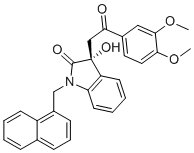
| DC73659 | 3hi2one-G4 Featured |
3hi2one-G4 is a highly selective small molecule activator targeting GIRK4 homomeric channels, does not activate GIRK2, GIRK1/2 or GIRK1/4 channels.
More description
|
|
| DC70158 | A293 |
A293 (AVE1231) is a potent and antiarrhythmic compound and selective inhibitor of two-pore-domain potassium channel TASK-1 (KCNK3, hK2P3.1).A293 (AVE1231) is an inhibitor of hKv1.5 currents with predominant action on channels in their open state.A293 (1 uM) prominently depolarized arterial smooth muscle and increased basal tone level and contractile responses to methoxamine of arteries from young rats but had almost no effect in adult rats.Pharmacological inhibition of atrial TASK-1 currents via A293 (AVE1231) exerts antiarrhythmic effects in vivo as well as in silico, resulting in acute cardioversion of paroxysmal trial fibrillation (AF).
More description
|
|
| DC11676 | NS15370 |
A novel, highly potent positive modulator of Kv7 channels with EC50 of 100 nM (Kv7.2-Kv7.5).
More description
|

|
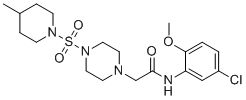
| DC70890 | VU0606170 Featured |
VU 0606170 (also referred to as VU0606170) is a selective inhibitor of the sodium-activated potassium channel KNa1.1, also known as Slack or Slo2.2. This compound has shown specificity for Slack channels over other related potassium channels, making it a valuable tool for studying the physiological and pathological roles of KNa1.1.
More description
|
|
| DC11947 | ML418 Featured |
The first potent, selective, CNS penetrating inward rectifier potassium channel Kir7.1 (KCNJ13) inhibitor with IC50 of 0.31 uM.
More description
|

|
| DC9595 | E-4031 Featured |
E-4031 is a benzenesulfonamide antiarrhythmic agent; blocks the ATP-sensitive potassium channel.
More description
|

|
| DC73665 | KCNQ2 activator Ebio1 Featured |
Ebio1 is a selective voltage-gated potassium channel KCNQ2 activator. Ebio1 activates KCNQ2 by generating an extended channel gate with greater conductance at a saturation voltage (+50 mV).
More description
|

|
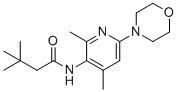
| DC70574 | Lu AA41178 Featured |
Lu AA41178 is a potent, pan-selective Kv7.2-7.5 opener with EC50 of 1.5, 0.6 20.5, and 37.0 uM for Kv7.2, Kv7.2/7.3, Kv7.4 and Kv7.5, respectively.Lu AA41178 displays no activity at Kv7.1 channels, has no potentiating impact on currents through GABAA ion channels, and a clean off-target profile against common cardiac ion channels.Lu AA41178 significantly increased the seizure thresholds in mice, demonstrating anticonvulsant efficacy in the maximum electroshock seizure threshold test and PTZ seizure threshold test.Lu AA41178 demonstrated antipsychotic-like activity by reducing amphetamine-induced hyperlocomotion in mice as well as lowering conditioned avoidance responses in rats, significantly reduced immobility in mouse model with antidepressant predictivity.
More description
|
|
| DC8789 | NS 11021 Featured |
NS 11021 is an activator of large-conductance Ca2+-activated potassium channels (BKCa, KCa1.1).
More description
|

|
