To enhance service speed and avoid tariff delays, we've opened a US warehouse. All US orders ship directly from our US facility.
| Cat. No. | Product Name | Field of Application | Chemical Structure |
|---|---|---|---|
| DC60706 | FO-35 Featured |
FO35 is an artificial intelligence-guided designed ionizable lipid for RNA delivery to the muscle, lung and nose. FO-35 LNPs enable potent transfection throughout the whole ferret lung epithelium, from trachea to alveoli.
More description
|

|
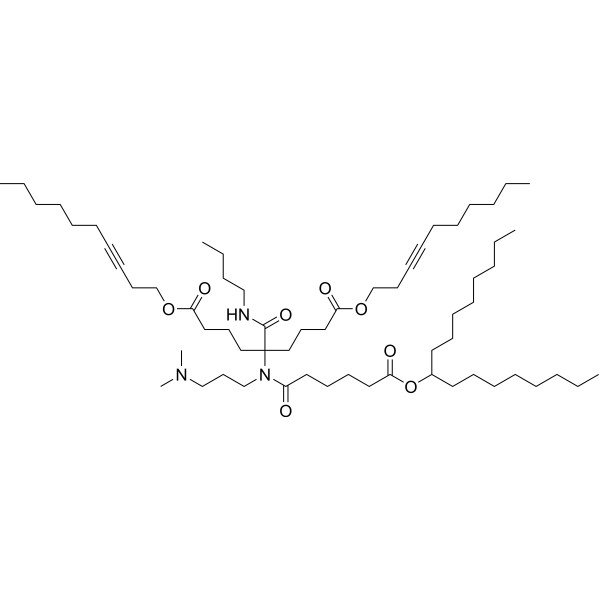
| DC60705 | FO-32 Featured |
FO-32 is an artificial intelligence-guided designed ionizable lipid for RNA delivery to the muscle, lung and nose. FO-32 LNPs enable potent transfection throughout the whole ferret lung epithelium, from trachea to alveoli.
More description
|
|
| DC65327 | 306-N16B Featured |
306-N16B is a lipidnanoparticle, and allows systemic codelivery of Cas9 mRNA and sgRNA. 306-N16B can transport mRNA to the pulmonaryendothelial cell. 306-N16B can be used for research of genome editing-based therapies. Based on the same lipid libraries with 306-O12B, the researchers also found that N-series ionizable lipids were able to selectively deliver mRNA to the lungs of mice. Compared with the liver-targeted O-series ionizable lipids which contained ester bond in lipid tail found in previous work, such as 306-O12B, the N-series ionizable lipids with
the lipid tail containing amide bond prefer to deliver mRNA to the lung. As a N-series ionizable lipid, the chemical structure of the 306-N16B is shown in Figure 4a,b. The difference of organ targeting may be due to their adsorption
of different protein coronas during blood circulation caused
by their different structures mentioned earlier.It has
shown that the second major protein of the protein
corona adsorbed by liver-targeting 306-O12B iLNPs was apolipoprotein
E (ApoE), while the three dominant proteins in the
protein corona adsorbed by lung-targeting 306-N16B iLNPs
were serum albumin, fibrinogen beta chain, and fibrinogen
gamma chain. However, the 306-N16B iLNPs showed less
organ selectivity when systematically codelivered Cas9
mRNA and sgRNA in vivo, which could simultaneously
activate tdTomato expression in the liver and lung of Ai14
mice, whereas single mRNA delivery could almost
exclusively deliver mRNA to the lungs. This surprising phenomenon
requires further investigation. Both the change of
iLNPs charge and the change of lipids functional group
can influence the distribution of iLNPs in vivo due to
the altering of protein corona composition. Therefore,
it is possible to control the organ targeting of iLNPs by
controlling the composition of the outer protein corona of
iLNPs.
More description
|

|
| DC67525 | Hopewell Lipid 649 Featured |
L649 is a next-generation, lung-targeting ionizable lipid specifically designed for systemic mRNA delivery developed by Hopewell. Belonging to the novel "N-series" lipid class, it features a unique structure with an amine-containing head group and hydrophobic tails incorporating amide bonds. This design enables L649 to form highly stable lipid nanoparticles (LNPs) that exhibit exceptional tropism for the lower respiratory tract (lungs, bronchi, trachea) following intravenous administration. It demonstrates superior efficiency in delivering therapeutic payloads (like mRNA) specifically to key lung cell types, including alveolar epithelial cells (AT1 and AT2) and bronchial cells, while minimizing off-target accumulation in organs like the liver. L649-based LNPs, particularly when formulated with helper lipids like POPE, combine high potency with significantly improved tolerability, allowing for effective dosing in vivo. This makes L649 a promising candidate for developing treatments for various lung diseases such as pulmonary fibrosis, COPD, lung cancer, and infectious diseases like COVID-19.
More description
|

|
| DC67315 | Lipid AA15 |
The AA15 lipid, an amino acid-derived ionizable lipid, integrates a carboxylic acid-containing headgroup and biodegradable branched ester tails (R2) to enhance mRNA delivery. Optimized as AA15V LNP, it exhibits a hydrodynamic diameter of 102.3 ± 4.1 nm, low polydispersity (PDI <0.15), and slightly positive zeta potential (+4–6 mV), enabling efficient tumor-targeted delivery. With a pKa ~6.1–6.4, AA15V ensures protonation in acidic endosomes, promoting mRNA release. It achieves >85% mRNA encapsulation efficiency, critical for stable saRNA delivery. In vitro, AA15V LNP-sSE-SCTs induced sustained SE-SCT expression (69% H-2Kb+β2m+ B16F10 cells at 72 h), outperforming mRNA formulations. In vivo, a single intratumoral dose of AA15V LNP-sSE-SCTs suppressed tumor growth by 22-fold in vaccinated mice, synergizing with checkpoint inhibitors (anti-PD-1/CTLA-4) for complete regression in 28.6% of lymphoma models. Ex vivo, AA15V enabled SE-SCT expression in human glioblastoma (7.1% CD45− cells) and lung cancer samples (5.8–8.7%), underscoring clinical potential. Key data: pKa ~6.3; encapsulation: 85–89%; zeta: +4–6 mV; size: 102.3 ± 4.1 nm.
More description
|

|
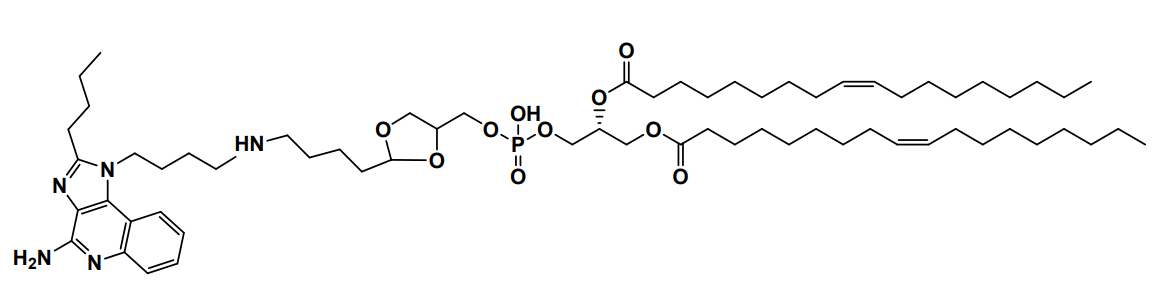
| DC60828 | YK-TLR-001 Featured |
YK-TLR-001 is a cyclic acetal-based ionizable lipid for mRNA delivery. YK-TLR-001 LNPs are demonstrated to enhance mRNA expression in the spleens and to induce exceptional maturation of antigen-presenting cells (APCs) and to promote antigen presentation.
More description
|
|
| DC11303 | CT7001(Samuraciclib hydrochloride) Featured |
ICEC0942 is a selective CDK7 inhibitor, with IC50s of 41 nM and 578 nM for CDK7/CycH/MAT1 and CDK2/cycE1, respectively.
More description
|

|
| DC67522 | AZD Lipid 17 Featured |
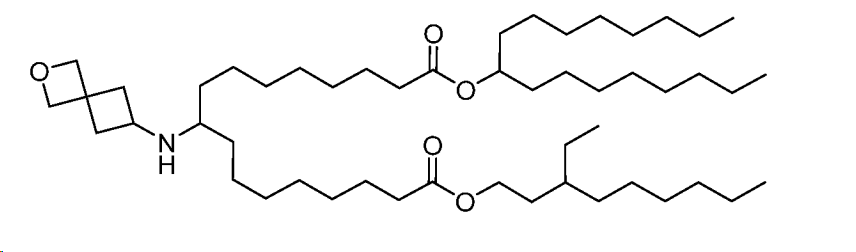
Lipid 17 is a novel, highly potent ionizable lipid designed for mRNA delivery within lipid nanoparticles (LNPs) developed by AstraZeneca . Its structure features a secondary amine head group attached to a cyclic ether moiety (specifically, the 2-oxaspiro[3.3]heptan-6-amine head group). It possesses an asymmetric tail architecture: one tail is derived from heptadecan-9-ol (a branched C17 secondary alcohol), while the other tail is a modified nonyl chain (C9) with a key ethyl branch at the 3-position. The linker connecting the head group to the tails has a length equivalent to n=3 (three methylene units) as defined in the study. This specific combination of the secondary amine cyclic ether head group, asymmetric tails, and the ethyl branch at the 3-position of the nonyl chain proved critical for its exceptional performance. When formulated into LNPs and administered intravenously in mice, Lipid 17 demonstrated a remarkable 6-fold increase in functional protein (eGFP) expression in the liver compared to the benchmark lipid MC3, with high statistical significance (P < 0.0001). This makes Lipid 17 one of the most active lipids identified in the study and a promising candidate for liver-targeted mRNA therapeutics.
More description
|
|
| DC67524 | Nitto Lipid 19 Featured |
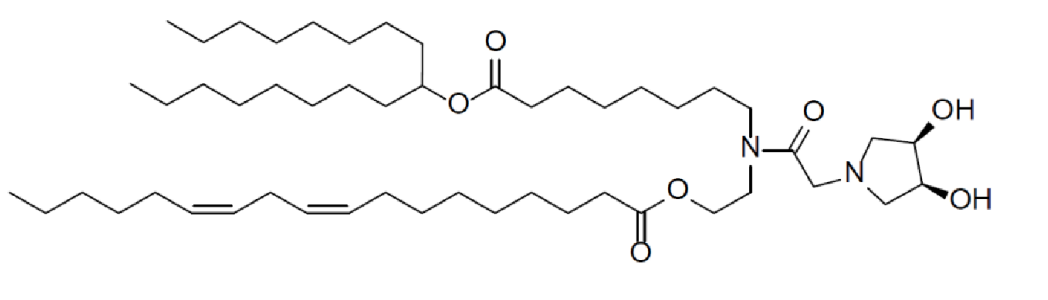
Lipid 19 is an engineered cationic lipid designed to optimize the delivery of RNA within lipid nanoparticles (LNPs) developed by Nitto. Its unique structure—featuring a dual-hydroxyl headgroup and tailored hydrophobic chains—enables highly efficient encapsulation of these fragile genetic payloads, protecting them from degradation. The resulting LNPs exhibit exceptional stability (<100 nm size), target the liver specifically for enhanced therapeutic impact, and support applications ranging from mRNA vaccines to gene-silencing therapies. This makes lipid 19 a pivotal advancement in precision nanomedicine for liver-related disorders.
More description
|
|
| DC67118 | PNI 132 Featured |
PNI 132, an ionizable lipid derived from the patent WO2020252589A developed by Precision Nanosystem, is useful in the formulation of lipid nanoparticles.
More description
|

|
| DC33635 | DODAP Featured |
DODAP, also known as 1,2-Dioleoyl-3-dimethylammonium-propane, is a cationic lipid. It has been used as a component in liposomes that can be used to encapsulate siRNA, immunostimulatory oligodeoxynucleotides, antisense oligonucleotides, or chemotherapeutic agents for in vitro and in vivo delivery.
More description
|

|
| DC33636 | DOTAP Featured |
DOTAP, also known as 1,2-Dioleoyl-3-trimethylammoniumpropane, is a cationic liposome-forming compound used for transfection of DNA, RNA, and other negatively charged molecules into eukaryotic cells. It has been used in gene delivery vectors for gene ther
More description
|

|
| DC65362 | BP Lipid 114 Featured |
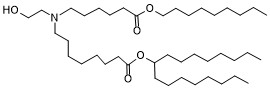
BP Lipid 114 is a well-designed ionizable lipid optimized for mRNA encapsulation and delivery. Its ethanolamine headgroup, ester bonds at the C6 and C8 positions, and 9-carbon tail contribute to efficient mRNA complexation, stability during delivery, and improved biodegradability. These properties make it a valuable component in LNPs for gene therapy and other mRNA-based therapeutic applications.
More description
|
|
| DC65390 | BP Lipid 135 Featured |
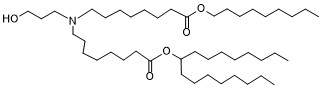
BP Lipid 135 is a well-designed ionizable lipid optimized for mRNA encapsulation and delivery. Its propanolamine headgroup, ester bonds at the C8 position, and 9-carbon tail contribute to efficient mRNA complexation, stability during delivery, and improved biodegradability. These properties make it a valuable component in LNPs for gene therapy and other mRNA-based therapeutic applications.
More description
|
|
| DC74113 | PAANIB-1 Featured |
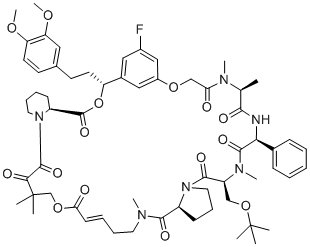
PAANIB-1 is a brain-penetrant PAAN/MIF nuclease inhibitor that prevents neurodegeneration that prevents neurodegeneration induced by α-syn PFF, AAV-α-syn overexpression, or MPTP intoxication in vivo.
More description
|
|
| DC49908 | OF-02 Featured |
OF-02 (OF-2) is an alkenyl amino alcohol (AAA) ionizable lipid for highly potent in vivo mRNA delivery.Alkenyl amino alcohols (AAA) are a functional group found in sphingosine and other bioactive molecules. It was used to prepare
AAA-based ionizable lipids through ring-opening reactions between alkenyl epoxides (AEs) and polyamine cores. These
AAA-based iLNPs could promote high-level protein expression Therefore, AAA-based ionizable lipids OF-00, OF-01,
OF-02, and OF-03 were prepared. The results of in vivo delivery
of human erythropoietin (hEPO) mRNA showed that the AAA
ionizable lipid OF-02 with the linoleic acid derivative
could effectively deliver hEPO mRNA. Compared with the positive
control CKK-E12, OF-02 showed an increased ability to
induce serum EPO protein expression by nearly twofold
(Figure 7b). Likewise, it outperformed two benchmark ionizable
lipids (503013 and C12-200) in the nucleic acid delivery field.
Furthermore, the mRNA delivered by OF-02 iLNPs was mainly
in vivo.translated into the liver. The liver-targeting ability of OF-02 iLNPs
improves their delivery efficiency. Therefore, the OF-02 iLNPs
may become excellent delivery vehicles for the treatment of liver
diseases without other side effects of damage to other organs
during the treatment
More description
|

|
| DC60475 | CL4F8-6 Featured |
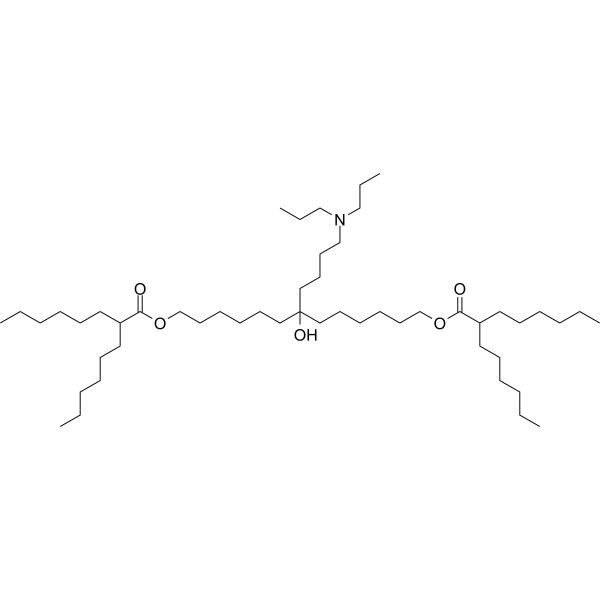
CL4F8-6 is an ionizable cationic lipid (pKa = 6.14) that has been used in combination with other lipids in the formation of lipid nanoparticles (LNPs).1 LNPs containing CL4F8-6 and encapsulating an mRNA reporter accumulate specifically in the mouse liver after intravenous administration. LNPs containing CL4F8-6 and encapsulating mRNA encoding the Cas9 nuclease (mCas9) and single-guide RNA (sgRNA) targeting Ttr (sgTtr), the gene encoding transthyretin, have been used to induce CRISPR-mediated gene knockdown in mice resulting in a reduction of serum levels of TTR.
More description
|
|
| DC12145 | DLinDMA Featured |
DLin-DMA is an ionizable amino lipid with cationic properties and a pKa of 6.7. It is widely utilized in lipid nanoparticle (LNP) formulations alongside helper lipids to enable efficient nucleic acid delivery.
More description
|

|
| DC66649 | CP-LC-1254 Featured |

|
|
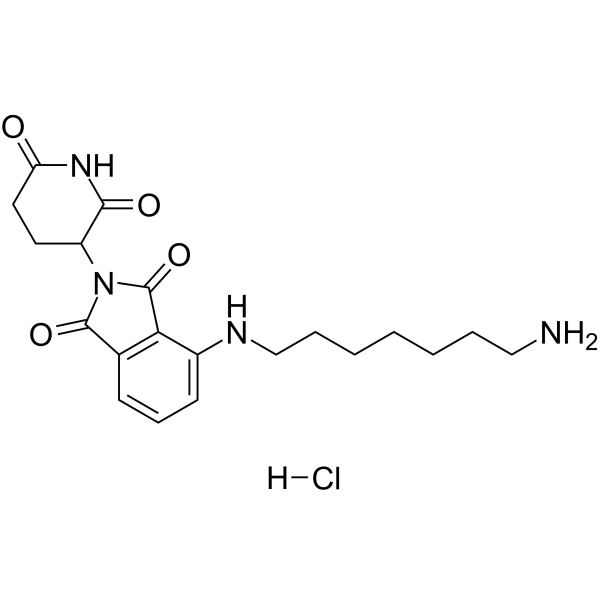
| DC67720 | Pomalidomide-C7-NH2 hydrochloride Featured |
Pomalidomide-C7-NH2 (Pomalidomide 4'-alkylC7-amine) hydrochloride is an E3 ligase ligand-linker conjugate. Pomalidomide-C7-NH2 hydrochloride can be used for the synthesis of PROTAC.
More description
|
|
| DC67719 | (S,R,S)-CO-C2-acid Featured |
(S,R,S)-CO-C2-acid (VH 032 amide-alkylC2-acid) is a functionalized von-Hippel-Lindau (VHL) protein ligand that can be used in PROTAC research and development. (S,R,S)-CO-C2-acid contains an E3 ligand alkyl ligand for conjugation of target protein ligands.
More description
|
-CO-C2-acid.gif)
|
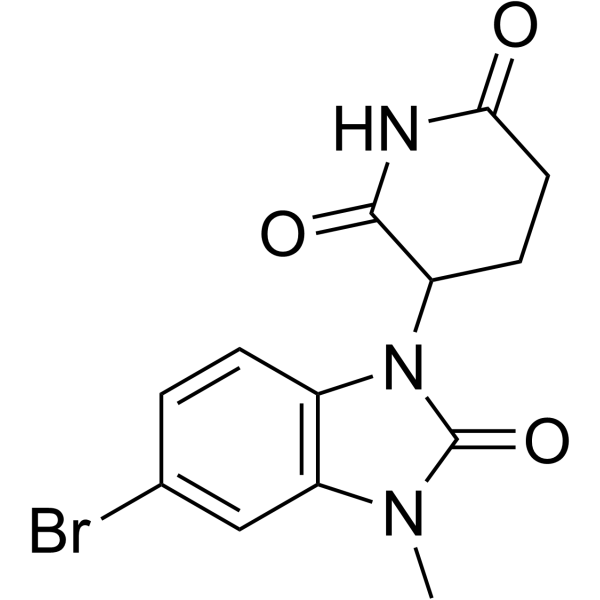
| DC67718 | E3 ligase Ligand 32 Featured |
E3 ligase Ligand 32 (First product in Example 52) is a ligand for E3 ubiquitin ligase. E3 ligase Ligand 32 can be connected to the ligand for protein by a linker to form PROTACs and can be used for the synthesis of PROTAC SMARCA2/4-degrader-29 (HY-162743).
More description
|
|
| DC46687 | Pomalidomide-PEG2-COOH Featured |
Pomalidomide-PEG2-COOH is a synthesized E3 ligase ligand-linker conjugate that incorporates the Pomalidomide based cereblon ligand and 2-unit PEG linker used in PROTAC technology.
More description
|

|
| DC67717 | 1H-Indazole-4-carboxamide, 6-bromo-N-[(1,2-dihydro-4,6-dimethyl-2-oxo-3-pyridinyl)methyl]-1-(1-methylethyl)- Featured |
methyl]-1-(1-methylethyl)-.gif)
|
|
| DC70723 | QC-01–175 Featured |
QC-01-175 is a hetero-bifunctional molecule designed to engage both tau and Cereblon (CRBN) to trigger tau ubiquitination and proteasomal degradation (tau PROTAC).QC-01–175 effected clearance of tau in frontotemporal dementia (FTD) patient-derived neuronal cell models, with minimal effect on tau from neurons of healthy controls.QC-01–175 also rescued stress vulnerability in FTD neurons, phenocopying CRISPR-mediated MAPT-knockout.
More description
|

|
| DC67716 | (S,R,S)-AHPC-PEG2-C4-Cl Featured |
(S,R,S)-AHPC-PEG2-C4-Cl (VH032-PEG2-C4-Cl) is a conjugate of ligands for E3 and 13-atom-length linker. The connector of linker is Halogen group. (S,R,S)-AHPC-PEG2-C4-Cl incorporates the (S,R,S)-AHPC based VHL ligand and an alkyl/ether-based linker. (S,R,S)-AHPC-PEG2-C4-Cl is capable of inducing the degradation of GFP-HaloTag7 in cell-based assays.
More description
|
-AHPC-PEG2-C4-Cl.gif)
|
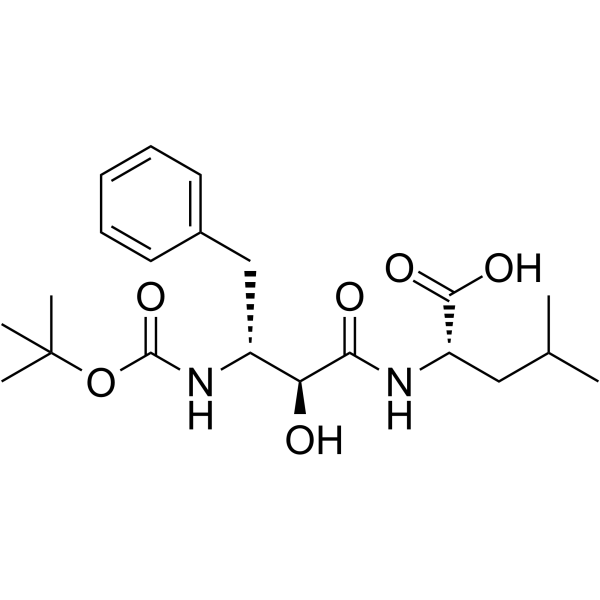
| DC67715 | E3 ligase Ligand 9 Featured |
E3 ligase Ligand 9 is a ligand for E3 ubiquitin ligase. E3 ligase Ligand 9 can be connected to the ligand for protein by a linker to form PROTACs or SNIPERs. PROTACs are inducers of ubiquitination-mediated degradation of cancer-promoting proteins.
More description
|
|
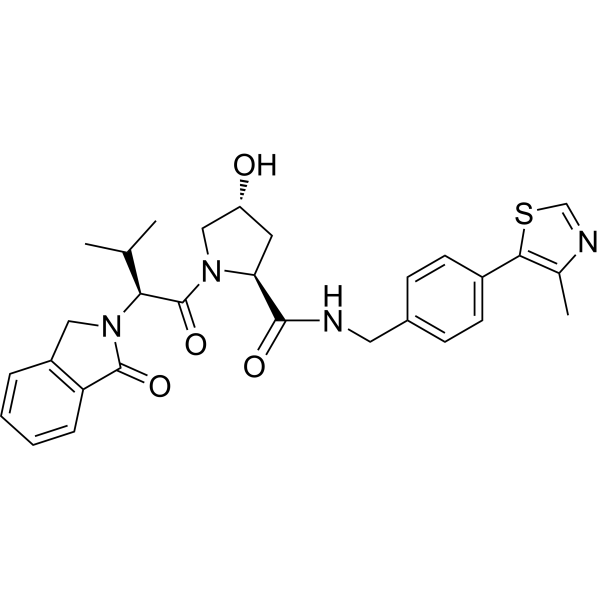
| DC12676 | VL-285 Featured |
VL285 is a potent VHL ligand, degrading HaloTag7 fusion proteins.
More description
|
|
| DC67714 | WAY-620124 Featured |
|
|
| DC67713 | VH 032 amide-alkylC6-acid Featured |
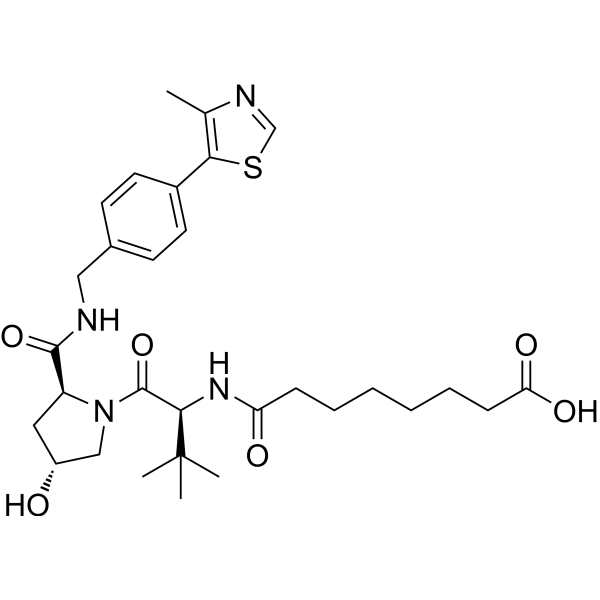
VH 032 amide-alkylC6-acid ((S,R,S)-AHPC-CO-C6-COOH) is a VH032 analog that acts as a ligand for VHL, recruiting von Hippel-Lindau (VHL) protein. VH 032 amide-alkylC6-acid can be used in the synthesis of PROTACs.
More description
|
|