 To enhance service speed and avoid tariff delays, we've opened a US warehouse. All US orders ship directly from our US facility.
| Cat. No. | Product Name | Field of Application | Chemical Structure |
|---|---|---|---|
| DC66163 | DSPE-PEG-RGD Featured |
RGD's receptors are integrins αvβ3 and αvβ5, which can mimic cell adhesion proteins and bind specifically to 11 kinds of integrins, which can effectively adhere to biological materials. DSPE-PEG-RGD can be used to make micelles and vesicles. The liposomes formed by RGD-PEG-DSPE can act directly on the target to form an active targeting effect. Rgd-peg-dspe peptide RGD polyethylene glycol phospholipid can be used for passive targeting of micelles and vesicles, active targeting research and drug delivery. DSPE (1, 2-distearoyl-SN-glycerol-3-phosphate ethanolamine) is a saturated 18-carbon phospholipid commonly used in the synthesis of liposomes. Polyethylene glycol (PEG) -coupled DSPE is hydrophilic and can be used for drug delivery, gene transfection, and biomolecular modification. Polyethylene glycol can enhance solubility and stability, reduce the nonspecific binding of charged molecules, and reduce the immunogenicity of polypeptides.
More description
|

|
| DC66168 | DSPE-PEG-ICG Featured |
DSPE phospholipids can be used as pharmaceutical excipients for emulsification and drug solubilization, and are important materials for slow release drug preparations such as liposomes, fat milk and nanoparticles in recent years.
Modification of phospholipid molecules can make these preparations have the ability of release and targeting under specific conditions.
Common modification methods include: disintegration time; Introducing immune factors to enhance targeting; Introduce markers for diagnosis and tracking.
More description
|
|
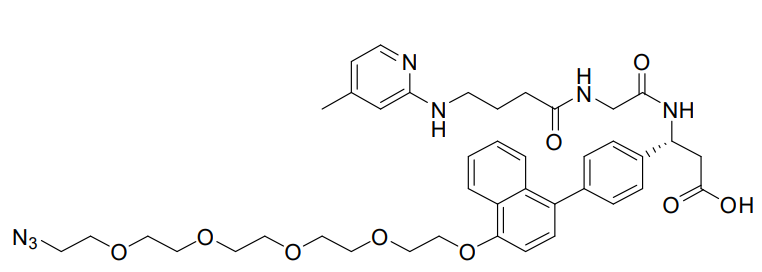
| DC67297 | SM6.1 azide (αvβ6 ligand) Featured |
SM-6.1 is a small molecule delivery vehicle developed by Arrowhead, targeting αvβ6, which selectively delivers therapeutic siRNA to lung epithelial cells and mediates durable gene silencing post-inhalation.
More description
|
|
| DC66295 | DSPE-PEG-CY7 Featured |
Polyethylene glycol phospholipid is an excellent material to form liposomes, which can be used for gene transfection, vaccine delivery, drug transportation, and targeted drug delivery. Phospholipids are hydrophobic and hydrophilic. It can be used to modify protein drugs, peptide compounds, organic small molecule drugs, biological materials, etc. Cy7 labeled PEG derivatives are used for fluorescence tracing or fluorescence observation.
More description
|
|
| DC66292 | DSPE-PEG-NPC Featured |
DSPE-PEG-NPC is a linear heterobifunctional polyglycolation reagent containing DSPE phospholipids and NPC groups. It is a useful self-assembly reagent for preparing PEGylated liposomes or micelles, and also provides a combination of NPC group and thiol containing molecules.
More description
|
|
| DC66116 | DSPE-PEG-FITC Featured |
DSPE-PEG-FITC, is a fluorescein attached PEG lipid. It can be used to prepare liposomes as drug carrier in targeted drug delivery. The polymer is modified with fluorescein (green) dye which can be used for staining cells, tissues, biomarkers, or nanoparticles.
More description
|

|
| DC66291 | DSPE-PEG-OPSS Featured |
DSPE-PEG-OPSS, DSPE (1,2-distearoyl-sn-glycerol-3-phosphoethanolamine) is a saturated 18 carbon phospholipid, commonly used in the synthesis of liposomes. Polyethylene glycol (PEG) - coupled DSPE is hydrophilic and can be used for drug delivery, gene transfection and biomolecular modification. The PEG of phospholipid significantly improved the blood circulation time and stability of the capsule drug. Polyethylene glycol can enhance the solubility and stability, reduce the non-specific binding of charged molecules on the surface, and reduce the immunogenicity of polypeptides. Mercaptopyridine reacts with mercapto group to release pyridine ring and generate stable disulfide bond.
More description
|

|
| DC66280 | DSPE-PEG-DOTA Featured |
Macrocyclic ligands are ring complexes formed by multi-dentate ligands with O, N, P, S and other coordination atoms on the ring skeleton. The range of complexes is wide. According to their structural characteristics, complexes can be divided into the following types: simple complexes, chelates, polynuclear complexes, carbonyl complexes, metal clusters, sandwich complexes, and macrocyclic ligand complexes.
More description
|

|
| DC66106 | DSPE-Maleimide Featured |

|
|
| DC66290 | DSPE-PEG-Mannose Featured |
DSPE (1,2-distearoyl-sn glycerol-3-phosphoethanolamine) is a saturated 18C phospholipid commonly used in liposome synthesis. Polyethylene glycol (PEG) conjugated DSPE has hydrophilicity and hydrophobicity, and can be used for drug delivery, gene transfection, and biomolecular modification. DSPE-PEG-Manose can be applied in medical research, drug release, nanotechnology and new material research, and cell culture. As well as ligand research, peptide synthesis support, grafting of polymer compounds, new materials, and polyethylene glycol modified functional coatings and other active compounds.
More description
|

|
| DC66117 | DSPE-PEG-Rhodamine Featured |
DSPE-PEG-FITC is a fluorescein attached PEG lipid. It can be used to prepare liposomes as drug carrier in targeted drug delivery. The polymer is modified with fluorescein (green) dye which can be used for staining cells, tissues, biomarkers, or nanoparticles.
More description
|

|
| DC66118 | DSPE-PEG-Galactose Featured |
Long circulating liposomes were obtained by modifying the surface of liposomes with polyethylene glycol, which could prolong the half-life of liposomes, improve its stability in blood circulation, and change the biological distribution of liposomes.
More description
|

|
| DC66276 | DSPE-PEG-Cholesterol Featured |
DSPE-PEG-CLS is a phospholipid PEG derivative used in liposome preparation, phospholipid polyethylene glycol binding with hydrophilic and hydrophobic, polyethylene glycol phospholipid liposome formation material, which can be used for drug delivery, gene transfection and vaccine delivery.
Cholesterol is the basic substance of cell membrane and liposome, is also an indispensable important substance of animal tissue cells, it not only participates in the formation of cell membrane, but also is the raw material of synthesis of bile acid, vitamin D and steroid hormone.
More description
|

|
| DC66166 | DSPE-PEG-Glucose;DSPE-PEG2000-Glucose Featured |
Glucose, organic compound, molecular formula C6H12O6. It is one of the most widely distributed and important monosaccharides in nature, and it is a polyhydroxyaldehyde. Glucose plays an important role in the field of biology, that is, the main energy supplier of living things. Plants produce glucose through photosynthesis. Liposome has the advantages of low toxicity, easy preparation, as a carrier of both water-soluble and fat-soluble drugs, suitable for a variety of drug delivery routes, improve drug stability, and achieve targeted drug delivery. However, after the liposome enters the body, it is easy to be taken up and cleared by RES cells due to the specific conditioning effect of opsonins in plasma on the liposome and the non-specific hydrophobic interaction between RES cells and liposome.
More description
|

|
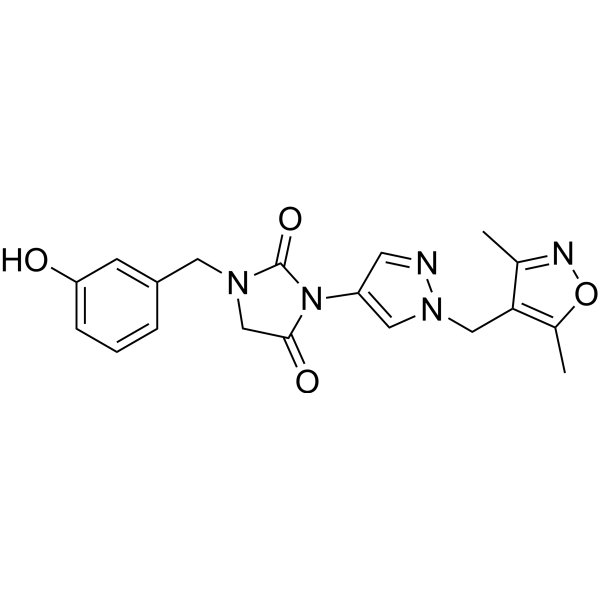
| DC73509 | S6821 Featured |
S6821 (S 6821) is a potent and selective antagonist of the bitter taste receptor TAS2R8, exhibiting an IC50 value of 21 nM.
It demonstrates high selectivity across a panel of 16 TAS2Rs, effectively reduces the bitterness of coffee, and shows an excellent safety profile.
More description
|
|
| DC67239 | KRN-7000(S34) Featured |

|
|
| DC67238 | KRN-7000(C34) Featured |

|
|
| DC67240 | KRN-7000(7DW8-5) Featured |

|
|
| DC60284 | GN13 Featured |
GN13 is a potent, selective, and cell-permeable inhibitor of Gαs, with a strong binding affinity for the active, GTP-bound state of Gαs (KD = 0.19 μM). Its high selectivity and ability to penetrate cells make it a powerful tool for studying Gαs signaling in both basic research and potential therapeutic applications.
More description
|

|
| DC66457 | FAP-IN-2 (FAPI) Featured |
FAP-IN-2 is a 99mTc-labeled FAPI inhibitor designed for tumor imaging. It targets fibroblast activation protein (FAP) in the tumor microenvironment, enabling high-contrast SPECT imaging of FAP-expressing tumors. Its specificity, stability, and imaging capabilities make it a valuable tool for cancer diagnosis, staging, and research. Additionally, it has potential theragnostic applications in oncology.
More description
|

|
| DC70444 | GS-680 Featured |
GS-680 (GS680) is a novel selective and ATP-competitive CaMKII inhibitor with biochemical IC50 of 2.3 and 15.9 nM against CaMKIIδ and CaMKIIα, respectively.GS-680 inhibited phospholamban phosphorylation in NRVM with an EC50 of 98.9 nM.GS-680 inhibits premature atrial contractions.GS-680 significantly reduced CaMKII autophosphorylation.GS-680 inhibits pro-arrhythmic activity in human atrium and improves contractility in failing human ventricle.
More description
|

|
| DC72871 | FHP01 Featured |
FHP01 (BA103) is a potent, small molecule inhibitor of DDX3X helicase activity with IC50 of 0.3 uM in in vitro enzyme assays, exhibits very effective antiproliferative and killing activity against different breast cancer cell types (IC50=3.058 and 3.21 μM in MDA MB 468 and MDA MB 231, respectively).
FHP01 does not inhibit the ATPase activity of DDX3X and the helicase activity of DDX1 (IC50>100 uM).
FHP01 also inhibited WNT signaling, a key tumorigenic pathway already correlated to DDX3X functions in breast cancer model cell lines.
FHP01 inhibits ER+/PR+ (IC50 = 12.43 and 10.62 μM in MCF7 and T47D cells, respectively) and HER2+ (IC50 = 13.46 μM in SKBR3) cells, but lower in control MCF10A cells (IC50 = 28.71 μM).
FHP01 (45 mg/kg, i.p. injection) suppresses rowth of MDA MB 231 tumor xenografts in nude mice.
More description
|

|
| DC60778 | TH6342 Featured |
TH6342 is a SAMHD1 inhibitor with IC50 of 9.1 μM/11.0 μM/5.8 μM against dGTP/Cl-F-ara-ATP/ara-CTP, respectively. TH6342 engages pre-tetrameric SAMHD1 and deter oligomerization and allosteric activation without occupying nucleotide-binding pockets.
More description
|

|
| DC60779 | TH7127 Featured |
TH7127 is a SAMHD1 inhibitor with IC50 of 4.9 μM/4.5 μM/4.0 μM against dGTP/Cl-F-ara-ATP/ara-CTP, respectively.
More description
|

|
| DC73988 | EP055 Featured |
EP055 (EP-055) is a small molecule that targets EPPIN on the surface of sperm and inhibits motility (IC50=199.5 uM, CASA assay using human sperm), binds to the C-terminal domain of EPPIN.
More description
|

|
| DC49572 | (R)-AM-5308 Featured |
AM-5308 is a potent and selective KIF18A inhibitor with demonstrated antitumor activity in cell-based and animal models. Its ability to disrupt mitosis and induce cancer cell death makes it a promising candidate for further development as a cancer therapeutic.
More description
|

|
| DCC3505 | Mßl-in-2i Featured |
Novel potent broad-spectrum metallo-β-lactamase (MβL) inhibitor, inhibiting the MβLs NDM-1, VIM-2, ImiS, and L1
More description
|

|
| DCC3584 | ncgc00161856 Featured |
NCGC00161856 is identified as the first small-molecule ligand and inverse agonist of the thyroid-stimulating hormone receptor (TSHR). It inhibits basal cAMP production in HEK-EM 293 cells that stably express TSHRs, with a half-maximal inhibitory concentration (IC50) of 3.0 µM. This means that NCGC00161856 effectively reduces the constitutive activity of TSHR, which is the receptor's activity in the absence of its natural ligand (thyroid-stimulating hormone, TSH).
More description
|

|
| DC60781 | TRPC6 activator compound 2 Featured |
TRPC6 activator compound 2 is selective activator of TRPC6 that does not potentiate TRPC3 and mTRPC7. Comp2 is able to cross BBB.
More description
|

|
| DC73863 | ODH-08 Featured |
ODH-08 is a novel specific small molecule ligand and agonist of RORα with KD value of 8.4 um, shows potent antifibrotic effect.
ODH-08 does not activate other nuclear receptors involved in lipid metabolism such as PPARα, PPARγ, PPARδ, and LXRα.
ODH-08 reduces hepatic collagen deposition and expression levels of fibrogenic markers such as α-smooth muscle actin and collagen type I alpha 1 chain in Western diet-fed mice.
ODH-08 suppresses the expression of fibrogenic proteins in hepatic stellate cells (HSCs).
ODH-08 suppresses the activity of SMAD2 and 3, which are the primary downstream proteins of transforming growth factor β.
More description
|

|
