To enhance service speed and avoid tariff delays, we've opened a US warehouse. All US orders ship directly from our US facility.
| Cat. No. | Product Name | Field of Application | Chemical Structure |
|---|---|---|---|
| DC36814 | TL4-12 Featured |
TL4-12 is a potent MAP4K2 (GCK) inhibitor that inhibits IL-1 and TGFβ-induced p38 MAPK phosphorylation, in vitro.
More description
|

|
| DC36530 | Dibenzo(a,i)pyrene Featured |
Dibenzo[a,i]pyrene is a polycyclic aromatic hydrocarbon (PAH) with potent carcinogenic activity. Dibenzo[a,i]pyrene was shown to induce DNA adduction, tumorigenicity as well as Ki-ras oncogene mutations in strain A/J mouse lung. Dibenzo[a,i]pyrene has been shown to be present in cigarette smoke condensate and in automobile exhaust gas in small quantities.
More description
|

|
| DC10401 | R121919 Featured |
R121919 is a potent small-molecule CRF1 receptor antagonist with a Ki of 2 to 5 nM for the CRF1 receptor and over 1000-fold weaker activity at the CRF2 receptor, CRF-binding protein, or 70 other receptor types.
More description
|
|
| DC42686 | AVE-9488 Featured |
Novel enhancer of endothelial NO synthase (eNOS)
More description
|

|
| DC70499 | HuR inhibitor KH-3 Featured |
HuR inhibitor KH-3 is a small molecule, selective inhibitior of HuR function with Ki of 0.83 and 0.72 uM in FP and AlphaLISA assays, respectively.KH-3 potently inhibits breast cancer cell growth in vitro and in vivo.KH-3 inhibits breast cancer cell invasion in vitro as well as delays initiation of lung colonies and improves mouse survival in an experimental metastasis model in vivo.KH-3 suppresses breast cancer cell invasion by disrupting HuR-FOXQ1 mRNA interaction.Inhibition of HuR with KH-3 yielded a significant reduced in the progression of pathological cardiac hypertrophy in a transverse aortic constriction model.
More description
|

|
| DC71689 | K145 Featured |
K145 is a selective, substrate-competitive and orally active sphingosine kinase-2 (SphK2) inhibitor with an IC50 of 4.3 µM and a Ki of 6.4 µM in biochemical assays.
More description
|

|
| DC42531 | 4-APC hydrobromide Featured |
4-APC hydrobromide is a highly sensitive and selective derivatization agent for aldehydes. 4-APC hydrobromide possesses an aniline moiety for a fast selective reaction with aliphatic aldehydes as well as a quaternary ammonium group for improved MS sensitivity. 4-APC hydrobromide allows highly sensitive and selective MS detection of aldehydes.
More description
|

|
| DC9655 | 20-O-Acetylingenol-3-angelate Featured |
20-O-Acetylingenol-3-angelate is a diterpene ester that has been found in E. peplus and a derivative of ingenol-3-angelate
More description
|

|
| DCC0661 | Ap1510 Featured |
AP1510 is a potent cell-permeable ligand for human FKBP12. AP1510 regulates protein-protein interactions through dimerization.
More description
|

|
| DC36715 | Taflpostamide(Tafluprost ethyl amide) Featured |
Tafluprost ethyl amide is a prostaglandin derivative. Tafluprost ethyl amide is capable of intraocular pressure (IOP) reduction and influencing eyelash growth. Tafluprost ethyl amide can be used in antiglaucoma ophthalmic compositions or cosmetics.
More description
|

|
| DC43920 | SBI-797812 Featured |
SBI-797812 is an orally active nicotinamide phosphoribosyltransferase (NAMPT) activator. SBI-797812 shifts NAMPT to NMN formation, increases NAMPT affinity for ATP, stabilizes phosphorylated NAMPT, promotes consumption of the pyrophosphate by-product, and blunts feedback inhibition by NAD+. SBI-797812 increases intracellular nicotinamide mononucleotide (NMN) and elevates liver NAD+ in mice.
More description
|

|
| DC22903 | SW-106 Featured |
SW106 is a potent, selective, competitive PTH/PTH-related peptide receptor (PPR) antagonist with IC50 of 0.99 uM.
More description
|

|
| DC22054 | CH5447240 Featured |
CH5447240 is a novel potent, selective, orally active hPTHR1 agonist with EC20 of 3.0 nM and EC50 of 12 nM.
More description
|

|
| DC33075 | Naltriben mesylate Featured |
Naltriben is a highly selective δ2 opioid receptor antagonist.Naltriben (NTB) has been used to differentiate the subtypes of delta opioid receptors, delta1 and delta2. NTB displaced the specific binding of [3H]DAMGO with Ki value of 19.79 +/- 1.12 nM in rat cortex membranes. Specific binding of [3H]diprenorphine ([3H]DIP) was inhibited by NTB with Ki value of 82.75 +/- 6.32 nM in the presence of DAMGO and DPDPE. Naltriben enhanced the MAPK/ERK signaling pathway, but not the PI3k/Akt pathway. Therefore, potentiated TRPM7 activity contributes to the devastating migratory and invasive characteristics of GBM.
More description
|

|
| DC74115 | PAT1inh-A0030 Featured |
PAT1inh-A0030 is a potent and selective SLC26A6 (putative anion transporter 1, PAT1) inhibitor with IC50 of 1.0 uM, shows no activity on relevant ion transporters/channels (SLC26A3, SLC26A4, SLC26A9, CFTR, TMEM16A).
More description
|

|
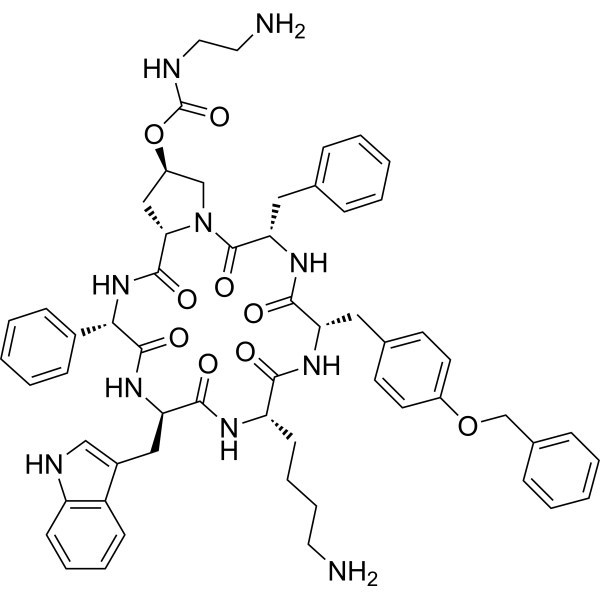
| DC22540 | Pasireotide Featured |
Pasireotide (SOM230), a long-acting cyclohexapeptide somatostatin analogue, can improve agonist activity at somatostatin receptors (subtypes sst1/2/3/4/5, pKi=8.2/9.0/9.1/<7.0/9.9, respectively). Pasireotide can suppress GH, IGF-I and ACTH secretion, indicating potential efficacy in acromegaly and Cushing's disease. Pasireotide also exhibits antisecretory, antiproliferative, and proapoptotic activity.
At equivalent molar concentrations, both the salt and free forms of a compound exhibit comparable biological activity. Nevertheless, the salt form (Pasireotide acetate) usually boasts enhanced water solubility and stability.
More description
|
|
| DC20174 | Albiglutide Featured |
Albiglutide is a glucagon-like peptide-1 agonist (GLP-1 agonist).
More description
|

|
| DC33395 | Arvanil Featured |
Arvanil is a CB1 and TRPV1 agonist. It increases lung tidal volume, diaphragm activity, mean arterial blood pressure and inhibits lymphocyte proliferation.
More description
|

|
| DC71882 | Palvanil Featured |
Palvanil is a capsaicin analogue, shows strong desensitizing capability against the TRPV1 receptor. Palvanil shows anti-nociceptive and anti-inflammation effects.
More description
|

|
| DC8849 | CID-2858522 Featured |
CID-2858522 is a selectively inhibits protein kinase C (PKC)-induced activation of the NF-κB pathway (IC50 < 0.1 μM for PMA-stimulated IL-8 production).
More description
|

|
| DC74116 | PAT1inh-B01 Featured |
PAT1inh-B01 is a small-molecule, selective SLC26A6 (putative anion transporter 1, PAT1) inhibitor, could fully inhibit PAT1-mediated anion exchange with IC50 of 350 nM.
More description
|

|
| DCC5325 | Unc0737 Featured |
UNC0737 is a negative control of UNC0638 and the N-methyl analog of UNC0638. UNC0737 was designed to eliminate the hydrogen bond interaction seen in the G9a-UNC0224 cocrystal structure between Asp1083 of G9a and the secondary amino group at the 4-position of UNC0224's quinazoline ring3. UNC0737 was >300-fold less potent than UNC0638 in G9a and GLP biochemical assays. As expected, UNC0737 was a poor inhibitor of G9a (IC50 = 5,000 ± 200 nM (n = 2)) and GLP (IC50 > 10,000 nM (n = 2)) in the SAHH-coupled assays.
More description
|

|
| DC21501 | PF-06648671 Featured |
PF-06648671 is a potent γ-secretase modulator with IC50 of 8.9 nM against Aβ42. PF-06648671 has favorable brain availability in rodent, which translated into excellent central exposure in human and robust reduction of amyloid β (Aβ) 42 in cerebrospinal fluid (CSF).
More description
|

|
| DC4217 | Maraviroc Featured |
Maraviroc (Selzentry, UK-427857, Celsentri) is a CCR5 antagonist for MIP-1α, MIP-1β and RANTES with IC50 of 3.3 nM, 7.2 nM and 5.2 nM, respectively.
More description
|

|
| DC42718 | G150 Featured |
G150 is a highly selective human cyclic GMP-AMP synthase (h-cGAS) inhibitor with an IC50 of 10.2 nM. G150 represses dsDNA-triggered interferon expression, and G150 can be used for the research of inflammatory.
More description
|

|
| DC42720 | G140 Featured |
G140 is a potent and selective inhibitor of cyclic GMP-AMP synthase (cGAS), with IC50s of 14.0 nM and 442 nM for h-cGAS and m-cGAS, respectively. G140 has anti-inflammatory activity.
More description
|

|
| DC7975 | CP 640186 Featured |
CP-640186 is an isozyme-nonselective acetyl-CoA carboxylase inhibitor with IC50s of 53 nM and 61 nM for rat liver ACC1 and rat skeletal muscle ACC2 respectively.
More description
|

|
| DCC4236 | Pradigastat Featured |
Pradigastat (LCQ-908) is a potent, selective and orally active diacylglycerol acyltransferase 1 (DGAT1) inhibitor. Pradigastat has anti-obesity and anti-diabetic effects.
More description
|

|
| DC21478 | PF-06928215 Featured |
PF-06928215 (PF06928215) is a high affinity Cyclic GMP-AMP synthase (cGAS) inhibitor with Kd of 200 nM, IC50 of 4.9 uM.
More description
|

|
| DC49945 | RBN013209 Featured |
RBN013209 is a potent CD38 inhibitor and is useful in the treatment of cancer.
More description
|

|