Alternate TextTo enhance service speed and avoid tariff delays, we've opened a US warehouse. All US orders ship directly from our US facility.
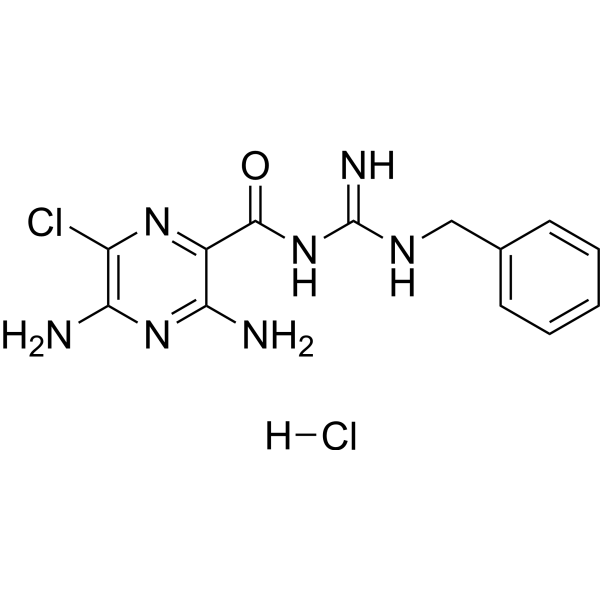

Benzamil (hydrochloride)

  Cat. No.:  DC26053   Featured
Chemical Structure
161804-20-2
For research use only. We do not sell to patients.
We match the best price and quality on market.
Email:order@dcchemicals.com  sales@dcchemicals.com
Tel:+86 21 58447131
We are official vendor of:
  • 20
  • 19
  • 18
  • 17
  • 16
  • 15
  • 14
  • 12
  • 11
  • 10
  • 9
  • 8
  • 13
  • 6
  • 5
  • 4
  • 3
  • 2
  • 1
More than 5000 active chemicals with high quality for research!
Field of application
Benzamil hydrochloride is a specific and potent sodium channel (ENaC) blocker.
Cas No.: 161804-20-2
Chemical Name: benzamil hydrochloride
Synonyms: benzamil hydrochloride;3,5-diamino-N-(N'-benzylcarbamimidoyl)-6-chloropyrazine-2-carboxamide,hydrochloride;Benzamil;Benzylamiloride hydrochloride;Benzamil HCl;Benzamil hydrochloride hydrate;N-(Benzylamidino)-3,5-diamino-6-chloropyrazinecarboxamide hydrochloride hydrate;Prestwick_985;Benzamil hydrate hydrochloride;N-(Benzylamidino)-3,5-diamino-6-chloropyrazinecarboxamide hydrate hydrochloride
SMILES: O=C(NC(=N)NCC1C=CC=CC=1)C1C(N)=NC(N)=C(Cl)N=1.[H]Cl
Formula: C13H15Cl2N7O
M.Wt: 356.210499048233
Purity: >98%
Sotrage: 2 years -20°C Powder, 2 weeks 4°C in DMSO, 6 months -80°C in DMSO
Description: Benzamil hydrochloride is a specific blocker of sodium channel (ENaC).
Target: Sodium channel[1]
In Vivo: Intracerebroventricular injection of endothelin-1 (1 nmol) after intracerebroventricular preinjection of the vehicle of Benzamil hydrochloride markedly increases both mean arterial pressure and abdominal sympathetic nervous activity for 10 min. In SHRSP, intracerebroventricular infusion either of 1 or 10 nmol/kg/day Benzamil hydrochloride decreases systolic blood pressure (4th day: F=6.131, 1 nmol/kg/day, P<0.05, 10 nmol/kg/day, P<0.01; 5th day: F=6.842, 1 nmol/kg/day, P<0.05, 10 nmol/kg/day, P<0.01; 6th day: F=5.988, 1 nmol/kg/day, P<0.05, 10 nmol/kg/day, P<0.01; 7th day: F=7.935, 1 nmol/kg/day, P<0.01, 10 nmol/kg/day, P<0.01), urinary excretion of vasopressin (5th day: F=9.385, 1 nmol/kg/day, P<0.05, 10 nmol/kg/day, P<0.05; 6th day: F=8.783, 1 nmol/kg/day, P<0.01, 10 nmol/kg/day, P<0.01; 7th day: F=8.996, 1 nmol/kg/day, P<0.01, 10 nmol/kg/day, P< 0.01), and norepinephrine (3rd day: F=4.341, 1 nmol/kg/day, P<0.05, 10 nmol/kg/day, P<0.01; 4th day: F=9.865, 1 nmol/kg/day, P<0.01, 10 nmol/kg/day, P<0.01; 5th day: F=14.652, 1 nmol/kg/day, P<0.01, 10 nmol/kg/day, P<0.01; 6th day: F=13.376, 1 nmol/kg/day, P<0.01, 10 nmol/kg/day, P<0.01; 7th day: F=8.594, 1 nmol/kg/day, P<0.01, 10 nmol/kg/day, P<0.01) compare with vehicle[1].
In Vitro: The specific ENaC blocker Benzamil hydrochloride adds to the luminal perfusate (10−6 M) significantly decreases baseline [Na+]i by 19.2 mM (n=5) and almost completely inhibits the [NaCl]L-dependent increasing in [Na+]i when coadministers with luminal AngII[2].
Cell Assay: Individual CCD segments are dissected from rabbit and mouse kidney.The measurements of [Na+]i are used as a reflection of Na+ transport across the apical membrane. EnaC-specific activity is assessed by applying 10−6 M of the ENaC blocker Benzamil hydrochloride, a concentration that does not affect Na+:H+ exchange. Experiments are performed in the presence/absence of luminal Benzamil hydrochloride or the Na:H exchanger blocker HOE694 administers with/without the AT1 receptor blocker candesartan. Final DMSO concentrations are below 0.1% [2].
Animal Administration: For the acute intracerebroventricular injection in anesthetized rats. A guide cannula is inserted into the right lateral cerebral ventricle, and Benzamil hydrochloride (0.1 nmol/kg, n=6; 1 nmol/kg, n=6; 10 nmol/kg,n=7) or vehicle (n=6) is injected into the right lateral ventricle through a cannula connected to a microsyringe 15 min before the start of intracerebroventricular infusion of hypertonic NaCl. Each injection consists of a volume of 10 μL deliver manually over a period of 30 s. To investigate the effects of Benzamil hydrochloride on the pressor response induced by intracerebroventricular injection of the pressor agent other than hypertonic NaCl, endothelin-1, which has a potent pressor action in the brain of rats, is intracerebroventricularly injected (1 nmol/10 μL) 15 min after the intracerebroventricular preinjection of Benzamil hydrochloride (10 nmol/kg, n=6) or the vehicle (n=6), and mean arterial pressure, heart rate, and abdominal sympathetic nerve firings are recorded for 20 min. Catheters are implanted into both the femoral artery and vein of 12-wk-old male rats anesthetized with urethan. Both catheters are filled with heparinized saline (50 U/mL). Fifteen minutes before the start of intracerebroventricular infusion of hypertonic NaCl, Benzamil hydrochloride (10 nmol/kg, n=6) or vehicle (10 μL, n=6) is injected into a tube connects to the femoral venous catheter by directly inserting the microsyringe, and 0.1 ml of isotonic saline solution is injected through the catheter to deliver the contents into the venous circulation[1].
References: [1]. Nishimura M, et al. Benzamil blockade of brain Na+ channels averts Na(+)-induced hypertension in rats. Am J Physiol. 1998 Mar;274(3 Pt 2):R635-44. [2]. Peti-Peterdi J, et al. Angiotensin II directly stimulates ENaC activity in the cortical collecting duct via AT(1) receptors. J Am Soc Nephrol. 2002 May;13(5):1131-5.
Cat. No. Product name Field of application
DC31074 Isopropyl myristate Isopropyl myristate is the ester of isopropyl alcohol and myristic acid.
DC79609 NCGC00685960 NCGC00685960 is a Nicotinamide N-methyltransferase (NNMT) inhibitor with an IC50 < 10  nM. NCGC00685960 has potent antitumor activity. NCGC00685960 increases H3K27 trimethylation levels in ovarian cancer cells and inhibits α-SMA expression in NNMT-expressing ovarian fibroblasts. NCGC00685960 reduces 1-MNA levels, reverses SAM and H3K27 hypomethylation and significantly impairs collagen contractility in cancer-associated fibroblasts (CAFs). NCGC00685960 can be used for cancers research.
DC77831 Vicadrostat Vicadrostat (compound 29 A) is a potent and selective inhibitor of aldosterone synthase(CYP11B2) with an IC50 of 16 nM. It exhibits potential in renal disease, diabetic nephropathy, cardiovascular diseases and fibrotic disorder research.
DC77813 Zeltociclib Zeltociclib is a cyclin-dependent kinase inhibitor with antitumor effects.
DC77714 S3226 S3226 is an inhibitor for Na+/H+ exchange subtype 3 (NHE3) with an IC50 of 0.2 µmol/L in rat NHE3 transfected fibroblasts. S3226 exhibits protective activity in rat ischemia-induced acute renal failure models.
DC77387 AUR1545 AUR1545 is a selective degrader of KAT2A and KAT2B. AUR1545 can be used in the cancer research, including studies on AML (Acute myeloid leukemia), SCLC (Small-cell carcinoma), and NEPC (Neuroendocrine Prostate Cancer).
DC77822 JNJ-77242113 (Icotrokinr) Icotrokinra (JNJ-77242113, JNJ-2113, PN-235) is an orally available and selective antagonist of the IL-23 receptor. It also inhibits IL-23–induced STAT3 phosphorylation in peripheral blood mononuclear cells with an IC50 of 5.6 pM and suppresses IL-23–induced IFN-γ production in NK cells with an IC50 of 18.4 pM. It also exhibits anti-inflammatory activity in a TNBS-induced colitis model in rats and holds potential for studying psoriasis, psoriatic arthritis, and inflammatory bowel disease.
DC77088 T025 T025 is as an orally available and potent inhibitor of Cdc2‐like kinases (CLKs) with an IC50s of 0.93 nM, 1 nM, 14 nM, 1.5 nM for CLK1, CLK2, CLK3, DYRK1B respectively. It exhibits anti‐tumor efficacy and can be used in MYC‐driven cancer research.
DC75868 AZ14133346 AZ14133346 (compound 36) is a potent and selective inhibitor of EGFR Exon20 insertions, with the IC50 of 85 nM. AZ14133346 plays an important role in cancer research.
DC75865 TI17 ​​TI17​​ represents a novel class of targeted anticancer agents that specifically disrupt DNA damage repair mechanisms in malignant cells.
X