 To enhance service speed and avoid tariff delays, we've opened a US warehouse. All US orders ship directly from our US facility.
| Cat. No. | Product Name | Field of Application | Chemical Structure |
|---|---|---|---|
| DC46276 | BRD0639 Featured |
BRD0639 is a first-in-class inhibitor of the PRMT5-substrate adaptor interaction. BRD0639 is a PRMT5 binding motif (PBM)-competitive agent that can support studies of PBM dependent PRMT5 activities.
More description
|

|
| DC70801 | SRX3305 Featured |
SRX 3305 is a potent, triple BTK/PI3K/BRD4 inhibitor with IC50 of 6.5 nM, 15 nM, and 4 nM toward BTK, PI3Kɑ and PI3Kδ respectively, inhibits BRD4 BD1 and BD2 with IC50 of 77 and 95 nM.SRX3305 showed enhanced binding to the drug-resistant C481S mutant of BTK compared to SRX-3262 (IC50=9 uM and 25 uM, respectively).SRX3305 displayed cytotoxicity aginst MCL cell lines JeKo-1, Mino, Granta with IC50 of 58 nM, 1 nM, 1.1 uM, respectively.SRX3305 inhibited cell vbiability of JeKo-1 BTK C481S and Mino BTK C481S mutant cell lines with IC50 of 1 uM and 47 nM, respectively, with minimally toxic to healthy donor PBMCs.SRX3305 showed improved efficacy in MCL and Ibrutinib-resistant MCL cells, SRX3305 impacted gene expression, perturbs the cell cycle and promotes apoptosis in MCL.
More description
|

|
| DC70865 | UHRF1 PHD inhibitor MLD4 Featured |
UHRF1 PHD inhibitor MLD4 is a specific compound that selectively inhibits the UHRF1-histone interaction (IC50=12.4 uM), targets the PHD finger of UHRF1, specifically disrupting histone H3 arginine 2 interactions with the PHD finger.UHRF1 PHD inhibitor MLD4 inhibited binding between H3K9me3(FAM) and UHRF1 with IC50 of 24-26 uM, displace UHRF1-histone H3 binding in cells.
More description
|

|
| DC70866 | UHRF1 PHD inhibitor MLD5 |
UHRF1 PHD inhibitor MLD5 is a specific compound that selectively inhibits the UHRF1-histone interaction (IC50=7.4 uM), targets the PHD finger of UHRF1, specifically disrupting histone H3 arginine 2 interactions with the PHD finger.UHRF1 PHD inhibitor MLD5 inhibited binding between H3K9me3(FAM) and UHRF1 with IC50 of 24-26 uM, displace UHRF1-histone H3 binding in cells.
More description
|

|
| DC70599 | miR-21 inhibitor 12 Featured |
miR-21 inhibitor 12 (miR-21-IN-12) is a small molecule inhibitor of microRNA-21 expression and inhibit miR-21 transcription.miR-21-IN-12 inhibited transcription of the miR-21 gene resulting in significant reductions in primary and mature miR-21 levels.miR-21-IN-12 demonstrated cytotoxicity in a cervical cancer cell line via induction of apoptosis and was capable of reducing microtumor formation in a long-term clonogenic assay.miR-21-IN-12 shows some level of selectivity for miR-21 and is not a general miRNA pathway inhibitor.
More description
|

|
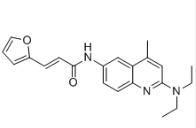
| DC73322 | DP308 Featured |
DP308 is a novel and effective 53BP1 tandem Tudor domain (TTD) inhibitor, disrupts the binding between 53BP1 and H4K20me2 peptide with IC50 of 1.69 uM.
More description
|
|
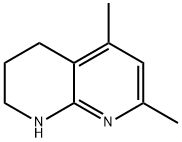
| DC73284 | F1957-0088 Featured |
F1957-0088 is a small molecule targeting the UHRF1 tandem Tudor domain (TTD) with TR-FRET (TTD vs. H3K9me3) EC50 of 45.1 uM.
More description
|
|
| DC72540 | MS8815 Featured |
MS8815 is a selective enhancer of zeste homolog 2 (EZH2) PROTAC degrader. MS8815 has inhibition activity for EZH2 with an IC50 value of 8.6 nM. MS8815 can be used for the research of triple-negative breast cancer (TNBC).
More description
|

|
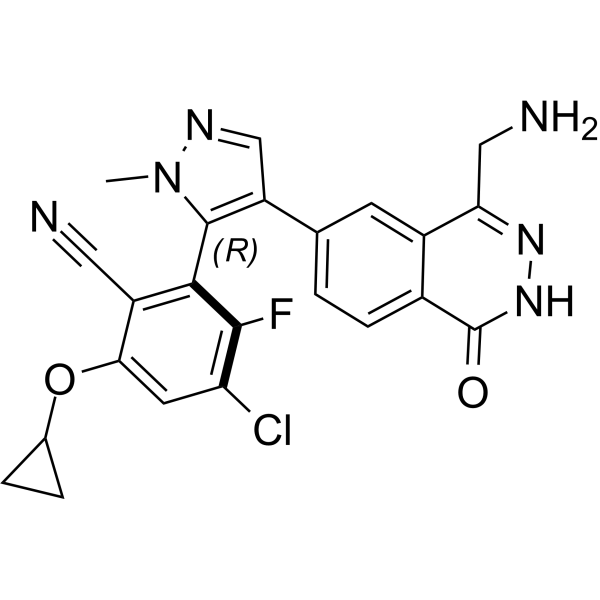
| DC47117 | Navlimetostat (BMS-986504,MRTX-1719) Featured |
MRTX-1719 is a potent first-in-class selective inhibitor of the PRMT5/MTA complex, with an IC50 of less than 10 nM in PRMT5/MTA MTAPDEL SDMA cells.
More description
|
|
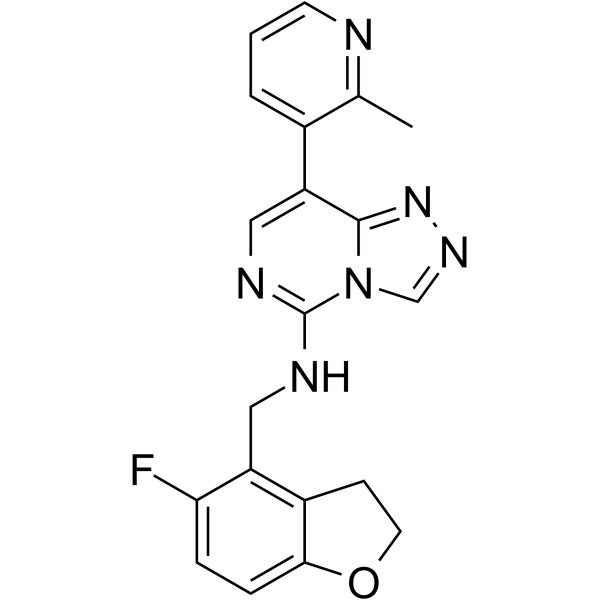
| DC10560 | MAK683 Featured |
MAK683 is a novel PRC2/EED inhibitor.
More description
|
|
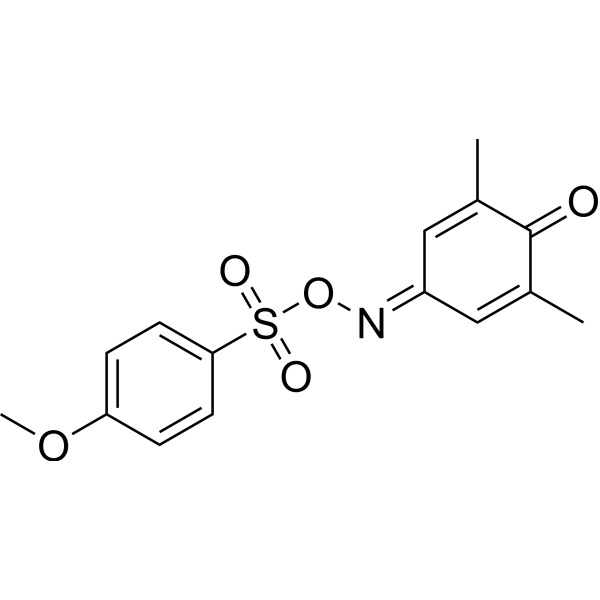
| DC8578 | L002(NSC764414) Featured |
L002 is a p300 inhibitor (IC50=1.98 μM) that inhibits p53 and histone acetylation. Suppresses STAT3 activation in vitro and suppresses tumor growth in some mouse cell lines.
More description
|
|
| DC81825 | JNJ-9350 |
JNJ-9350 is a chemical probe that inhibits spermine oxidase (SMOX) with an IC50 of 0.01 μM. This compound also shows inhibitory activity against polyamine oxidase (PAO), exhibiting an IC50 of 0.79 μM. JNJ-9350 has potential applications in cancer research.
More description
|

|
| DC81797 | ZY39 |
ZY39 is a SaClpP agonist. ZY39 promotes the enzymatic hydrolysis of SaClpP and HsClpP in vitro. ZY39 inhibits the growth of Staphylococcus aureus strains. ZY39 reduces the load of Staphylococcus aureus in organs and ascites in mouse peritonitis models and zebrafish infection models, and improves the survival rate of model animals. ZY39 can be used in studies related to Staphylococcus aureus infection, such as peritonitis.
More description
|
|
| DC81658 | TMLB-C16 |
TMLB-C16 is a potent and orally active B3GAT3 inhibitor with a KD of 3.962 μM. TMLB-C16 suppresses proliferation and migration, and induces cell cycle arrest and apoptosis in MHCC-97H (IC50 = 6.53 μM) and HCCLM3 cells (IC50 = 6.22 μM). TMLB-C16 inhibits tumor growth in both MHCC-97H and HCCLM3 xenograft tumor mouse models without causing obvious toxicity. TMLB-C16 can be used for hepatocellular carcinoma research.
More description
|
|
| DC81647 | TKP-5 |
TKP-5 is a PROTAC protein degrader targeting BRD4. TKP-5 can binds to BRD2, BRD3, BRD4 and BRDT, with Ka values of 150 nM, 100 nM and 150 nM for the first three proteins respectively. TKP-5 inhibits the production of thymic stromal lymphopoietin and suppresses the expression of IL-33 mRNA. TKP-5 is applicable to studies related to tape-stripping induced skin injury.
(Pink: Epigenetic Reader Domain ligand ; Blue: Cereblon ligand ; Black: linker).
More description
|
|
| DC81636 | Thalidomide-azetidine-COOH |
Thalidomide-azetidine-COOH is an E3 ligase ligand-linker conjugate containing a CRBN-based ligand and linker, which can be used to synthesize PROTAC.
More description
|
|
| DC81570 | STAT3-IN-53 |
STAT3-IN-53 (Compound L20) is a STAT3 inhibitor with a Kd value of 6.16 μM. STAT3-IN-53 binds directly to the SH2 domain of STAT3, inhibits phosphorylation at the Y705 site without affecting the total STAT3 protein level, and suppresses the IL-6/JAK/STAT3 pathway. STAT3-IN-53 downregulates the transcription and expression of cyclin-D1 and c-Myc. STAT3-IN-53 induces cell cycle arrest and promotes Apoptosis. STAT3-IN-53 exhibits anticancer activity against colorectal cancer.
More description
|
|
| DC81567 | ST1072 |
ST1072 is a dual inhibitor of CerS4 and CerS6. ST1072 significantly reduces the ability of murine T cells to proliferate and produce IFN-γ. ST1072 can be used for hematologic malignancies research.
More description
|
|
| DC81558 | Sodium Channel-IN-7 |
Sodium Channel-IN-7 (Example 59) is a NaV1.7 voltage-gated sodium channel inhibitor.Sodium Channel-IN-7 binds to the VSD4 binding pocket of NaV1.7, with reduced interaction with Try1537.Sodium Channel-IN-7 can be used for the research of pain.
More description
|
|
| DC81434 | RA190-PEG1-NH2 |
RA190-PEG1-NH2, RA190 derivative, is an E3 ligase ligand. RA190-PEG1-NH2 can be used to synthesis FKBP12 PROTAC degrader RAFKBP12.
More description
|
|
| DC81432 | R-130823 |
R-130823 is an orally active, highly selective p38α inhibitor with an IC50 of 22 nM against p38α, an IC50 of 820 nM against p38β, and no activity against p38γ or p38δ. R-130823 downregulates downstream cartilage degradation and inflammatory mediators, and inhibits the release of MMP-13, MMP-1 and PGE2. R-130823 reduces hind paw swelling, improves hyperalgesia, and blocks arthritis progression.\nR-130823 is applicable to research related to osteoarthritis and rheumatoid arthritis.
More description
|
|
| DC81431 | R06039-696 |
R06039-696 is a neuropeptide S receptor (NPSR) agonist with an EC50 of 91 nM. R06039-696 can participate in regulating various biological functions such as arousal, stress and anxiety responses, memory processes, and food intake by activating NPSR.
More description
|
|
| DC81377 | PROTAC HDAC3 degrader-1 |
PROTAC HDAC3 degrader-1 is a selective PROTAC degrader targeting HDAC3 with a DC50 of 30.73 nM. PROTAC HDAC3 degrader-1 induces degradation of HDAC3 via the ubiquitin-proteasome system. PROTAC HDAC3 degrader-1 promotes apoptosis, induces DNA damage, and downregulates anti-apoptotic proteins Mcl-1 and Bcl-xL. PROTAC HDAC3 degrader-1 can be used for the research of acute myeloid leukemia.
(Pink: HDAC3 ligand ; Blue: VHL ligand ; Black: linker).
More description
|
|
| DC81363 | PROTAC EZH2 Degrader-30 |
PROTAC EZH2 Degrader-30 (compound 67) is ais a PROTAC protein degrader targeting EZH2 with an IC50 of 6.22 μM against SU-DHL-6 cells. PROTAC EZH2 Degrader-30 can be used for the research of diffuse large B-cell lymphoma.
(Pink: EZH2 ligand ; Blue: MDM2 ligand ; Black: linker).
More description
|
|
| DC81317 | Premafloxacin |
Premafloxacin is a potent antimicrobial agent that exhibits activity against Staphylococcus aureus, Corynebacterium bovis, and Corynebacterium amylocolatum. Premafloxacin demonstrated potent antimicrobial activity against S. aureus by targeting topoisomerase IV, and is a poor substrate for NorA efflux pump. Premafloxacin can be used for antimicrobial research.
More description
|
|
| DC81271 | PF-07245303 |
PF-07245303 is a ITK/TRK inhibitor. PF-07245303 reduces the production of inflammatory cytokines such as IL-4 and IFNγ, and inhibits the phosphorylation of PLCγ1. PF-07245303 inhibits nerve growth factor-induced basophil activation and the phosphorylation of TRKA. PF-07245303 reduces oxazolone-induced ear swelling in mouse ear tissues. PF-07245303 is applicable to research related to atopic dermatitis.
More description
|
|
| DC81234 | PARP1/c-Met-IN-3 |
PARP1/c-Met-IN-3 (Compound L19) is a selective c-Met and PARP1 inhibitor, with an IC50 of 5.4 nM against c-Met and an IC50 of 3.7 nM against PARP1. PARP1/c-Met-IN-3 inhibits PARP2 enzymatic activity with an IC50 of 4.52 nM, and shows no specificity for PARP1 and PARP2. PARP1/c-Met-IN-3 induces cell cycle arrest and apoptosis. PARP1/c-Met-IN-3 exhibits anti-tumor activity against triple-negative breast cancer.
More description
|
|
| DC81226 | P53 mutant stabilizer-1 |
P53 mutant stabilizer-1 (compound 274) is a covalent mutant p53 stabilizer. P53 mutant stabilizer-1 can be used for the study of wild-type function of p53 mutants, such as cancers associated with p53 mutation.
More description
|
|
| DC81124 | NB-7 |
NB-7 (example 12) is a potent and orally active SARM1 inhibitor with an IC50 < 1 μM. NB-7 can be used for neurological disorders research.
More description
|
|
| DC81067 | MNK/PIM-IN-2 |
MNK/PIM-IN-2 is a Mnk/Pim kinase inhibitor with an IC50 of 32 nM for Mnk1, 3 nM for Mnk2, and 37 nM for Pim1. MNK/PIM-IN-2 reduces the levels of p-eIF4E and p-4EBP1. MNK/PIM-IN-2 induces cell cycle arrest, apoptosis (apoptosis) and exerts antiproliferative effects in leukemia cells. MNK/PIM-IN-2 can be used in studies related to leukemia.
More description
|
|
